What Causes Fordyce Spots on Lips? Visible Oil Glands, Not Infection
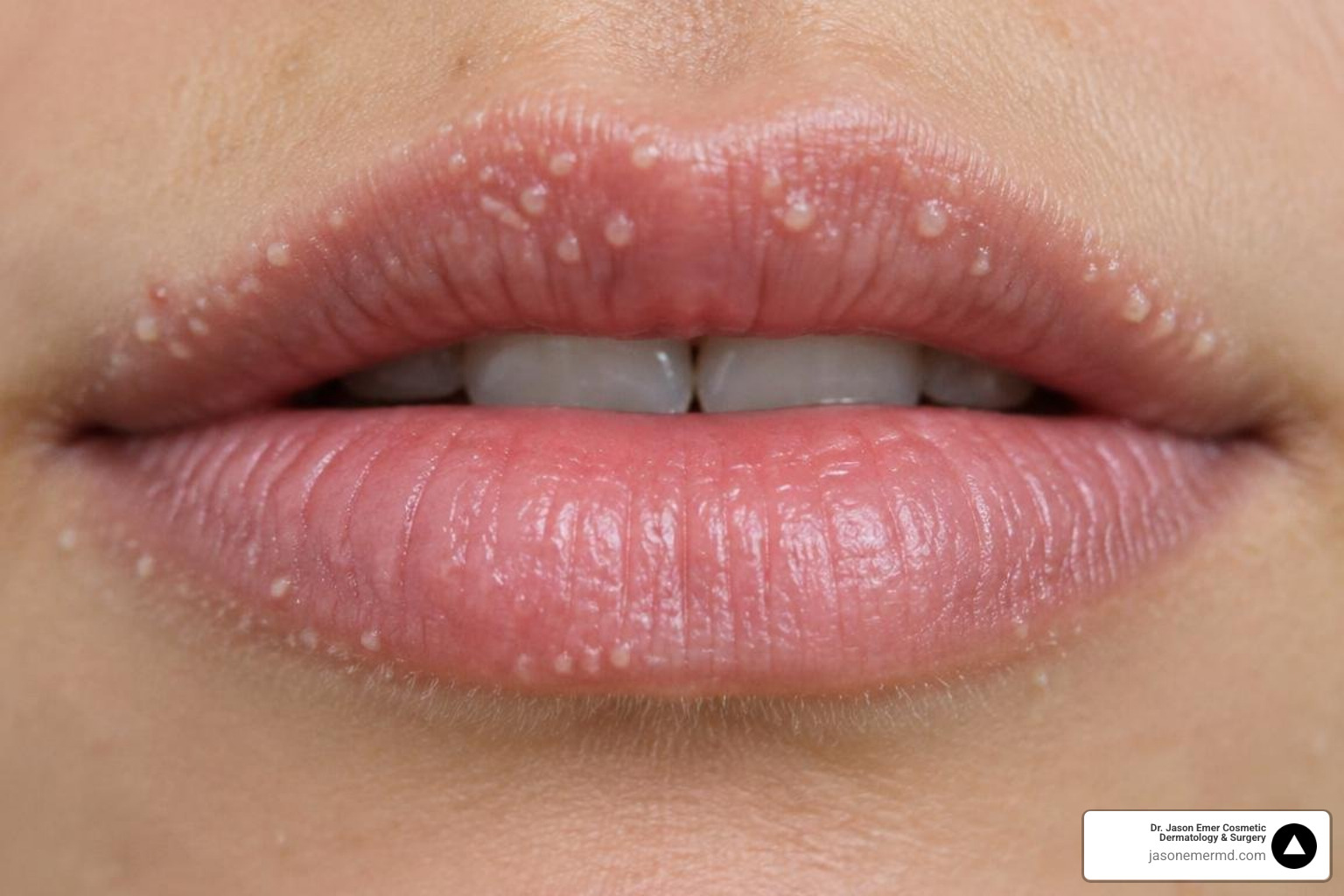
Most people assume a new bump on the lip signals infection. In Dr. Emer's practice, the evaluation starts the opposite way: by recognizing normal anatomy first. Fordyce spots can resemble infectious lesions, but they are visible oil glands, not transmissible pathogens. They occur naturally along mucosal margins and become more noticeable during puberty, when hormonal shifts stimulate sebaceous activity. These small, pale papules are benign and carry no risk of malignancy.
When patients ask what causes fordyce spots on lips, Dr. Emer explains that these structures are ectopic sebaceous units. Understanding what causes fordyce spots helps patients tell harmless anatomical variation apart from contagious conditions, much as similar glands can appear as penile fordyce spots elsewhere on the body.
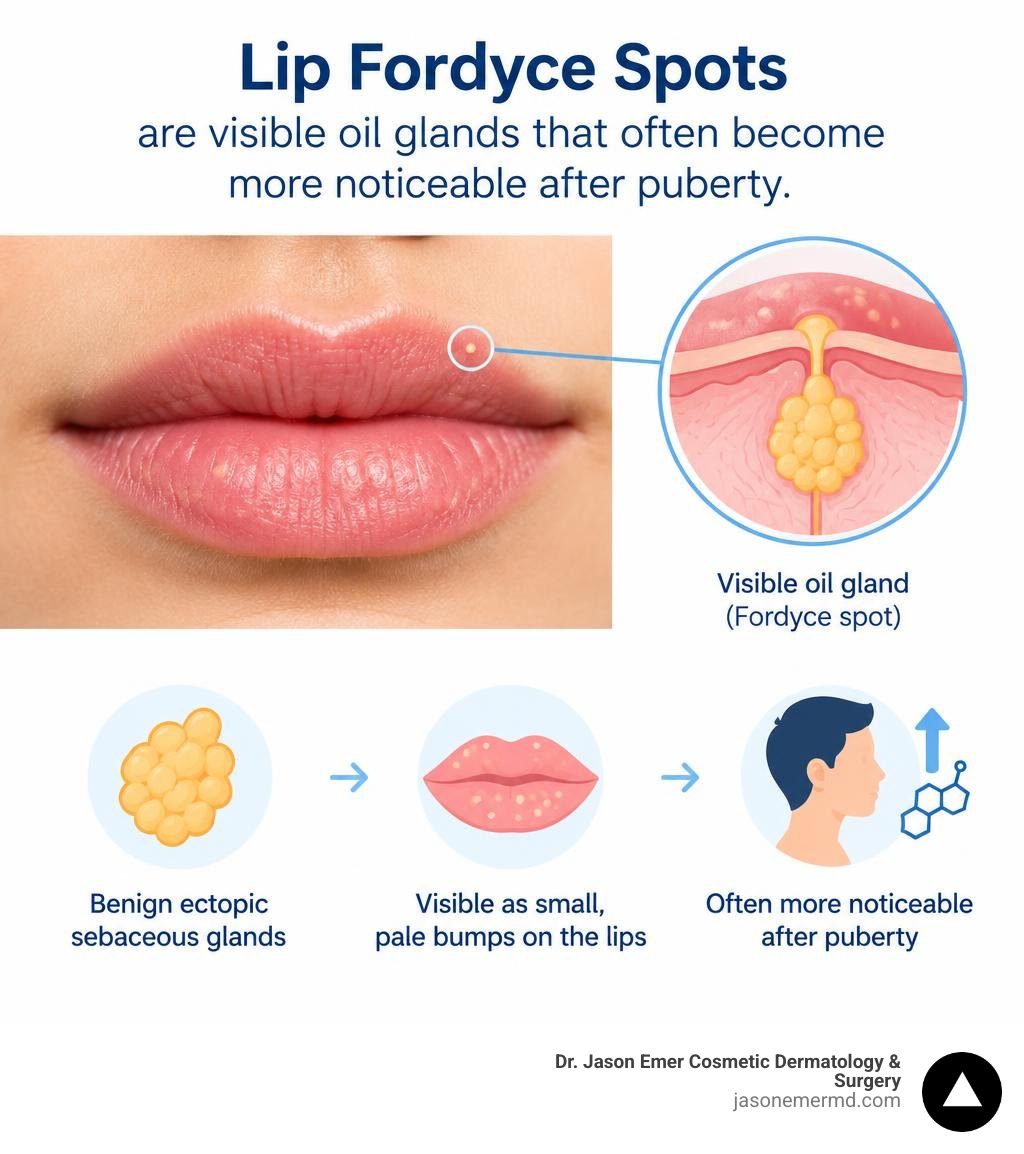
What causes Fordyce spots on lips is the visibility of benign ectopic sebaceous glands.
Fordyce spots are ectopic sebaceous glands. Normally, sebaceous glands attach to hair follicles to secrete sebum. The vermilion border and oral mucosa have no hair follicles, so oil-producing structures found there are classified as ectopic. First described by dermatologist John Addison Fordyce in 1896, these pale yellow or white papules measure roughly 1 to 3 millimeters across. Histologic review shows Fordyce spots are present in 70 to 80 percent of adults. They are not a disease; they are a standard anatomical variant.

Hormones largely drive when these structures become visible. The glands exist at birth, but androgen production surges during puberty, enlarging glandular tissue that was previously invisible. Maternal hormone transfer also explains why Fordyce granules appear in roughly 1 percent of neonates. Biological males show noticeable spots about twice as often as females, reflecting higher baseline androgen activity.
Congenital architecture and skin type also shape how prominent the glands become. People with oilier skin often have larger sebaceous units. The vermilion border is thin, translucent epithelium, so as oil glands mature, their pale contents show through as isolated dots or small clusters. This visibility is a normal anatomical feature, not a progressive skin condition.
Clinical evaluation distinguishes harmless oral granules from viral infections and cysts.
A visual assessment by an experienced specialist usually identifies Fordyce spots and prevents unnecessary worry. Because these papules often cluster along the lip margin, people sometimes mistake them for infectious conditions. A skin examination differentiates benign glands from viral pathology or keratin cysts.
| Feature | Fordyce Spots | Herpes Simplex Virus (Cold Sores) | Milia |
|---|---|---|---|
| Primary Cause | Ectopic sebaceous glands | Viral infection (HSV-1) | Trapped keratin proteins |
| Physical Sensation | Asymptomatic, without pain | Tingling, burning, painful | Asymptomatic, without pain |
| Lesion Evolution | Stable, persistent papules | Fluid-filled vesicles that crust | Firm, dome-shaped cysts |
| Transmissibility | Non-contagious | Highly contagious | Non-contagious |
Unlike herpes simplex, Fordyce spots do not blister, ulcerate, crust, or cause pain. They also differ from HPV lesions, which have irregular, verrucous borders rather than smooth, uniform domes. Milia appear as firm, isolated keratin plugs rather than soft, lipid-filled sebaceous collections.
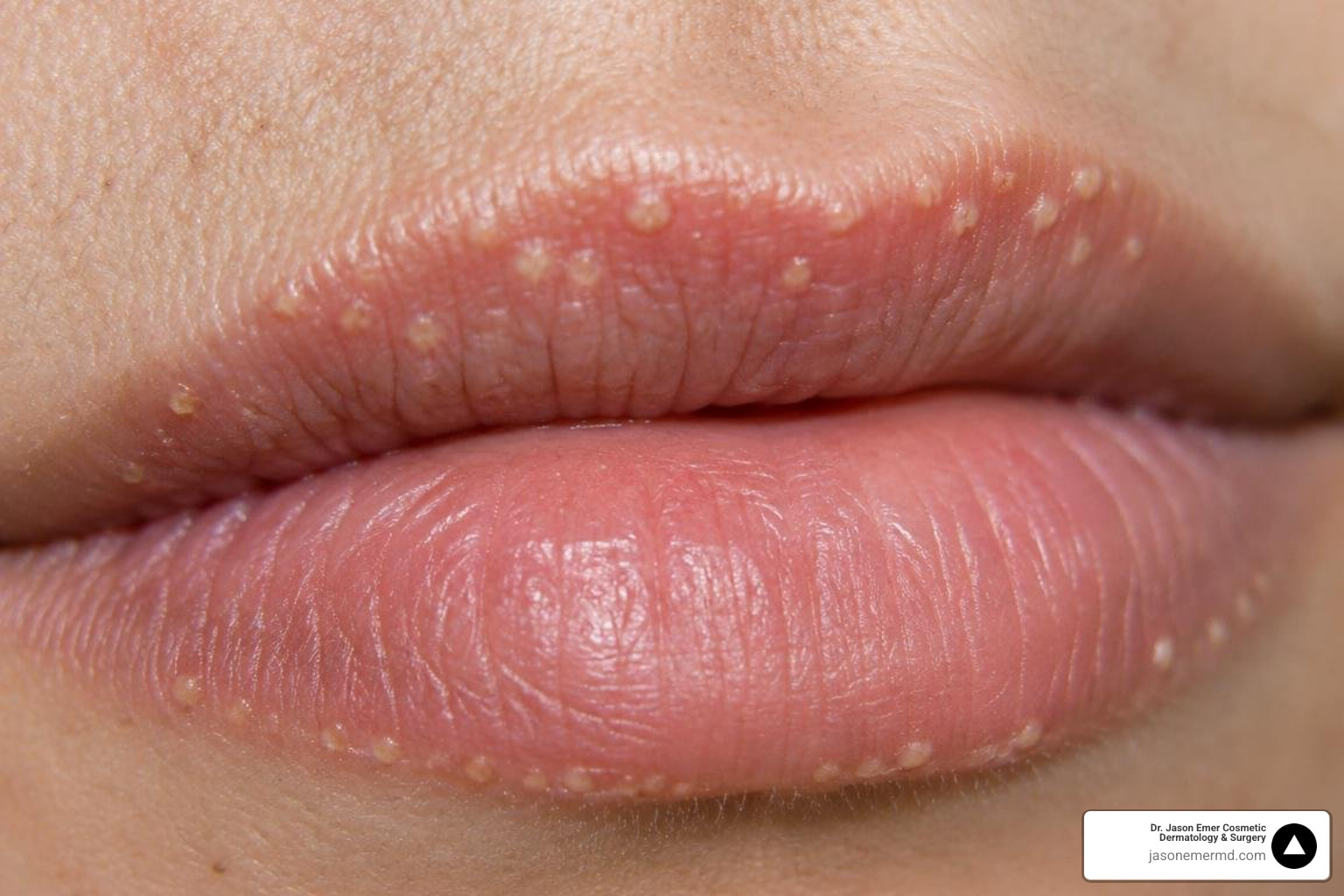
In rare cases, extensive sebaceous changes correlate with broader systemic findings, including Muir-Torre syndrome, a Lynch syndrome variant, and certain lipid profile elevations. For most patients, however, these spots remain a localized, benign mucosal finding with no systemic significance.
A clinical assessment can guide decisions about cosmetic reduction.
Because Fordyce spots are harmless, doing nothing remains a reasonable option and requires no medical intervention. Patients bothered by their cosmetic appearance sometimes explore dermatological care instead. Squeezing, scratching, or popping these papules at home should be avoided: the glands sit beneath intact mucosal tissue, and mechanical trauma can introduce bacteria, causing scarring or infection without clearing the underlying gland.
Gentle skincare helps avoid irritation. A mild, fragrance-free cleanser and regular sun protection reduce friction and UV stress along the lip margin. Avoiding harsh exfoliants and picking supports the natural mucosal barrier.
For patients seeking aesthetic refinement, specialized Fordyce spots treatment requires a tailored approach. Dr. Emer evaluates tissue architecture to determine appropriate options:
Topical retinoids, such as prescription tretinoin, gently encourage cellular turnover and may reduce glandular prominence over months, though mucosal irritation can limit use. Ablative CO2 laser resurfacing vaporizes superficial sebaceous tissue to flatten papules, but it carries downtime, including crusting and swelling for several days. Micro-punch excision physically removes individual glandular units, lowering the chance of recurrence in treated areas. Electrodessication uses high-frequency current to desiccate individual sebaceous cores along the vermilion line.
Every approach involves tradeoffs. Energy-based devices carry a risk of post-inflammatory hyperpigmentation, particularly in darker skin tones (Fitzpatrick types IV through VI). In these cases, Dr. Emer sequences treatment carefully, often pre-treating with pigment inhibitors and using conservative energy settings to protect the mucosal boundary. Decisions about staging, modality, and healing are made during a clinical consultation.
What to remember
- Fordyce spots are benign, non-contagious ectopic sebaceous glands present in up to 80 percent of adults.
- Hormonal fluctuations during puberty cause these oil glands to enlarge and become cosmetically noticeable along the lips.
- Medical intervention is unnecessary, but patients seeking aesthetic improvement can discuss procedural options during an in-office evaluation.
To explore personalized cosmetic options, a specialized Fordyce spot consultation with Dr. Emer can help determine the right path forward.
This content is for general education and does not provide a diagnosis, determine candidacy, or replace a consultation with a licensed clinician.
This resource provides general educational information. Treatment recommendations depend on your health, goals, and consultation with a qualified clinician.