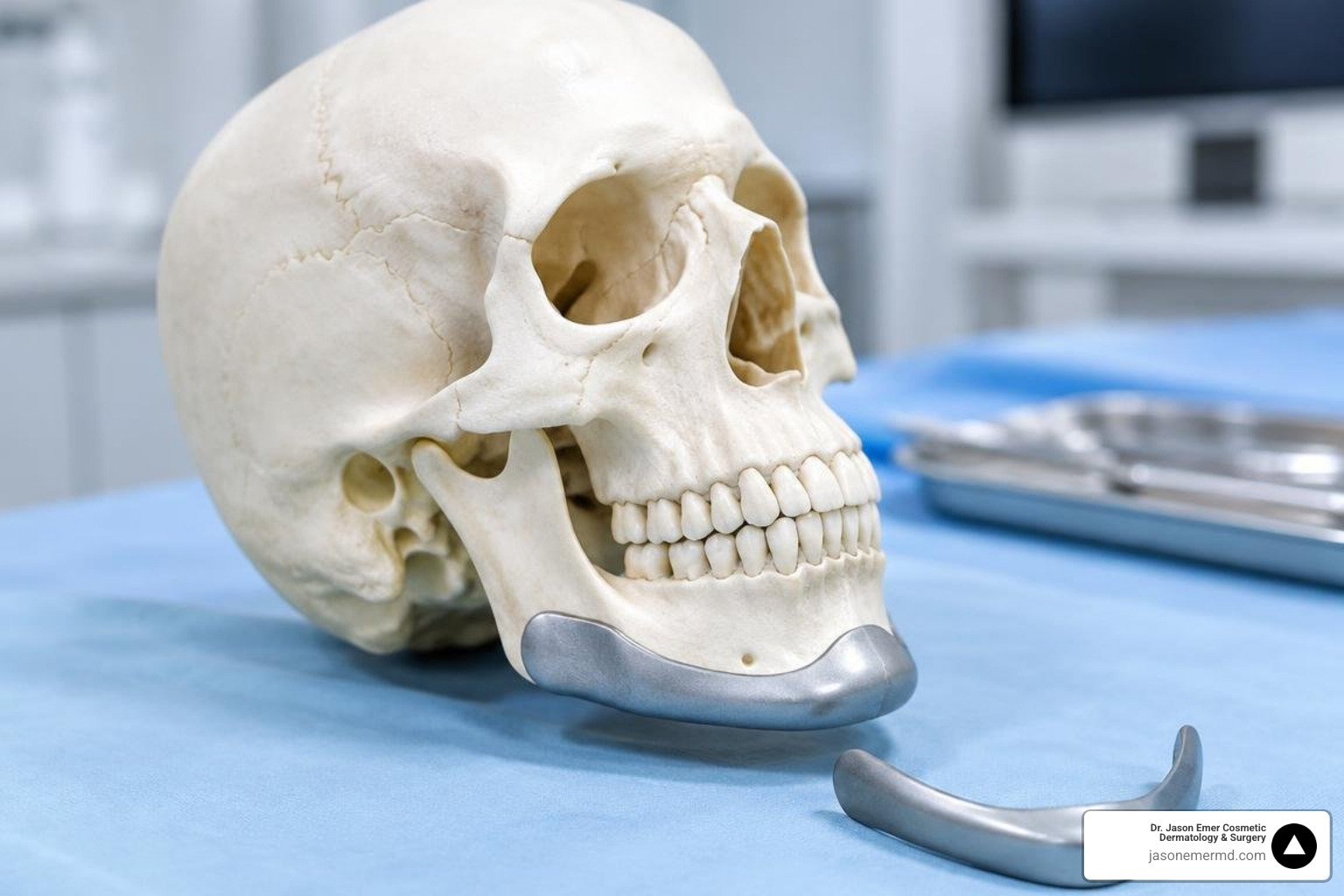
A jaw line implant starts with facial balance, not just a stronger angle
Most consultations begin with a patient pointing to a photo and asking for a sharper angle. Dr. Emer's process begins somewhere else entirely: a full map of the facial framework, including chin projection, jaw width, gonial angles, bite alignment, and neck contour. Only after that map is complete does implant selection enter the conversation.
A jaw line implant is surgically placed along the mandible to establish structural definition. Unlike a chin implant that targets anterior projection or joint replacement that addresses functional pathology, mandibular implants shape the lower third of the face as a whole.
The objective is balanced facial harmony rather than exaggeration. Functional considerations, including occlusion and temporomandibular joint dynamics, help determine the optimal surgical path. Dr. Jason Emer utilizes his facial contouring expertise to assess when surgical structural support is warranted and when less invasive interventions provide a better fit. This distinction matters because not every patient who wants a stronger jawline needs an implant; some are better served by soft tissue work, injectables, or simply monitoring the area over time.
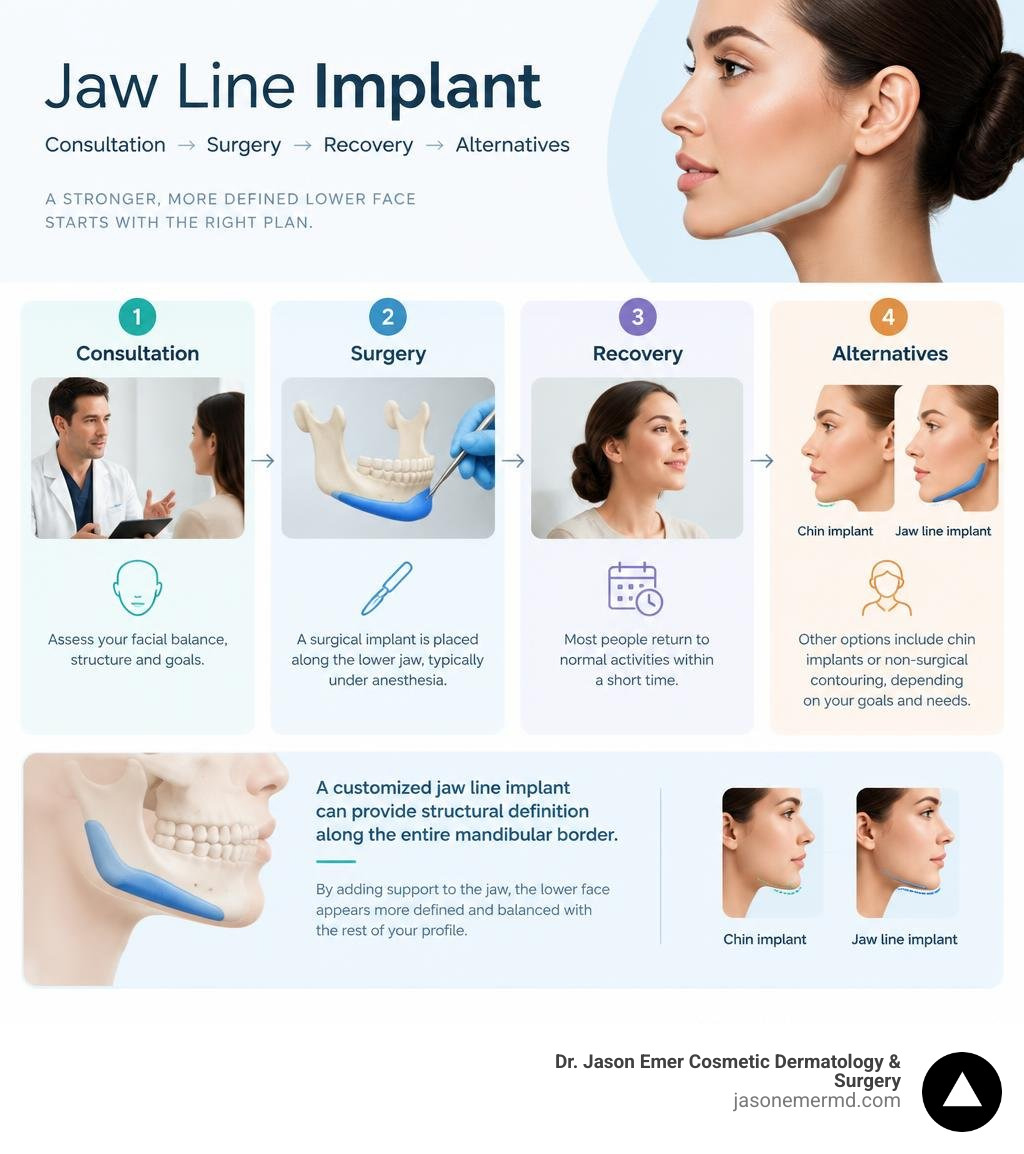
A customized jaw line implant can provide structural definition along the entire mandibular border
Most patients picture a single wedge of silicone sliding under the chin. Dr. Emer's process starts further back, mapping the entire mandibular border against the facial framework. Lower facial definition relies on underlying bony architecture. When mandibular structure lacks lateral width or height, soft tissues lack support and the jawline appears blurred. Mandibular augmentation establishes separation between the jawline and neck by restoring skeletal foundation.
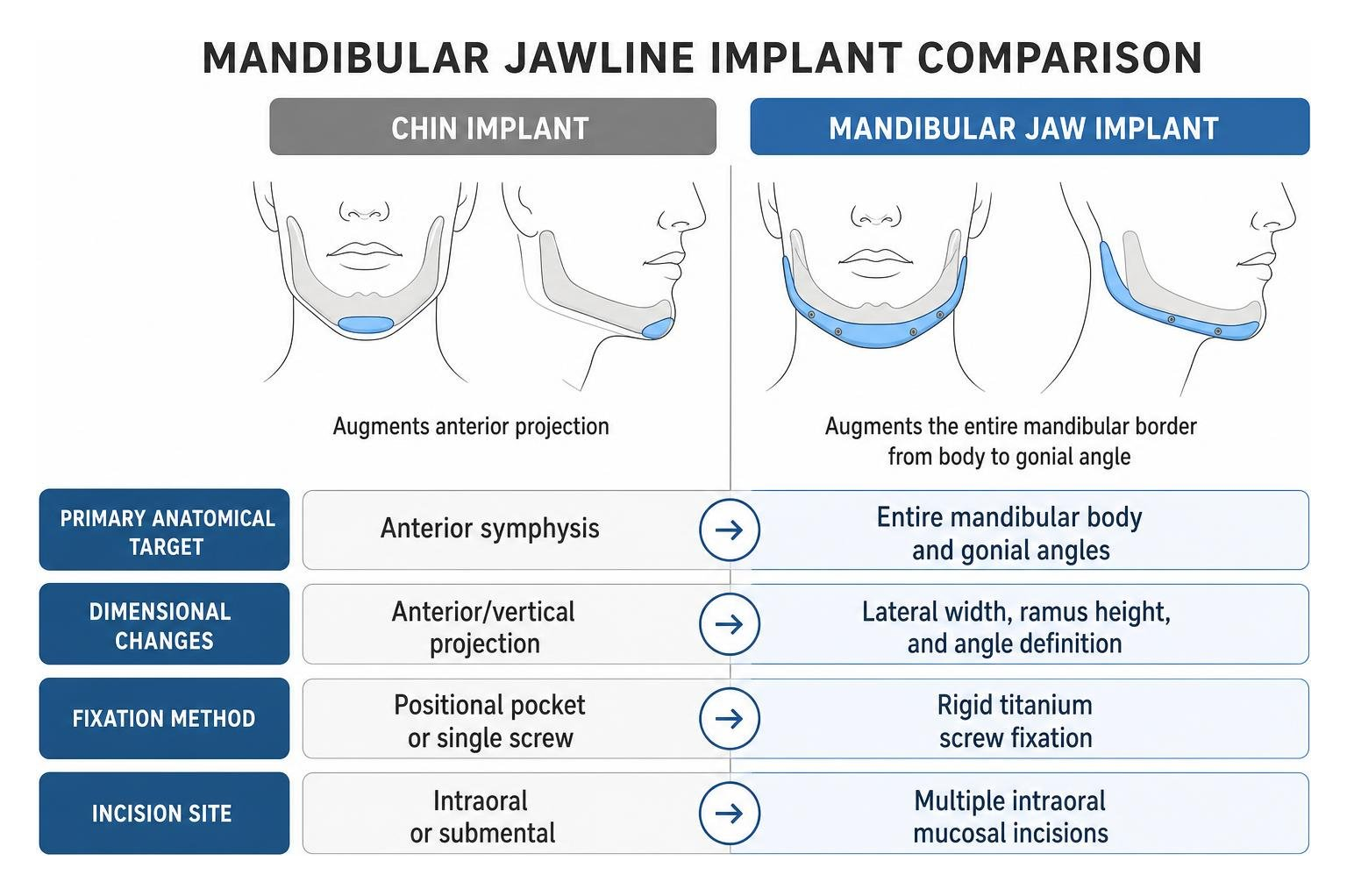
Standard chin implants primarily adjust anterior projection. In contrast, comprehensive jawline implants span the mandibular body to the gonial angle, addressing lateral width and angularity. This distinction is often the source of patient confusion: a chin implant can make the front of the face more prominent, but it cannot widen a narrow lower face or sharpen the corners of the jaw.
| Feature | Chin Implants | Mandibular Jaw Implants |
|---|---|---|
| Primary Anatomical Target | Anterior symphysis | Mandibular body and gonial angles |
| Dimensional Changes | Anterior projection | Lateral width and angle definition |
| Fixation Method | Positional pocket or single screw | Rigid titanium screw fixation |
| Incision Site | Intraoral or submental | Intraoral mucosal incisions |
Understanding custom jaw line implant design and materials
Advanced mandibular augmentation uses 3D CT imaging to match patient anatomy and address asymmetries before surgery. This imaging step allows the surgical plan to be built around the patient's existing bone structure rather than a generic template, which reduces the chance of an implant that looks unnatural or shifts unevenly over time.
Solid medical-grade silicone provides structural stability and is easily removed or exchanged if goals evolve. Porous polyethylene permits tissue ingrowth for an integrated result. Neither material is universally superior; selection depends on required correction and patient preference for reversibility. A patient who values the option to reverse the procedure later may lean toward silicone, while one seeking maximal long-term integration may consider porous polyethylene. Principles outlined by the American Society of Plastic Surgeons inform broader lower facial planning.
How jaw line implant surgery compares to chin augmentation
Anterior chin surgery alters sagittal projection but cannot widen a narrow posterior jawline or sharpen mandibular angles. Complete mandibular implants broaden the lateral lower face and define gonial angles. Many patients benefit from a combined approach, aligning anterior projection with posterior width for a unified lower third. The decision to combine procedures, or to stage them separately, is made during consultation once imaging and facial analysis are complete.
Mandibular augmentation surgery requires careful planning and a dedicated recovery timeline
Placement is performed as an outpatient procedure under general anesthesia, typically taking around two hours. Because implants sit directly against bone near sensitive nerve pathways, surgical precision remains paramount, and the surgical plan is built around the imaging and facial mapping completed beforehand.
Operative details and incision techniques
Surgeons place incisions inside the oral cavity to avoid visible external scars. Subperiosteal dissection creates precise pockets along the mandibular bone, limiting bleeding and preserving soft tissue attachments. Small titanium screws provide rigid fixation to prevent migration while protecting the mental and marginal mandibular nerves. Dissolvable sutures close the mucosal incisions, so there is no need for suture removal during follow-up visits.
Healing phases and activity restrictions
Post-operative swelling peaks during the first 48 to 72 hours. Head elevation and cold compresses help manage edema. Patients maintain a soft-food diet and strict oral hygiene during the initial week, since the incisions sit inside the mouth and are exposed to saliva and bacteria. Most individuals resume desk work within seven to ten days, while strenuous exercise is restricted for several weeks to avoid disrupting the healing bone-implant interface. Residual swelling resolves over several months before final contours emerge, and patients are counseled not to judge the result too early in that process.
As with any surgical implant, there are real tradeoffs to weigh. Infection, hematoma, temporary or lasting nerve neuropraxia, and implant displacement are recognized risks, even when technique is precise. These risks, along with the extended timeline before final results are visible, are part of why candidacy and staging are discussed individually rather than assumed from a single photo or online description.
Comprehensive lower facial balance can integrate complementary surgical and non-surgical treatments
Isolated bone augmentation may not address soft tissue redundancy. Evaluating the lower third helps determine whether structural facial implants should accompany soft tissue modification, or whether a non-surgical approach might address the concern on its own.
Combining skeletal augmentation with soft tissue contouring
Submental liposuction removes pre-platysmal fat to sharpen the cervicomental angle. Dr. Emer frequently coordinates surgical measures, such as chin & jawline surgery, with non-surgical modalities. When incorporating energy-based skin tightening, skin phototype is evaluated; deeper complexions (Fitzpatrick IV–VI) carry higher risk for post-inflammatory hyperpigmentation (PIH), requiring calibrated settings and, in some cases, a different treatment sequence than lighter skin types would follow. Neurotoxin injections for jawline slimming and contouring can address masseter hypertrophy without any incision at all.
Structural implants compared to injectable volumizers
Dermal fillers provide temporary volume without surgery through targeted facial sculpting. However, injectables require maintenance and cannot replicate substantial skeletal widening. Implants provide enduring structural change but entail surgical risks like infection, hematoma, nerve neuropraxia, or displacement. Choosing non-invasive treatments, or doing less altogether, remains a reasonable alternative for patients seeking modest changes rather than a structural rebuild of the lower face. There is no single correct answer here; the right path depends on anatomy, goals, and tolerance for downtime and surgical risk.
Frequently Asked Questions about lower facial augmentation
How long can a mandibular implant last?
Solid medical-grade silicone implants maintain structural integrity indefinitely without degrading, remaining in place unless complications or aesthetic changes arise.
Can jaw implants be removed or revised if necessary?
Yes. Solid silicone does not integrate into tissue, allowing surgical removal or exchange through intraoral incisions if revision is needed. This reversibility is one reason some patients choose silicone over porous alternatives when they are uncertain about long-term plans.
What to remember
- Mandibular implants provide lateral width and gonial angle definition beyond the scope of anterior chin implants.
- Surgical placement is performed through intraoral incisions with titanium screw fixation and requires a dedicated initial recovery window, along with real risks such as infection, nerve neuropraxia, or displacement.
- Non-surgical injectables, soft tissue contouring, or doing less offer viable alternatives depending on individual anatomical goals.
This content is for general education and does not provide a diagnosis, determine candidacy, or replace a consultation with a licensed clinician.
A formal clinical consultation serves as the setting to evaluate facial proportions, review 3D imaging, and explore surgical chin & jawline contouring options.
This resource provides general educational information. Treatment recommendations depend on your health, goals, and consultation with a qualified clinician.