
Surgical technique and anatomical focus distinguish partial abdominoplasty from traditional full procedures
Many patients assume that any abdominal contouring procedure requires a hip-to-hip incision and a repositioned navel. In Dr. Emer's practice, the clinical model starts with a map of the abdominal wall, distinguishing isolated lower laxity from full-thickness diastasis before any incision is planned. A mini tummy tuck targets isolated tissue laxity situated between the umbilicus and the pubic region. During this targeted approach to surgical body contouring, a surgeon makes a single incision placed low on the pelvis. This incision often sits lower than a traditional abdominoplasty scar and can incorporate or replace a previous C-section scar.
Through this single incision, redundant skin and excess subcutaneous fat are excised from the lower abdominal wall. If mild muscle separation exists below the navel, targeted fascial tightening can be performed. However, the navel remains anchored in its native position without requiring surrounding incisions. The trade-off is that a limited resection only changes the lower abdominal contour. Upper abdominal fullness or separation above the navel stays visible until a more extensive reconstruction is undertaken.
Distinguishing partial abdominoplasty from a panniculectomy
A partial abdominoplasty is fundamentally distinct from a panniculectomy. A panniculectomy focuses on removing a hanging apron of skin and fat, known as a pannus, often following significant weight fluctuations. This procedure serves a primarily functional purpose to alleviate skin irritation, chafing, or hygiene difficulties.
In contrast, a partial abdominoplasty refines the lower abdominal contour cosmetically by excising moderate skin and tightening underlying tissue. Patients presenting with massive overhang after massive weight loss may require comprehensive body contouring after weight loss, rather than a limited sub-umbilical resection. The distinction matters because a mini tummy tuck is not designed to treat a heavy pannus or severe skin redundancy. Attempting to fit that level of laxity into a smaller operation can leave the abdominal wall unbalanced and the patient dissatisfied with the final shape.
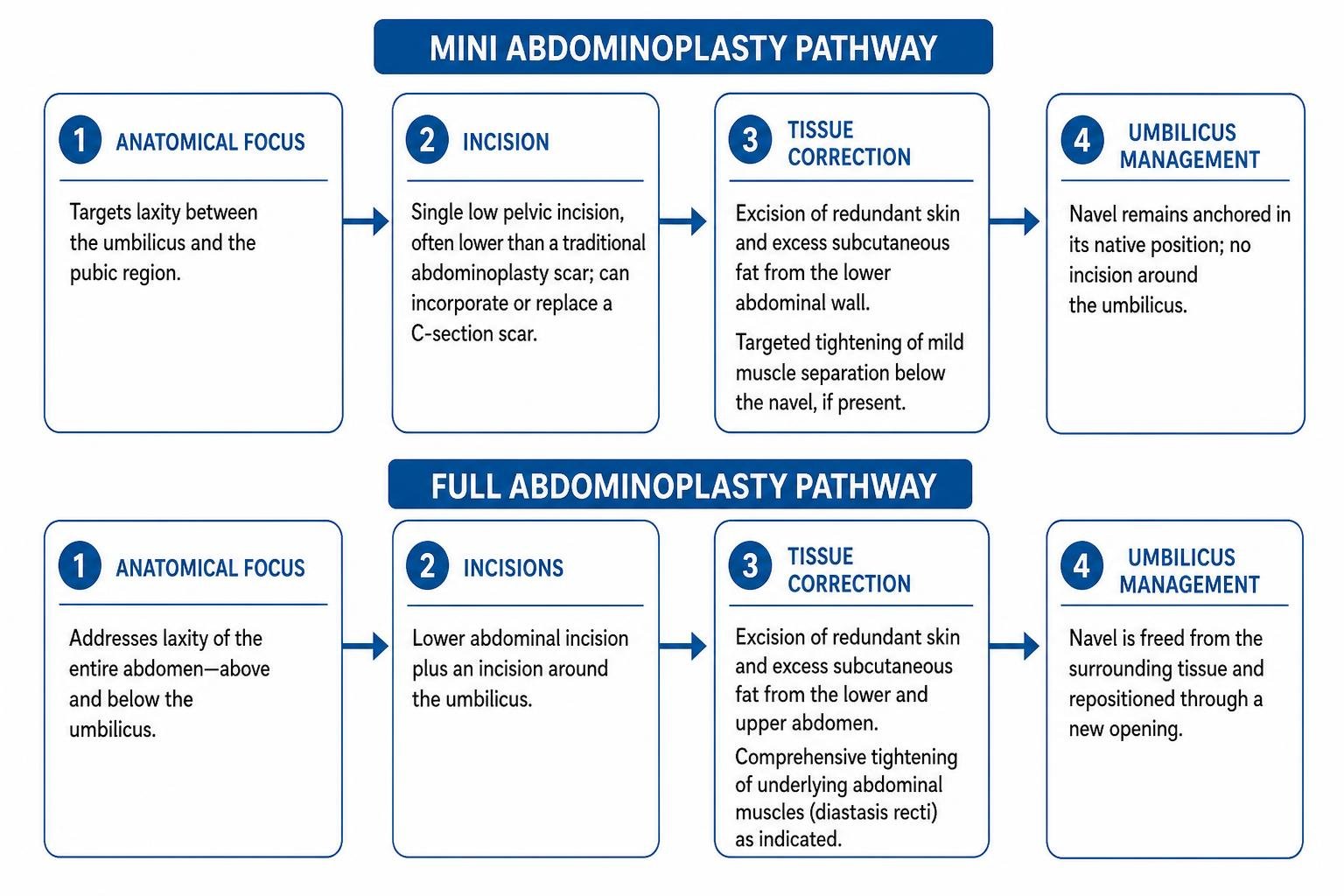
Choosing between a partial procedure and a full tummy tuck depends directly on the anatomical distribution of loose skin and the extent of diastasis recti. The abdominoplasty family of procedures ranges from limited lower-wall excision to full-wall reconstruction.
| Surgical Feature | Mini Tummy Tuck | Full Tummy Tuck |
|---|---|---|
| Primary Treatment Area | Lower abdomen (below navel) | Entire abdominal wall (upper and lower) |
| Incision Extent | Short suprapubic incision | Hip-to-hip suprapubic incision |
| Navel Repositioning | Not required | Periumbilical incision and relocation |
| Muscle Repair Scope | Limited to lower rectus fascia | Full vertical plication (xiphoid to pubis) |
| Typical Recovery Window | Approximately 1 to 2 weeks | Approximately 2 to 4 weeks |
Comparing surgical outcomes of a tummy tuck mini and full abdominoplasty
A full abdominoplasty addresses the entire abdominal wall from the rib cage down to the pubic bone. When significant diastasis recti extends above the belly button, a traditional approach allows the surgeon to perform full-length muscle plication to restore core support. This extensive mobilization requires freeing and repositioning the belly button through an umbilicoplasty.
A partial abdominoplasty leaves the upper abdominal tissue untouched. If laxity or significant muscle separation exists above the navel, a mini approach will leave those upper contours unresolved. Careful anatomical assessment determines whether comprehensive body contouring or a limited excision yields the appropriate structural outcome.
Combining abdominal procedures with liposuction and mommy makeover plans
Partial abdominoplasty can be combined with other surgical modalities to enhance waistline definition. Suction-assisted lipectomy or energy-based liposuction along the flanks and hips often complements lower abdominal skin removal by reducing stubborn localized fat pockets.
These combined strategies frequently form part of customized plastic surgery procedures body plans. When addressed alongside breast enhancement or non-surgical skin treatments, patients receive balanced rejuvenation across multiple areas in a single staged surgical session.
Recovery timelines, candidacy, and cost expectations shape the decision
Candidate selection depends on skin elasticity, baseline weight, and future pregnancy plans, all discussed directly in consultation rather than decided in advance. Recovery after a partial abdominoplasty is generally shorter than after a traditional abdominoplasty. Most patients resume light daily tasks within one to two weeks, while full structural recovery and swelling resolution unfold over six to twelve weeks. Compression garments must be worn consistently during early healing to control fluid retention and support tissue adaptation.
Surgical risks are real and should be weighed against expected benefits. These include seroma, hematoma, infection, delayed wound healing, and prominent scarring. Non-surgical skin-tightening or liposuction alone are lower-intervention alternatives, though neither replicates the tissue excision achieved with surgery. When post-operative scar protocols involve energy-based devices or fractional lasers, skin phototype must be evaluated first. Darker skin tones carry increased risk of post-inflammatory hyperpigmentation, calling for conservative energy settings, appropriate wavelength selection, and adjusted treatment sequencing.
Elective body contouring is categorized as cosmetic by insurance providers. Because a partial abdominoplasty addresses aesthetic proportions rather than functional impairment, insurance typically excludes coverage for surgery, anesthesia, and facility fees, unlike a medically indicated panniculectomy performed to relieve chronic skin irritation. Patients should plan for out-of-pocket costs and review financing options during an in-person evaluation.
Results from tissue excision are durable, but substantial weight fluctuations, aging, and subsequent pregnancies can stretch remaining skin and fascia over time. Maintaining stable weight and an active lifestyle helps preserve the abdominal profile. The resulting scar sits low along the bikini line, typically hidden within swimwear, with quality depending on closure technique, individual genetics, and diligent scar care such as sun protection and silicone sheeting.
A consultation with Dr. Jason Emer Cosmetic Dermatology & Surgery remains the venue where anatomy, goals, and recovery plans are discussed in detail before any decision is made.
What to remember
- A partial abdominoplasty refines localized skin laxity and mild muscle separation strictly below the navel through a single low incision.
- Full abdominoplasty is necessary when upper abdominal skin excess, significant diastasis recti, or navel repositioning must be corrected.
- Surgical candidacy, anatomical needs, and combination treatments are established through an individualized clinical evaluation.
This content is for general education and does not provide a diagnosis, determine candidacy, or replace a consultation with a licensed clinician.
This resource provides general educational information. Treatment recommendations depend on your health, goals, and consultation with a qualified clinician.