
Filler treatment requires individualized safety planning and anatomical mapping
Most people assume penile enlargement with fillers is simply about adding volume. In Dr. Emer's practice, it starts with mapping the tissue planes. Safe soft-tissue augmentation requires an exact understanding of local anatomical boundaries before any product is placed.
The target zone sits in the loose areolar plane between the superficial Dartos fascia and the deep Buck's fascia. Placing product outside this layer invites complications. Injecting too superficially creates visible lumps under delicate skin. Injecting too deeply risks puncturing Buck's fascia, which encloses the erectile chambers and the dorsal neurovascular bundle.
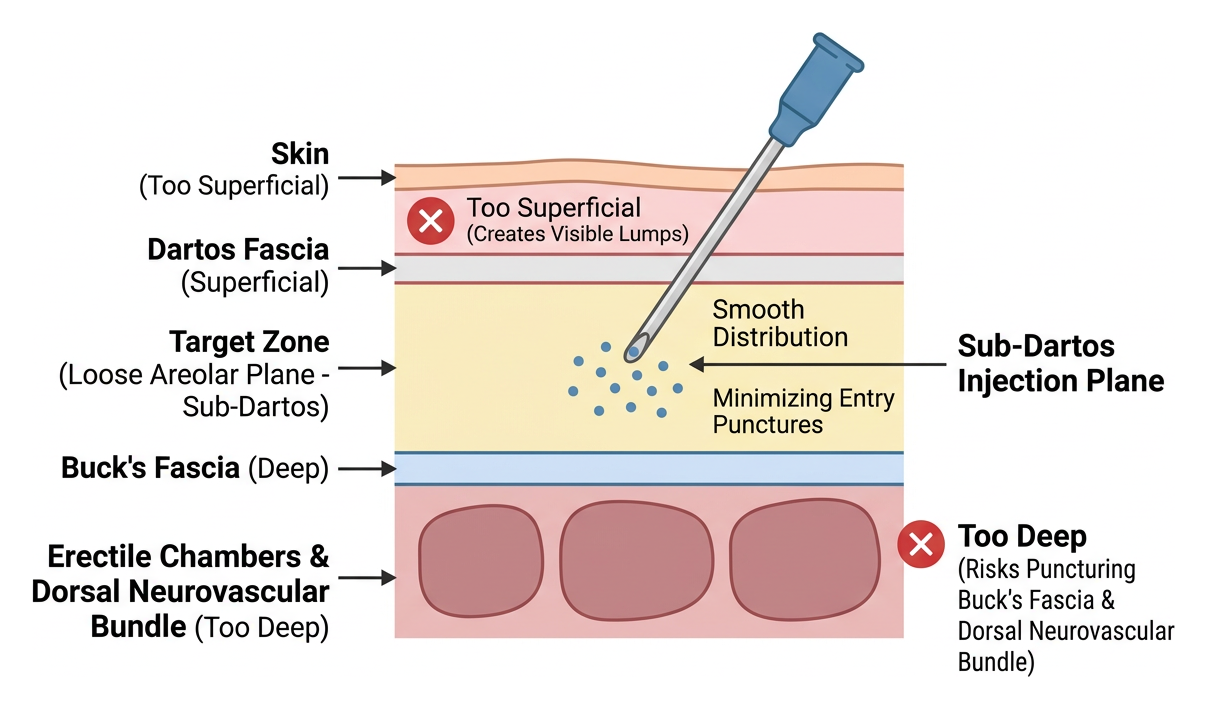
Dr. Emer uses a blunt-tip cannula rather than a sharp needle. Cannulas glide through loose connective tissue rather than cutting vessels. Depositing small micro-droplets in the sub-Dartos space creates smooth distribution while minimizing entry punctures. This approach reduces the chance of piercing the vascular structures that run beneath Buck's fascia.
Product selection determines how the tissue feels and moves. Hyaluronic acid (HA) is a naturally occurring glycosaminoglycan that binds water to create soft-tissue volume. Dr. Emer selects cross-linked HA formulas with high cohesivity. Cohesive gels resist mechanical shear stress during erection while preventing filler migration toward the base or head of the shaft. Over 6 to 18 months, the body naturally metabolizes the cross-linked gel through enzymatic degradation. This temporary nature provides an essential safety buffer, and if asymmetry or swelling occurs, the enzyme hyaluronidase can be injected to dissolve the product.
Uniformity is essential. Dr. Emer relies on structured retrograde fanning to place micro-aliquots of filler circumferentially around the shaft. Volume calibration is staged conservatively over multiple sessions. Rushing large volumes into a single visit strains tissue vascularity and increases the risk of product pooling. Careful post-injection molding ensures an even, natural cylinder without irregular ridges.
Adverse events and vascular risks demand careful monitoring and reversible products
Dermal fillers are not FDA-approved for penile augmentation. Their use in this anatomical area is entirely off-label. Minor adverse events include localized bruising, transient edema, and mild tenderness. These are expected tradeoffs of an elective procedure, not signs that something has gone wrong.
Serious risks require immediate clinical intervention:
- Vascular occlusion: product entering or compressing blood vessels can compromise blood flow.
- Tissue necrosis: untreated vascular compromise leads to skin breakdown and scarring.
- Nodule formation: clumping of product creates palpable or visible lumps.
- Infection: introducing bacteria into deep fascial spaces can cause cellulitis or abscesses.
Improper technique from unqualified providers can lead to severe deformities requiring surgical repair. This is why Dr. Emer evaluates vascular anatomy, tissue quality, and prior treatments before any injection plan is finalized. Hyaluronic acid remains the standard in his practice because it is reversible with hyaluronidase, unlike non-dissolvable alternatives that cannot be easily removed if a complication develops.
Many men seeking aesthetic enhancement also experience body-image concerns or perceived inadequacy. Clear counseling ensures expectations remain aligned with anatomical limits. Non-surgical injections add circumferential volume, but they do not alter skeletal anatomy, increase erect length, or resolve underlying erectile dysfunction. Exploring what penile filler can do helps patients distinguish realistic cosmetic enhancements from misconceptions.
Patients must also weigh alternatives. Autologous fat grafting, non-invasive devices, addressing body-image concerns through specialized counseling, or choosing no treatment at all remain valid paths discussed during evaluation. The American Society of Plastic Surgeons provides additional context on dermal fillers and their off-label applications.
Individualized consultation guides safer treatment decisions
A treatment plan should account for the quality and mobility of the skin, prior procedures, the amount of change being considered, and the ability to return for follow-up. Healing also matters. Bruising, swelling, and temporary unevenness can affect how the area looks early on, so assessment should not be rushed while tissues are still settling. Follow-up also gives the clinician an opportunity to assess healing, address questions, and decide whether further treatment should be deferred.
For some people, doing less, staging treatment, or choosing no procedure may better match their goals and risk tolerance. A consultation with Dr. Emer is the setting for reviewing anatomy, alternatives, recovery expectations, and whether a customized plan is appropriate.
What to remember
- Penile filler is an off-label procedure that depends on precise anatomical placement and careful product selection.
- Hyaluronic acid is commonly used because it can be dissolved if a complication or asymmetry requires correction.
- Treatment goals, alternatives, healing, and risk tolerance should be reviewed in a personal consultation.
This content is for general education and does not provide a diagnosis, determine candidacy, or replace a consultation with a licensed clinician.
This resource provides general educational information. Treatment recommendations depend on your health, goals, and consultation with a qualified clinician.