Understanding the 360 Lipo Procedure and Treated Areas
Real 360 lipo before and after results deliver a comprehensive midsection transformation featuring a flatter abdomen, narrowed waistline, and smooth flank and back contours visible over three to six months. Circumferential 360 liposuction treats the entire core as a continuous, three-dimensional anatomical unit rather than addressing isolated pockets of fat. By sculpting the anterior abdomen, the lateral flanks (love handles), the lower back, and extending up into the posterior bra rolls, this approach establishes a seamless transition from front to back without disjointed contours. In our practice, we use advanced technology to melt fat cells, stimulate dermal retraction, and etch around underlying muscular borders. For a deeper breakdown of the surgical technique and targeted anatomical zones, review our comprehensive 360 Liposuction Treatment Overview.
By harmonizing all four quadrants of the midsection, 360 lipo accomplishes several distinct cosmetic goals:
- Waistline Narrowing: Removing deep and superficial fat layers along the waist to accentuate the natural taper of the torso.
- Flattening the Anterior Abdomen: Eliminating stubborn subcutaneous fat resting above the abdominal wall that resists diet and exercise.
- Eliminating Bra Rolls and Flank Bulges: Smoothing out lateral and posterior rolls so clothing, swimwear, and athletic gear fit flush against the skin without pinching.
- Enhancing the Waist-to-Hip Ratio: Refining the transitional curve between the lower back, flanks, and gluteal region to create an athletic or hourglass silhouette.
Traditional Liposuction vs. Circumferential 360 HD Lipo
The difference between standard liposuction and advanced circumferential body sculpting comes down to clinical philosophy, artistic design, and surgical precision. Standard liposuction focuses primarily on volume reduction in a single isolated area. While it removes fat, it often fails to highlight muscle anatomy or address how surrounding zones interact when you move, twist, or bend.
In contrast, our proprietary 360 High-Definition (HD) approach utilizes ultrasound energy (such as VASER) to selectively liquefy fat while preserving vital blood vessels, nerves, and connective tissue. This energy delivery also heats the underside of the dermis, encouraging soft-tissue tightening. We can then sculpt with millimeter precision along natural anatomical landmarks, such as the rectus abdominis, linea alba, and oblique margins. Discover more about our approach through the 360 HD Lipo Treatment options we offer.
| Feature | Traditional Liposuction | Circumferential 360 HD Lipo |
|---|---|---|
| Treatment Scope | Single, isolated zone (e.g., lower belly only) | 360-degree circumferential torso (abdomen, flanks, back, bra rolls) |
| Primary Goal | Debulking / localized fat reduction | Full three-dimensional contouring, waist narrowing, and anatomical definition |
| Technology | Standard mechanical suction | Ultrasound-assisted (VASER), power-assisted, and subdermal skin-tightening energy |
| Tissue Definition | Flat surface with minimal muscular highlighting | High-definition muscle etching and natural shadow enhancement |
| Skin Retraction | Limited; relies solely on native skin elasticity | Enhanced through internal ultrasound heating and specialized energy devices |
| Surgical Artistry | Functional fat debulking | Anatomical sculpting tailored to male and female aesthetic ideals |
Ideal Candidates for Circumferential Body Contouring
Not every patient looking to improve their midsection is an immediate candidate for 360 lipo. Because liposuction is a contouring procedure rather than a weight-loss solution, candidacy depends on tissue quality, body mass index, and overall health.
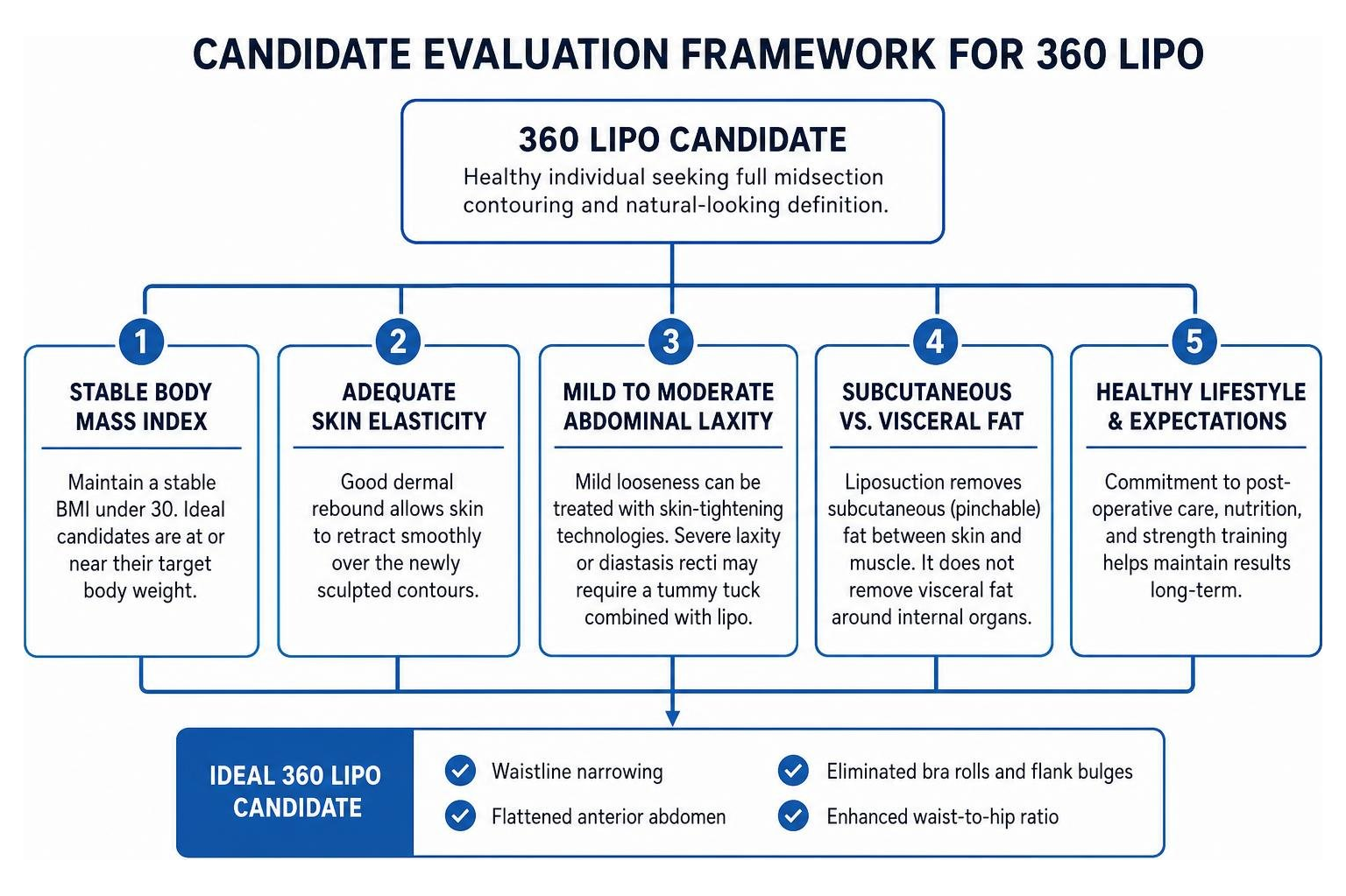
- Stable Body Mass Index (BMI): Ideal candidates typically maintain a stable BMI under 30. Patients at or near their target body weight achieve the crispest anatomical definition and longest-lasting results.
- Adequate Skin Elasticity: Good dermal rebound ensures that the skin snaps back cleanly against newly sculpted muscle beds once the underlying fat layer is removed.
- Mild to Moderate Abdominal Laxity: If a patient presents with mild skin looseness, we can integrate skin-tightening technologies. However, patients with severe skin redundancy or separated abdominal muscles following multiple pregnancies may require a full or mini tummy tuck combined with liposuction.
- Subcutaneous vs. Visceral Fat: Liposuction safely removes subcutaneous fat (the pinchable fat sitting between skin and muscle). It cannot remove visceral fat, which sits deep within the abdominal cavity around internal organs.
- Healthy Lifestyle and Realistic Expectations: A commitment to post-operative maintenance, structured nutrition, and consistent strength training preserves surgical outcomes indefinitely.
Evaluating Real 360 Lipo Before After Results
When examining clinical photographic transformations, looking past the initial "wow" factor helps reveal the true quality of the surgical outcome. A well-executed 360 lipo transformation should look natural, proportional, and balanced from every perspective—front, profile, oblique, and posterior.
To assess high-quality results in clinical galleries, keep these critical benchmarks in mind:
- Smooth Surface Topography: The skin should look even and uninterrupted, without lumps, dents, or irregular ridges (known as contour deformities).
- Symmetrical Waistline Contraction: The curve of the waist should taper symmetrically on both sides, creating a balanced frame.
- Defined Muscle Transitions: In high-definition cases, muscular transitions—such as the vertical abdominal lines and the curve of the obliques—should look soft and natural, avoiding an artificial "washboard" appearance.
- Clean Posterior Silhouette: The transition from the mid-back over the flanks down to the gluteal shelf should be smooth, without overhang or residual bra roll bulges.
To explore the diverse range of transformations possible with circumferential sculpting, browse our extensive gallery of 360 Lipo Before and After transformations.
Case Study: 41-Year-Old Female 360 Lipo Before After Outcomes
A representative case from our practice involves a 41-year-old female patient who presented with persistent midsection concerns following childbearing and hormonal shifts. Despite maintaining a consistent workout regimen and a balanced diet, she struggled with localized fat deposits across her lower abdomen, heavy flanks that spilled over her waistline, and noticeable bra rolls across her upper back. She also exhibited mild abdominal skin laxity that made her midsection look soft and unstructured.
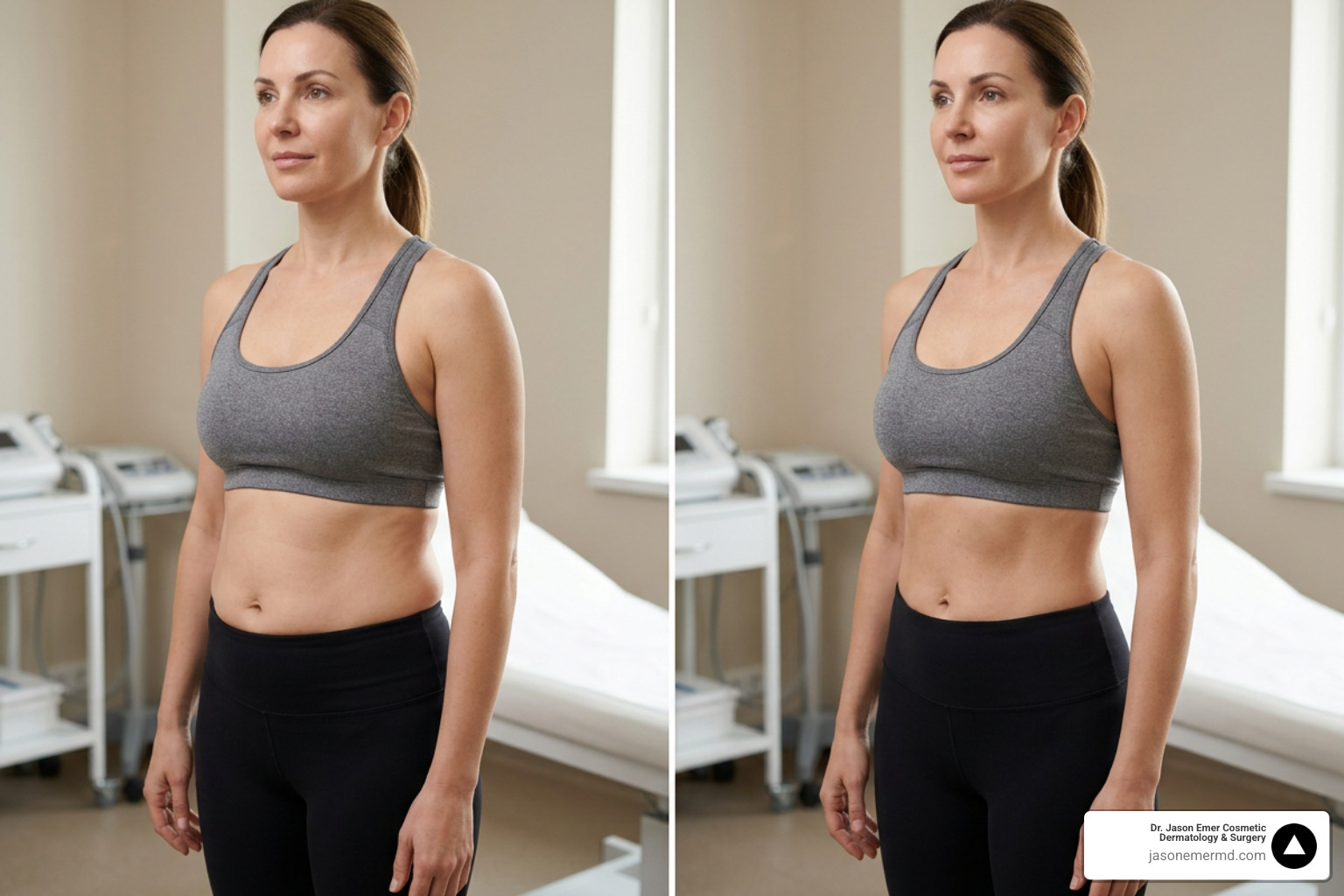
During her surgical planning, we addressed her torso circumferentially. Using ultrasound-assisted liposuction, we carefully sculpted her upper and lower abdomen, narrowed her lateral waist, and cleared the stubborn fat deposits across her upper and lower back. By heating the deep dermal architecture, we encouraged skin contraction over her newly defined abdominal wall.
- Clinical Presentation: 41-year-old female, BMI 24.5, localized midsection lipodystrophy, upper back rolls, mild supraumbilical skin laxity.
- Surgical Strategy: 360-degree high-definition liposuction targeting the full abdomen, love handles, lower back, and bra roll zone, combined with internal tissue tightening.
- Outcome: At her post-operative evaluations, the patient demonstrated a dramatic reduction in circumferential torso diameter, complete resolution of her bra rolls, and a contoured waist-to-hip ratio. Her abdominal skin retracted smoothly without requiring an invasive surgical excision.
To see similar female transformations and explore customized treatment plans, view our specialized 360 HD Lipo for Women options.
Male Sculpting: Athletic Definition and 360 Lipo Before After Changes
Male body contouring requires a distinct surgical approach focused on sharp muscular borders, broader upper-torso proportions, and a classic athletic "V-taper." While female sculpting emphasizes a softer, hourglass curve with a narrowed waist and rounded hips, male sculpting focuses on flattening the flank region completely to accentuate the latissimus dorsi and external obliques.
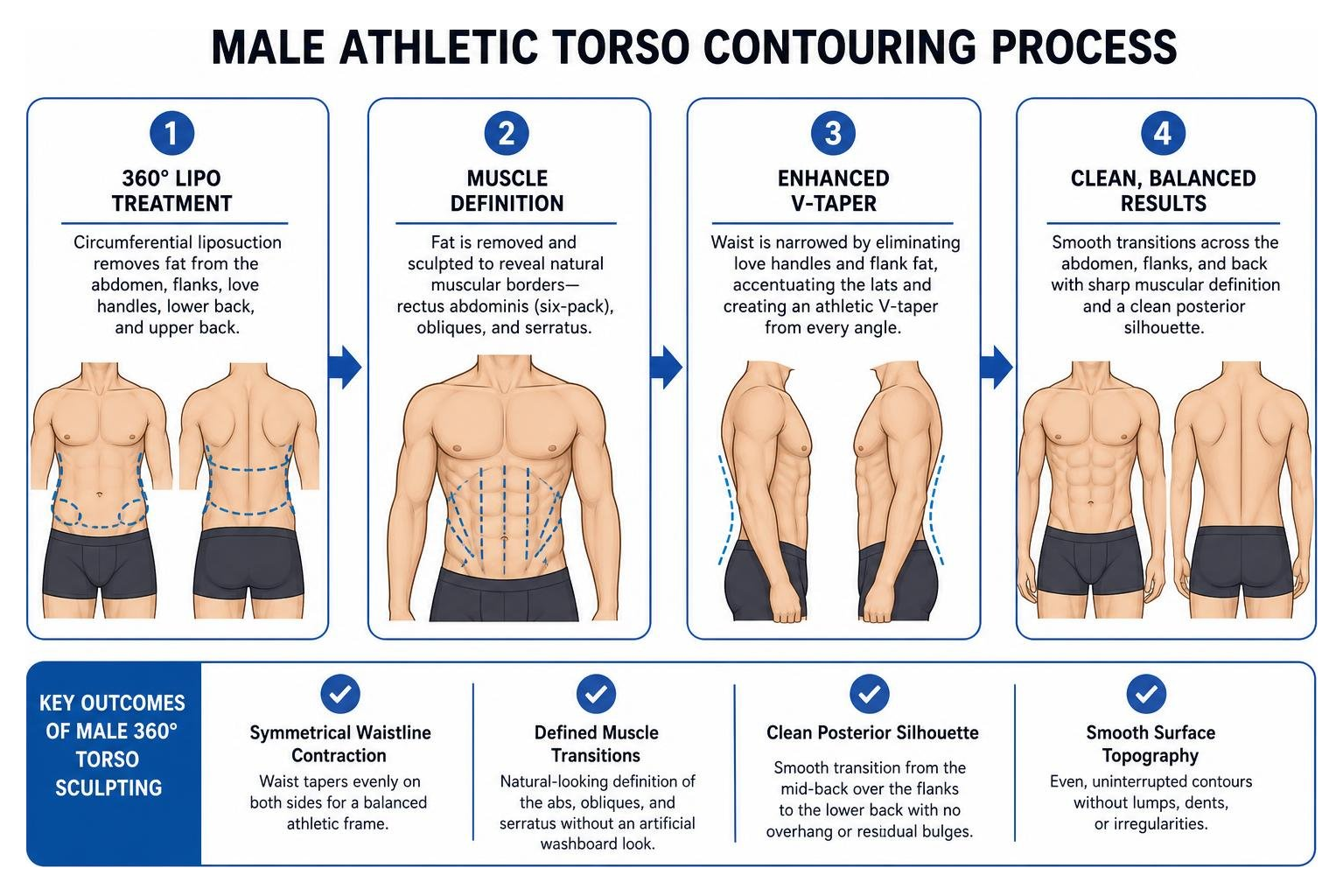
In male patients, circumferential 360 lipo removes the dense, fibrous fat of the love handles and lower back while etching along the anatomical borders of the rectus abdominis (six-pack) and serratus muscles. To read a detailed breakdown of a male patient's transformation and surgical journey, read this 360 HD Male Liposculpture Patient Story. You can also evaluate more athletic transformations in our Hi-Def Lipo Before and After showcase.
Recovery Timeline, Potential Risks, and Long-Term Results
Understanding the recovery timeline is essential for keeping expectations aligned with biological healing. The body requires time to resolve surgical swelling, clear residual fluids, and allow the skin and subcutaneous tissues to adhere to underlying muscle fascia.
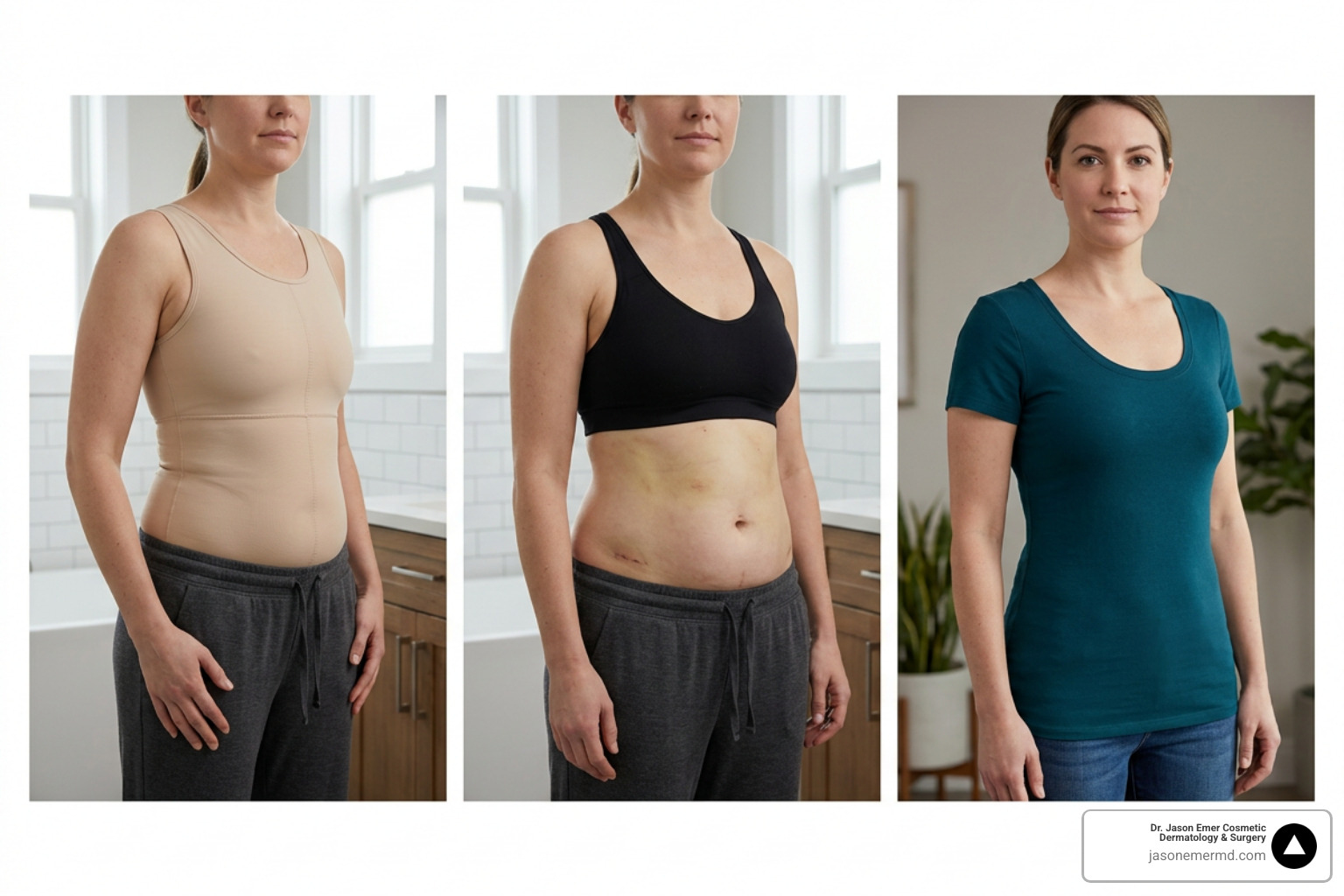
The Recovery Milestones
- Days 1 to 7 (The Acute Phase): Patients wear specialized medical-grade compression garments around the clock. Mild swelling, bruising, and fluid drainage from small portal sites are normal. Light walking is encouraged from day one to stimulate circulation and prevent blood clots.
- Weeks 2 to 4 (The Remodeling Phase): Most superficial bruising fades. Patients begin specialized manual lymphatic drainage massages to soften healing tissues, minimize post-op seroma risk, and flush out retained fluid. Light cardiovascular exercise can usually resume around week three.
- Months 2 to 3 (The Definition Phase): Approximately 70% to 80% of swelling resolves. Patients notice significant waist narrowing and emerging muscle definition.
- Months 6 to 12 (Final Maturation): Tissues fully soften, the lymphatic system normalizes, and deep dermal collagen remodeling completes. The final, high-definition result is fully visible.
To observe how healing progresses over several months, examine our 360 Full Circumferential Liposuction Before and After photo gallery.
Frequently Asked Questions About 360 Lipo
How long does it take to see final results after 360 lipo?
While you will notice an immediate change in your body shape right after surgery, significant post-operative swelling and fluid retention temporarily mask your final outcome. Most patients appreciate roughly 60% of their final look by the end of month one, 80% by month three, and the complete, refined result between six and twelve months as the skin fully contracts and internal scar tissue softens.
What are the primary risks and side effects of 360 lipo?
Like any surgical procedure, 360 liposuction carries inherent risks. Common and temporary side effects include bruising, swelling, localized soreness, and temporary skin numbness due to nerve irritation. Less common risks include seromas (fluid pockets under the skin), minor contour irregularities, delayed wound healing, or infection. Choosing an experienced, board-certified surgeon who uses modern tissue-sparing techniques significantly mitigates these risks.
What should patients look for when choosing a 360 lipo surgeon?
Look for a board-certified specialist with extensive, documented experience in advanced circumferential and high-definition liposculpture. Examine un-retouched before-and-after galleries featuring patients with your specific anatomical build. Ensure the surgeon demonstrates a deep understanding of three-dimensional athletic aesthetics and offers a structured post-operative recovery protocol—including lymphatic aftercare and tissue management—to protect your surgical investment.
Conclusion
Achieving a truly athletic, balanced midsection requires a comprehensive three-dimensional perspective. Circumferential 360 lipo reshapes the entire torso—addressing the abdomen, flanks, and back rolls simultaneously to deliver an uninterrupted, natural contour from every angle.
If you are looking to refine stubborn fat deposits, improve abdominal definition, or explore comprehensive body-sculpting strategies, learn more about our advanced non-surgical fat reduction and skin tightening options and high-definition surgical treatments to discover the ideal path for your aesthetic goals.
This resource provides general educational information. Treatment recommendations depend on your health, goals, and consultation with a qualified clinician.