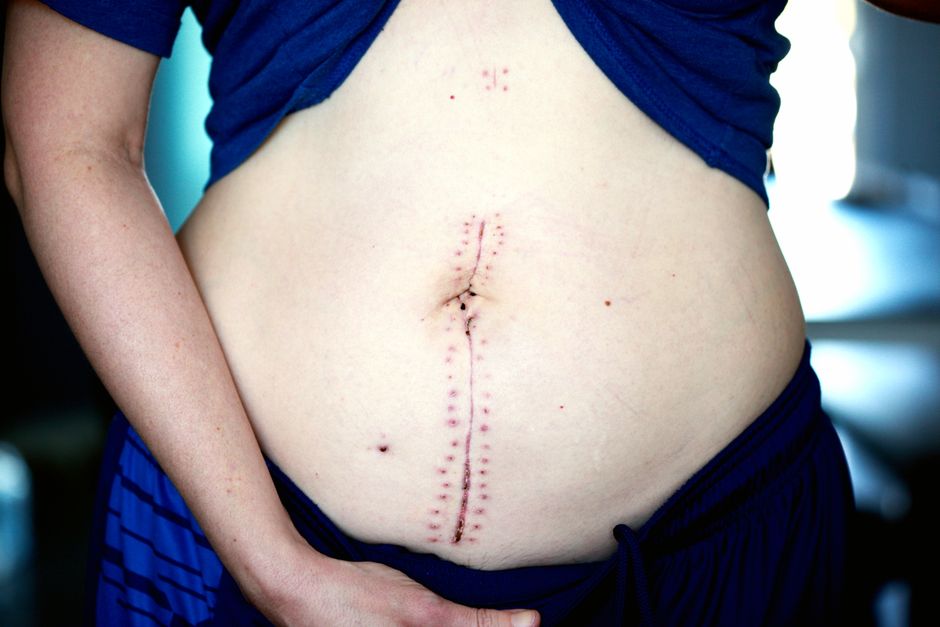
A modified tummy tuck targets localized lower abdominal laxity through a limited surgical approach
Most abdominal contouring discussions assume a full abdominoplasty is the only way to correct lower abdominal laxity. In Dr. Emer's clinical model, the evaluation starts with an anatomical map, not a default operation. A targeted surgical strategy isolates changes strictly to the infraumbilical zone, rather than treating the entire abdominal wall as a single surgical field. While traditional abdominoplasty addresses the full abdominal wall from rib cage to pubis, a modified tummy tuck isolates redundant tissue beneath the navel and leaves the upper abdomen untouched. This distinction matters most for patients whose laxity is confined below the belly button, often after modest weight change or childbearing, where the upper abdominal skin and muscle remain structurally sound. When localized fullness persists despite exercise, pairing the approach with body liposuction services refines the transition across the flanks so the treated zone blends with the surrounding contour instead of appearing as an isolated correction.
How incision placement and tissue dissection define the modified tummy tuck technique
The incision sits low across the pubic hairline, positioned to remain concealed beneath most underwear and swimwear lines. Dissection stops at or just below the navel rather than elevating tissue up to the ribs, which is the defining technical difference from a traditional procedure. Because tissue release is limited, blood supply to the lower flap remains intact, which supports a more predictable healing course.
Variations depend on tissue excess:
- Standard modified abdominoplasty removes a crescent of lower abdominal skin while preserving upper abdominal skin attachments.
- A mini tummy tuck procedure involves less skin excision, addressing laxity isolated strictly to the suprapubic fold.
- Limited internal dissection permits direct visualization of lower fascia without detaching the umbilicus, allowing rectus plication in that segment alone.
None of these variations are interchangeable with a full abdominoplasty. Choosing among them is a decision made in consultation, based on where laxity begins and ends on physical exam, not on patient preference for a shorter scar alone.
Comparing recovery timelines between a full abdominoplasty and a modified tummy tuck
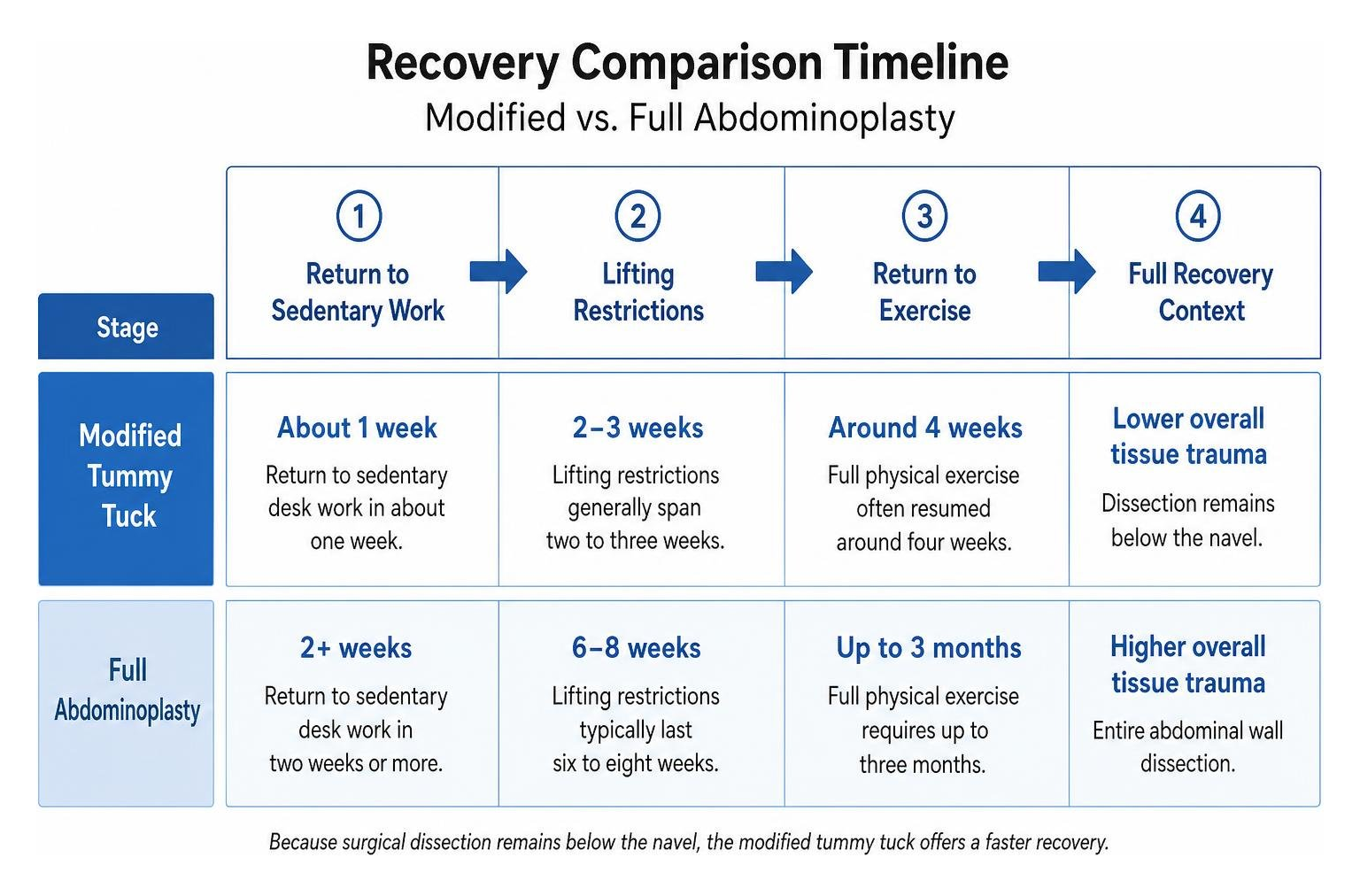
Because surgical dissection remains below the navel, post-operative tissue trauma is reduced. Patients undergoing a modified abdominoplasty typically return to sedentary desk work in about one week, though this varies with individual healing and the extent of muscle repair performed.
Lifting restrictions span two to three weeks, and regular physical exercise resumes around four weeks post-surgery. Even with a shorter recovery arc, swelling and firmness can persist for several months as tissues settle, and compression garment use during this period supports the final contour.
| Surgical Parameter | Modified Tummy Tuck | Traditional Full Tummy Tuck |
|---|---|---|
| Incision Placement | Low suprapubic; shorter line | Hip bone to hip bone |
| Belly Button Repositioning | Preserved in place | Released and transposed |
| Muscle Repair Scope | Infraumbilical fascia only | Full-length (xiphoid to pubis) |
| Desk Work Resumption | Approximately 1 week | 2 weeks or longer |
| Lifting Restrictions | 2 to 3 weeks | 6 to 8 weeks |
| Return to Full Exercise | Approximately 1 month | Up to 3 months |
Surgical incision design determines muscle access and aesthetic outcomes below the umbilicus
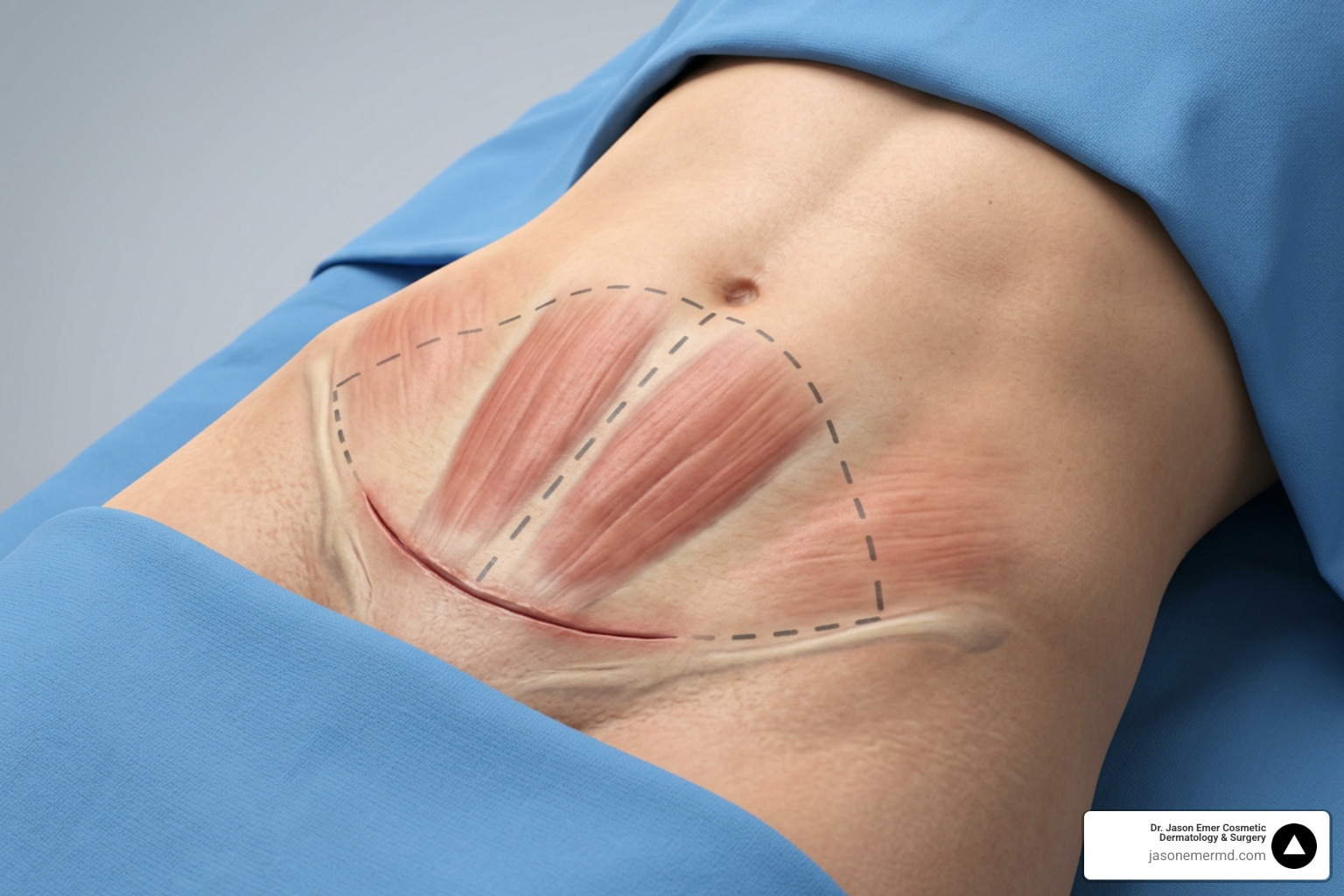
Precision mapping dictates how the abdominal wall responds to tension after surgery. Through targeted lower incisions, surgical body contouring restores tension to the lower abdominal wall without broad superior undermining, which keeps recovery contained to a smaller surgical field and reduces the trauma associated with wider tissue release.
Targeted rectus fascia tightening beneath the navel
Lower midline separation, known as diastasis recti, often follows childbearing or weight changes. When separation is confined to the subumbilical midline, the surgeon sutures the medial borders of the rectus sheath together below the navel stalk, restoring midline tension without disturbing tissue above it.
This internal plication creates structural support and flattens the lower pooch that often persists despite diet and exercise. If rectus separation extends above the navel, however, a modified repair cannot correct the upper weakness. In that scenario, a full abdominoplasty with extended plication becomes the more appropriate option, and attempting a limited fix would leave a visible step-off between the treated and untreated segments. This is one of the clearest tradeoffs of the modified approach: it trades a shorter scar and faster recovery for a narrower scope of correction.
Navel preservation and lower abdominal redraping
Preserving the natural umbilical attachment avoids a circular scar around the belly button, which many patients consider a meaningful aesthetic advantage. The lower skin flap is advanced downward, excess skin is excised, and closure occurs in multiple layered tiers to distribute tension evenly across the incision.
Careful tension distribution keeps the final scar hidden within low-cut swimwear, though scar appearance still depends on individual healing, skin tone, and aftercare. As with any incisional procedure, temporary numbness, swelling, or firmness along the incision line can occur while tissues remodel over the following months.
Strategic candidacy selection supports appropriate expectations for limited-incision abdominal surgery
Patient selection determines procedural success. The ideal candidate maintains weight stability, exhibits mild-to-moderate skin laxity below the navel, and presents good upper abdominal skin tone.
Reviewing anatomical indicators for limited-incision procedures
A comprehensive clinical assessment evaluates three distinct anatomical layers:
- Upper abdominal laxity: Significant skin overhang above the belly button requires a full abdominoplasty rather than a modified approach.
- Intra-abdominal visceral fat: Deep visceral fat behind the muscle wall cannot be corrected with skin excision or subcutaneous tightening.
- Prior surgical interventions: Patients seeking a tummy tuck revision must be evaluated for scar tissue that could compromise vascularity.
Balancing surgical limitations with long-term aesthetic goals
A modified abdominoplasty cannot tighten skin above the navel or repair supraumbilical muscle diastasis. Non-surgical alternatives—such as doing less through focused skin-tightening energy devices or isolated liposuction—provide pathways for patients with minimal skin excess.
When energy devices or post-surgical scar lasers are utilized, skin phototype requires careful analysis. In darker skin tones (Fitzpatrick IV–VI), conservative energy settings mitigate the risk of post-inflammatory hyperpigmentation (PIH). Future pregnancies or substantial weight fluctuations will stretch repaired fascia and skin.
Frequently asked questions about limited-incision abdominal contouring
How does a modified abdominoplasty differ from a traditional full procedure?
A modified procedure uses a shorter suprapubic incision, focuses dissection below the umbilicus, avoids navel repositioning, and limits muscle tightening to the lower abdomen.
Can a modified procedure address upper abdominal muscle separation?
No. Tightening the rectus sheath above the belly button requires wide surgical undermining and umbilical transposition found in a full abdominoplasty.
What is the expected timeline for returning to regular physical activity?
Desk work typically resumes after one week, light activity around two to three weeks, and unrestricted exercise by four weeks, supported by compression garments.
A personalized evaluation for an advanced abdominoplasty consultation provides the diagnostic clarity needed to align anatomical requirements with realistic surgical goals at Dr. Jason Emer Cosmetic Dermatology & Surgery.
What to remember
- A modified abdominoplasty isolates skin removal and muscle tightening to the region below the navel, leaving the belly button in its natural position.
- Recovery timelines are significantly shorter than traditional abdominoplasty, permitting a return to desk work in about one week and full exercise in approximately one month.
- Anatomical factors, including upper abdominal skin tone and the vertical extent of muscle separation, determine whether a limited-incision technique is clinically appropriate.
This content is for general education and does not provide a diagnosis, determine candidacy, or replace a consultation with a licensed clinician.
This resource provides general educational information. Treatment recommendations depend on your health, goals, and consultation with a qualified clinician.