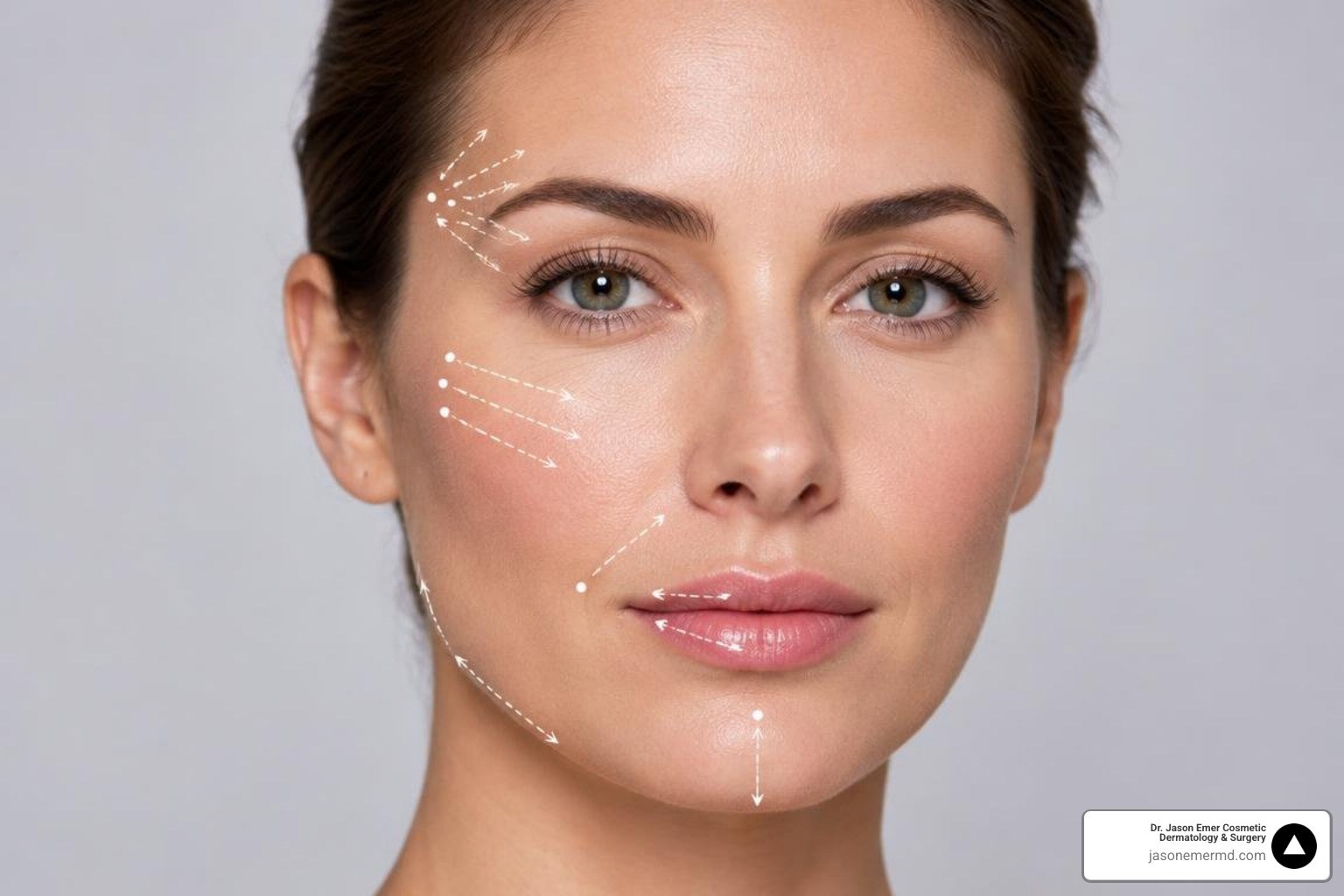
How face filler areas shape facial balance
Most consultations begin with a request for a specific line or syringe. In Dr. Emer's practice, treatment starts with anatomical balance. The primary face filler areas include the temples, forehead, cheeks, under-eyes, nasolabial folds, lips, chin, and jawline. Treating these regions means weighing bone structure, fat compartments, skin quality, and vasculature together.
Rather than injecting isolated folds, Dr. Emer assesses how each plane supports adjacent structures. A patient requesting lower-face refinement may benefit from midface support, while another might need staged treatments across multiple visits. Bone resorption and deep fat pad atrophy occur before surface lines become visible, so treating the surface alone often produces an incomplete result.
Jason Emer, MD, FAAD, designs plans tailored to individual facial anatomy. His approach to facial sculpting considers how each region contributes to overall facial harmony rather than treating features in isolation. This means the forehead and temples are evaluated alongside the cheeks, and the chin is assessed in relation to the jawline and lips. A change in one zone shifts the perception of the next, which is why isolated correction can look disconnected from the rest of the face.
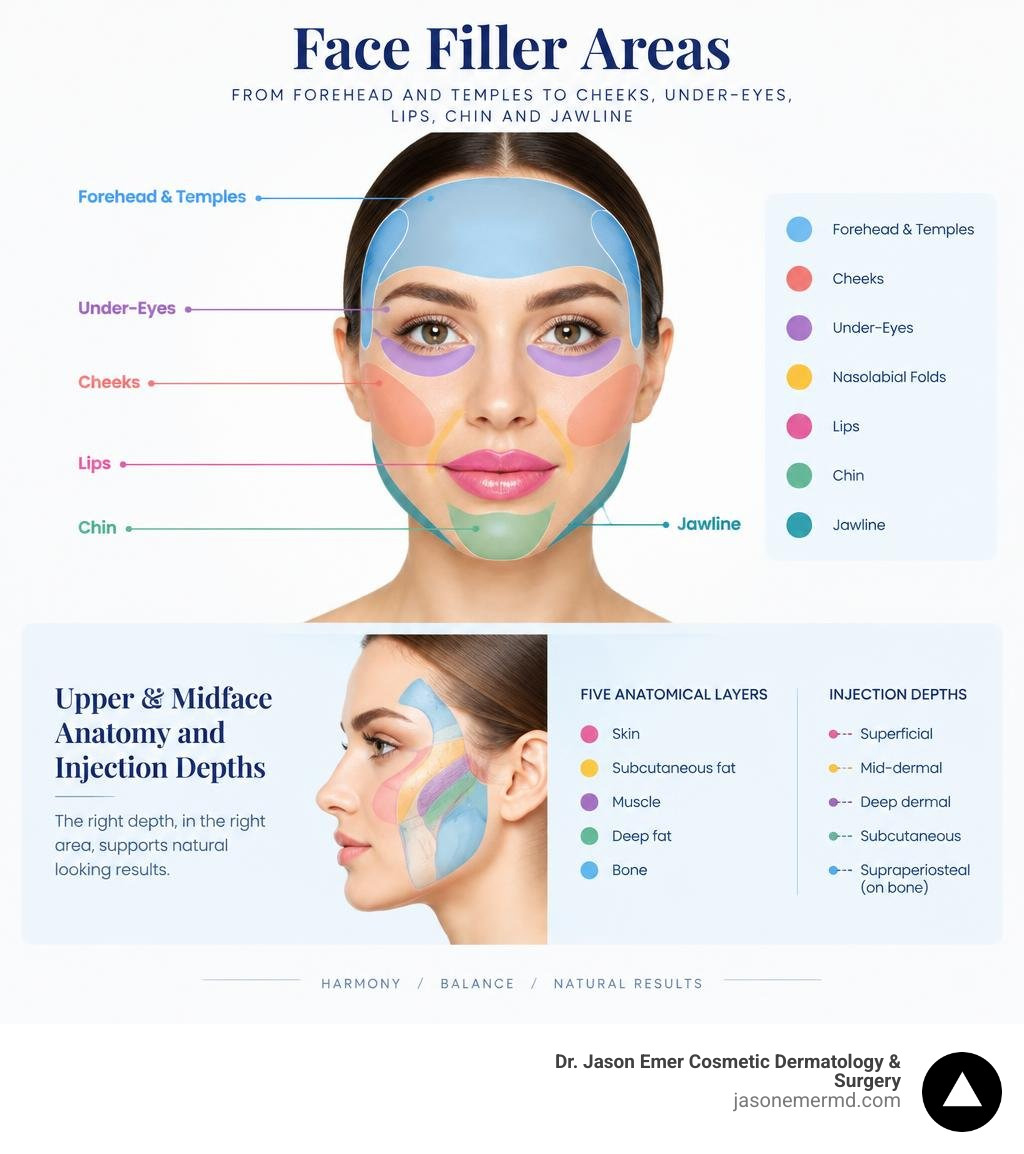
Deep structural support across upper and midface face filler areas guides treatment
Facial aging involves bone resorption, deep fat pad atrophy, and skin thinning. Restoring balance requires respecting the anatomical layers of the face. Dr. Emer treats the upper and midface as foundational pillars that reduce volume demands in the lower face.
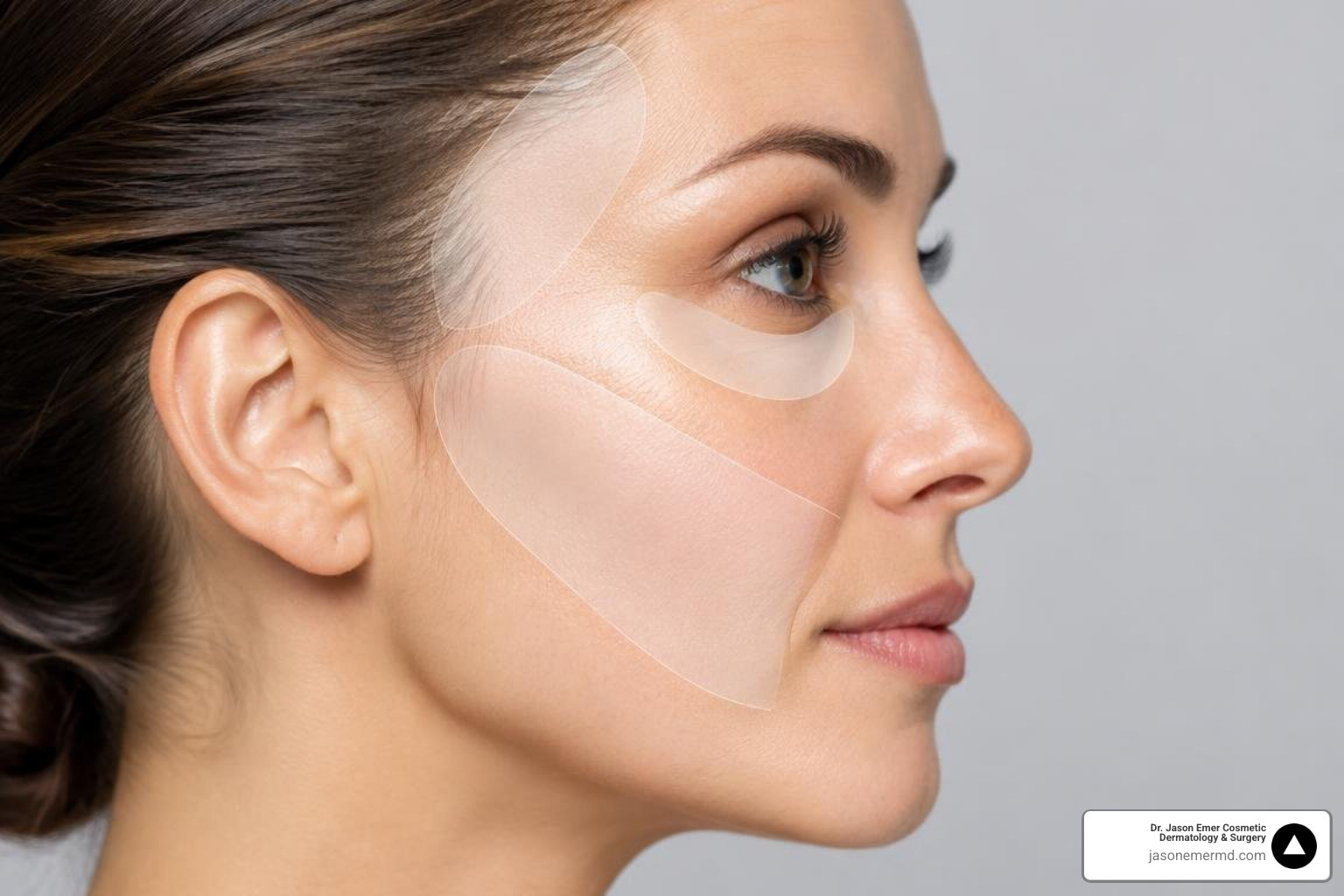
Temporal hollowing creates a skeletal appearance and causes the lateral brow to descend. Through temple augmentation with fillers, structural product is placed deep along the periosteum to smooth the transition to the zygomatic arch. This placement supports the brow without adding surface bulk.
In the midface, fat pad deflation leads to tear trough depression and soft tissue descent. Strategic cheek augmentation with fillers restores malar projection and reinforces the infraorbital rim, softening nasolabial folds. Restoring anterior cheek projection redistributes overlying skin and reduces lower-face shadowing.
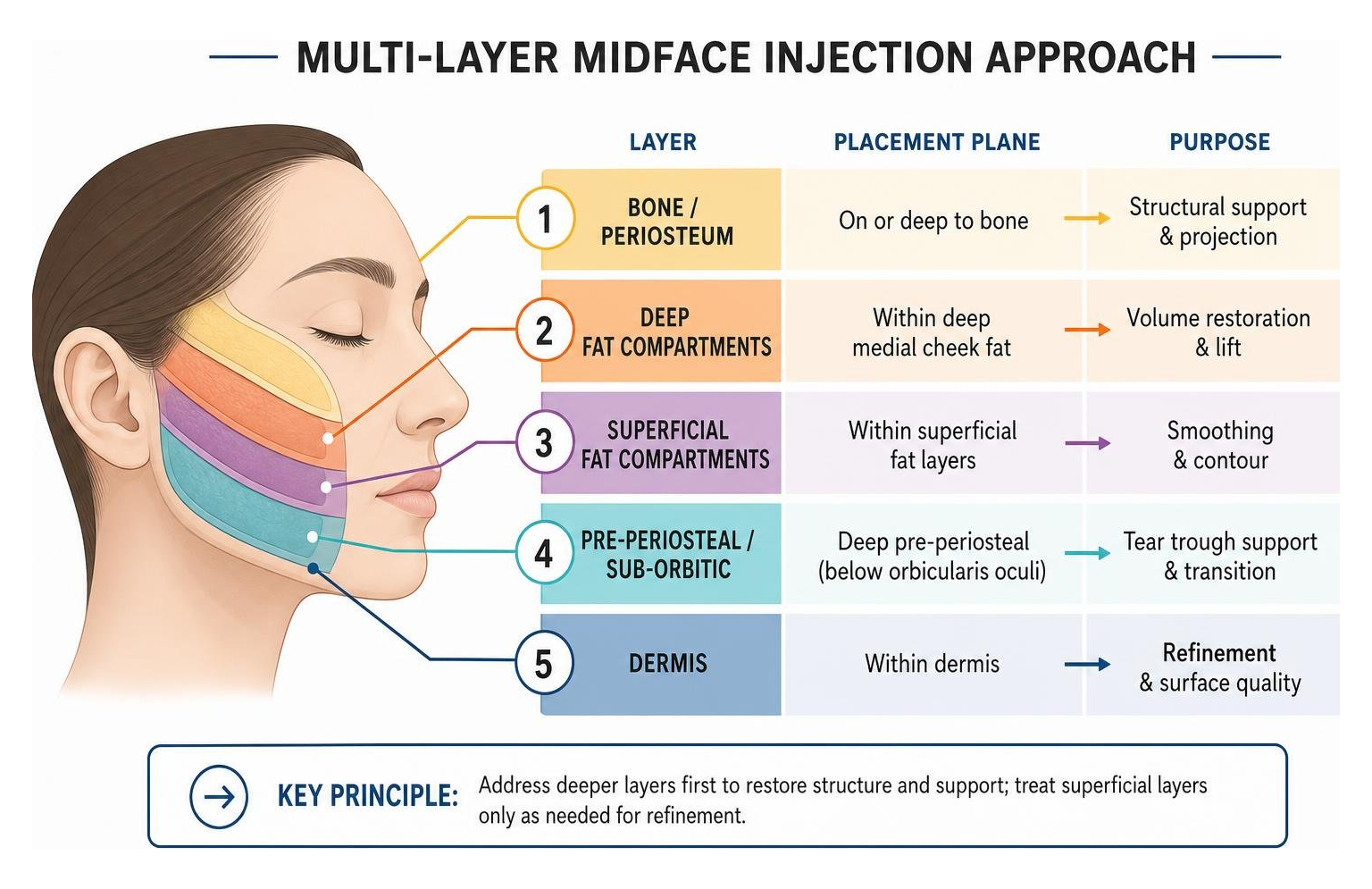
Targeted under-eye fillers soften the tear trough junction. Delicate periorbital tissue requires deep placement or cannula delivery to protect local vessels. Dr. Emer frequently treats the cheek first and reassesses the under-eye area in follow-up visits, as midface support alone often corrects tear trough depth.
Lower-face filler placement defines contours while respecting dynamic movement

The lower third of the face requires distinct gel rheology to accommodate active muscle movement. The jawline and chin demand high structural support, whereas the perioral area requires soft tissue integration.
Mandibular bone loss and jowl descent blur the jawline. Targeted jawline contouring establishes definition along the mandibular angle and straightens the pre-jowl sulcus, while chin augmentation improves profile projection. Through customized facial sculpting, Dr. Emer balances lower contours with midface proportions.
| Facial Area | Structural Requirement | Rheological Property | Movement Consideration |
|---|---|---|---|
| Cheeks & Temples | High lift and projection | High G-prime (firm gel) | Low dynamic movement |
| Jawline & Chin | Sharp bony definition | High G-prime and viscosity | Moderate dynamic strain |
| Lips & Perioral | Soft volume and smoothing | Low G-prime, high stretch | High dynamic movement |
| Tear Troughs | Smooth transition | Low hydrophilic spread | Low to moderate mobility |
Perioral balance requires conservative micro-droplet placement. Refining the vermilion border with lip augmentation smooths fine lines while maintaining natural lip mobility. Constant muscular activity metabolizes perioral fillers faster than static structural products, so treatments are staged in smaller increments to prevent unnatural stiffness.
Clinical assessment and strict safety protocols guide multi-region facial rejuvenation
A customized aesthetic approach begins with comprehensive baseline analysis. Targeted dermal fillers refine natural proportions rather than overfilling features.
Patient safety requires deep anatomical expertise. Inherent procedural risks include bruising, swelling, asymmetry, and vascular occlusion. Blunt cannulas, slow injection technique, aspiration, and immediate hyaluronidase access help mitigate these complications. Dr. Emer maps vascular anatomy prior to injection and uses conservative volumes in high-risk zones.
Not every patient needs every area treated. Electing to treat fewer zones, or to pursue no treatment at all, remains a reasonable choice, and staging decisions are made together with the patient during consultation. Some downtime and swelling are part of the healing timeline rather than a setback from it. When injectables are combined with energy-based treatments, darker skin types carry an elevated risk of post-inflammatory hyperpigmentation, which calls for modified settings and adjusted treatment sequencing discussed in advance.
Frequently asked questions about facial filler placement
How long do dermal fillers last across different facial regions?
Hyaluronic acid fillers typically last 6 to 18 months, metabolizing faster in mobile perioral areas than in static zones like the cheeks or jawline.
What is the safety difference between using a needle versus a cannula?
Blunt cannulas minimize vascular trauma in high-risk tissue planes, while sharp needles allow precise placement directly on bone.
How is hyaluronic acid filler dissolved if adjustments are needed?
Hyaluronidase breaks down cross-linked hyaluronic acid, allowing the body to resorb the product within 24 to 48 hours.
What to remember
- Multi-region filler treatment requires structural layer evaluation rather than isolated line filling.
- Product rheology must match tissue movement, using firm gels for bone support and flexible gels for dynamic zones.
- Patient safety depends on cannula technique, precise injection depth, and available reversal agents.
This content is for general education and does not provide a diagnosis, determine candidacy, or replace a consultation with a licensed clinician.
To evaluate facial anatomy and explore personalized aesthetic options, schedule a clinical consultation at Dr. Jason Emer Cosmetic Dermatology & Surgery.
References
Clark NW, Pan DR, Barrett DM. "Facial fillers: Relevant anatomy, injection techniques, and complications.." World journal of otorhinolaryngology - head and neck surgery, 2023. PMCID PMC10541169. Trevidic P, Kaufman-Janette J, Weinkle S, Wu R, Dhillon B, Antunes S, Mace E, Maffert P. "Injection Guidelines for Treating Midface Volume Deficiency With Hyaluronic Acid Fillers: The ATP Approach (Anatomy, Techniques, Products).." Aesthetic surgery journal, 2022. PMCID PMC9373948.
This resource provides general educational information. Treatment recommendations depend on your health, goals, and consultation with a qualified clinician.