What a rolling scar is
A rolling scar is a wide, shallow depression with soft, sloping edges, often 4 to 5 mm across or more. Several together give the cheek a wavy surface that shows most in side light. The cause sits underneath: fibrous bands run from the deep skin down to the tissue below and pull the surface down.
A simple test shows it. When the skin beside a rolling scar is pinched and lifted, the surrounding skin rises and the scar stays anchored. That tether is the target.
Why surface treatments cannot release it
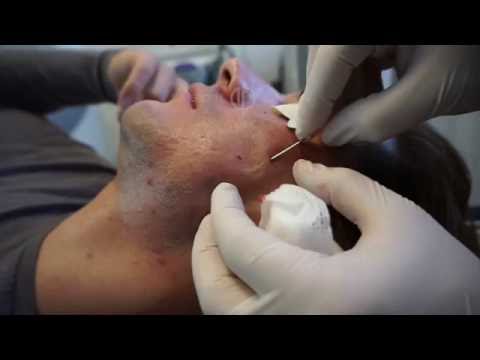
Lasers, peels and microneedling work from the top. None of them can cut a band that sits underneath the scar, so on their own they polish a surface that is still being pulled down. In Dr. Emer’s words: "for patients that have deep scars that are tethered down onto the skin you have to sometimes do what’s called subcision this is taking a needle under the skin and basically cutting the tissue bands that hold the scar down" (film c8QWF7-vYls).
Subcision, step by step
After local anesthetic, a fine needle or a blunt cannula is passed under the scar and moved to cut the bands. The skin is released at once and can rise. The released space is then supported, because an empty pocket can tether again: biologics such as PRP, filler or microdroplet silicone are placed where the scar needs support, as part of the same plan.
Subcision is never a standalone treatment at the practice. It is the first move in a sequence, release first and then refill, followed by resurfacing so the surface catches up with the floor. In the film, Dr. Emer explains that the release is what lets him "later laser or micro needle the area and get improvement."
Who subcision is for, and who it is not for
Subcision is matched to scars that are tethered. It is planned when:
- the scars are mainly rolling, or deep boxcars with a tethered floor;
- a pinch test shows the scar held down while the skin around it lifts;
- there is no active acne in the area;
- blood thinners, if any, have been planned around with the prescribing doctor.
It is not used for scars that are mainly ice-pick pits or enlarged pores, because there is no band to cut and the bruising brings risk without benefit. On Fitzpatrick IV to VI skin, bruising can leave lasting brown marks, so subcision is used there only where a tether is clearly present, with pigment preparation beforehand.
Supporting the released scar
What fills the released space depends on the scar and the skin. The biologic layer (PRP and related products) supports healing; a filler or microdroplet silicone gives structure where the scar floor needs it; deep RF microneedling adds tightening for depth and stretch. Bellafill is one option for distensible scars, and its FDA approval covers certain distensible acne scars on the cheek. Microdroplet silicone is permanent and used off-label, so it is placed in small amounts over staged sessions.
Then the surface catches up
Once the scar has been released and supported, resurfacing smooths the remaining texture. The erbium platform is the default because it runs cooler, with CO2 where skin type and depth justify it. On a mixed face, the same sessions address boxcar and ice-pick scars with their own tools.
Sessions and what rolling scar treatment costs
Some rolling scars release fully with one subcision; others tether again and need a second release, which the plan allows for. Subcision typically starts at about $500 per session with Dr. Emer, and the total depends on how large the scar field is. A programme that combines release, filler and resurfacing typically runs $5,000 to $17,000; the written quote follows the consultation.
The $500 non-surgical consultation with Dr. Emer is where the scar map is drawn. The fee is credited only toward the treatment consulted for, within 30 days, never toward skincare or peptides. Financing is available through PatientFi, Alphaeon and CareCredit. Call (213) 985-0618.