
Dermal fillers for the jawline can restore selected structural support but cannot correct every cause of contour loss.
Many assume a soft lower face always requires added volume. In Dr. Emer's clinic, evaluation begins by identifying the anatomical cause of contour loss. Dermal fillers for the jawline can add support along the chin, mandibular angle, or prejowl area when structural bone loss diminishes definition. However, injectables cannot remove submental fullness or lift loose tissue.
Jason Emer, MD, FAAD, is a Beverly Hills cosmetic dermatologist and surgeon. His dermal fillers jawline treatment plans evaluate underlying facial anatomy to establish realistic non-surgical goals.
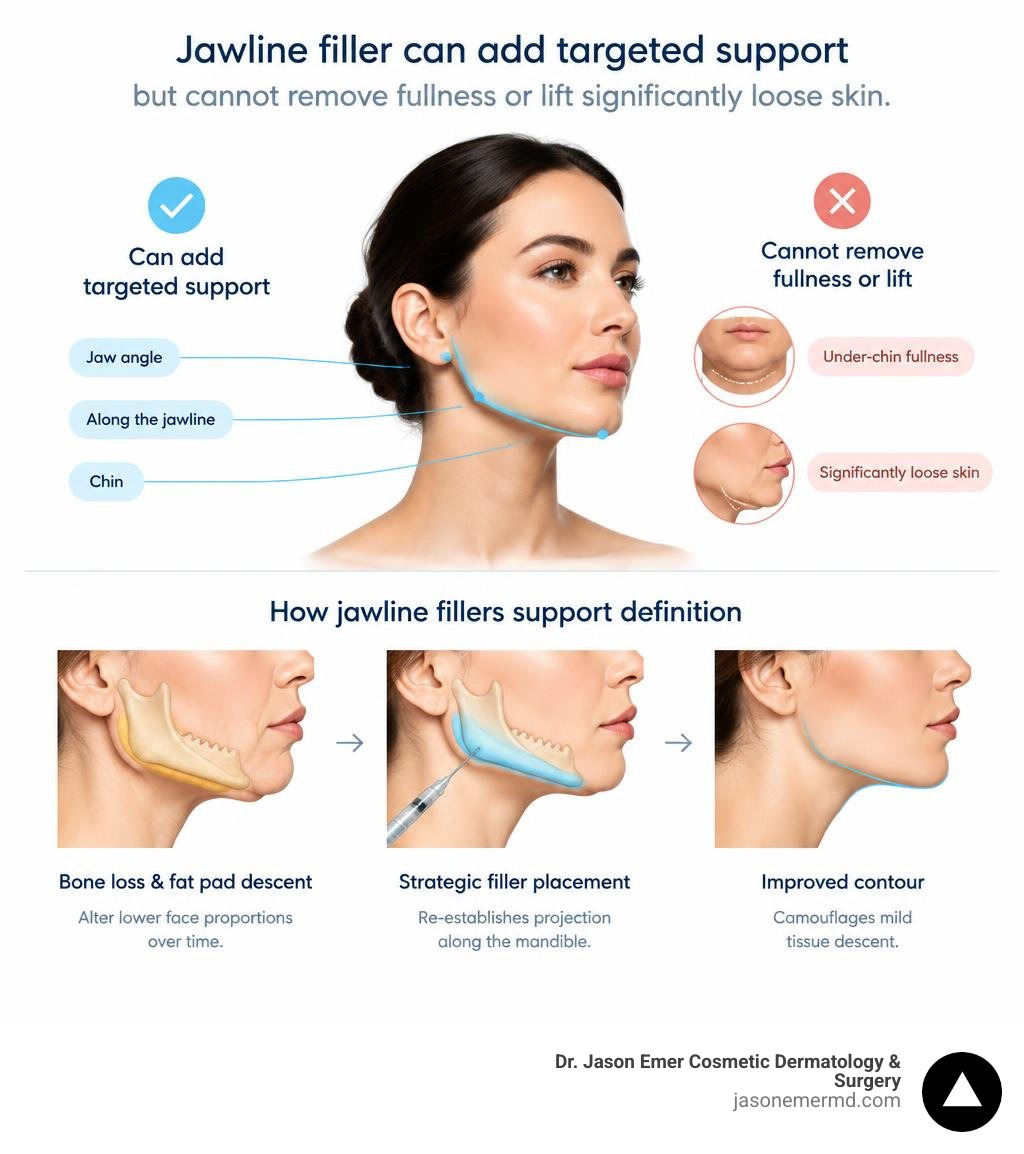
Dermal fillers can support jawline definition by replacing selected areas of structural volume.
Bone reabsorption along the mandible and descending fat pads alter lower face proportions. When deep structural support diminishes, soft tissue shifts forward. Strategic placement of dermal fillers re-establishes projection along the mandibular border, camouflaging mild descent.
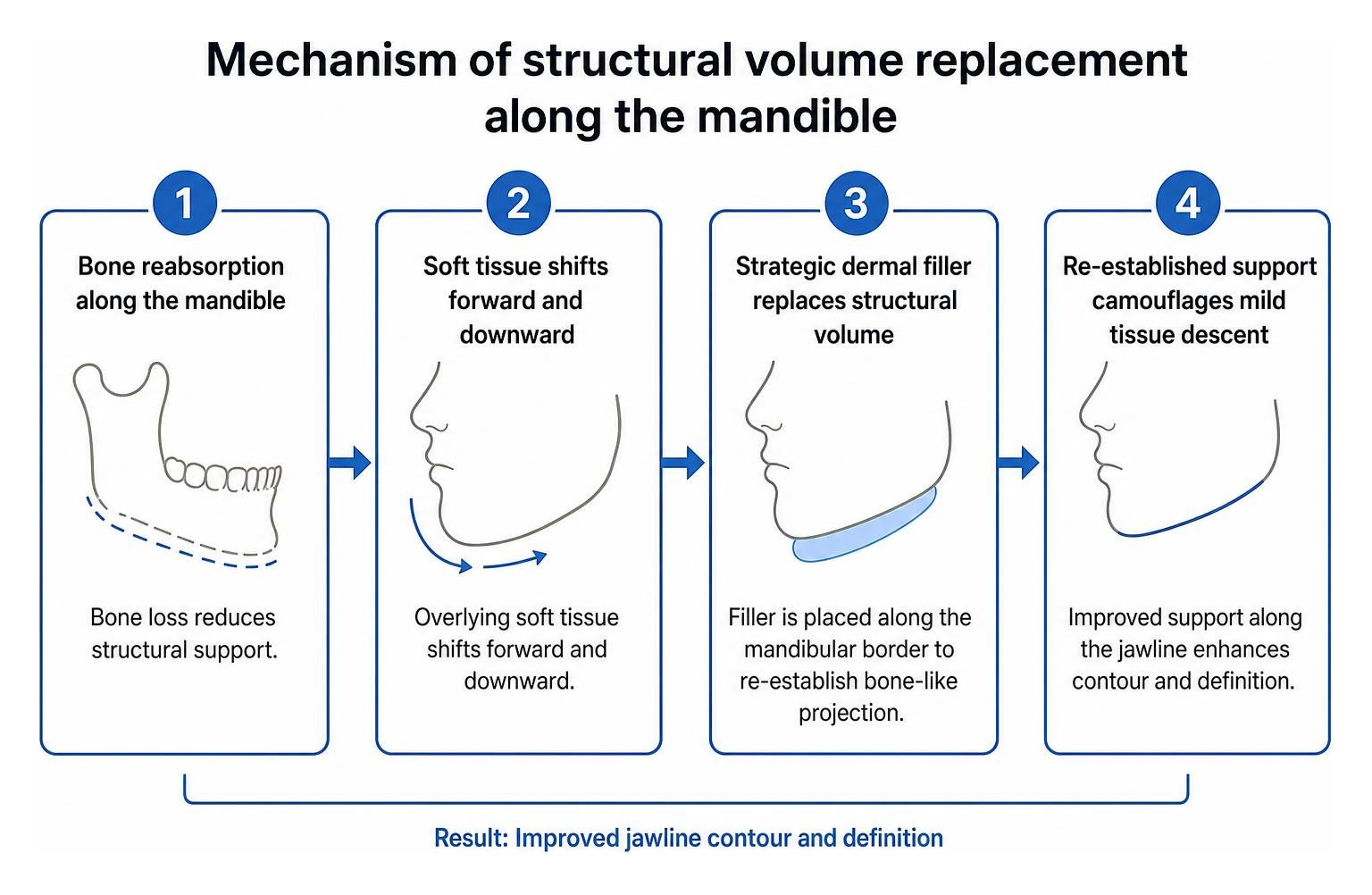
Filler formulations differ in support, flexibility, and duration.
Hyaluronic acid (HA) gels like Juvéderm® VOLUX® XC offer firm elasticity for bony mimicry along the jawline and remain reversible with hyaluronidase. Calcium hydroxylapatite (CaHA), such as Radiesse® (+), provides immediate structural lift using suspended mineral microspheres.
| Filler Type | Mechanism of Action | Primary Advantage | Typical Duration | Reversibility |
|---|---|---|---|---|
| Hyaluronic Acid (HA) | Water binding and high structural elasticity | Immediate volume; easily adjusted | Up to 12 months | Reversible with hyaluronidase |
| Calcium Hydroxylapatite (CaHA) | Mineral microsphere scaffolding and neocollagenesis | High lift capacity; stimulates natural collagen | 12 to 18 months | Non-reversible |
Collagen-stimulating fillers may provide gradual structural support.
Biostimulatory agents encourage progressive neocollagenesis. CaHA stimulates collagen growth as its carrier gel resorbs. For patients seeking non-surgical jawline contouring, this scaffolding offers firm integration, though collagen production rates vary.
Precise filler placement can support natural balance while reducing anatomical risks.
Accurate anatomical placement separates natural contouring from complications. Dr. Emer places firmer products in the deep supraperiosteal plane directly over bone to recreate sharp angles without soft-tissue migration. Superficial subcutaneous placement remains reserved for blending transitions like the prejowl sulcus.
Awareness of anatomical danger zones informs injection planning.
The lower third of the face contains critical neurovascular structures.

The facial artery crosses the mandibular border at the antegonial notch, where intravascular injection risks vascular occlusion. Safe clinical execution requires cautious aspiration, slow injection speeds, and microcannula techniques.
Filler plans can be tailored to facial structure and aesthetic goals.
Structural goals differ across facial phenotypes. Enhancing the gonial angle creates a wider mandibular base during male facial sculpting. Conversely, female facial sculpting often focuses on tapering the lower face and projecting the chin apex.
Injectable contouring can refine the jawline but cannot reposition significantly lax tissue.
Fillers provide volume, not skin excision. Injecting excessive product to stretch sagging skin creates an unnatural, heavy lower face. Recognizing the boundary between volume loss and severe skin laxity prevents aesthetic overcorrection.
Skin laxity and volume deficit call for different treatment considerations.
Prominent platysmal banding, submental fat accumulation, and heavy skin laxity cannot be resolved with dermal fillers alone. Patients with severe tissue descent may achieve better anatomical balance through surgical neck lifting or submental chin liposuction. In some cases, doing less or opting for structural surgery is the safer, more aesthetic path.

A broader treatment plan may address more than filler alone.
A comprehensive lower-face strategy frequently pairs fillers with complementary modalities during multi-vector facial sculpting. Neuromodulators can relax hypertrophic masseter muscles or soften downward pull from the platysma. When energy devices or lasers are integrated to improve skin tightness, skin tone must be evaluated. Darker skin types (Fitzpatrick IV–VI) face an increased risk of post-inflammatory hyperpigmentation (PIH), requiring conservative energy settings and customized treatment sequencing.
Filler longevity depends on formulation and individual factors.
The longevity of lower-face injectables depends on product cross-linking density, depth of placement, and patient metabolic rates. Dynamic areas break down filler faster than static bony contours along the posterior mandibular angle.
Fillers may soften mild contour irregularities but have limits with significant sagging.
Mild prejowl indentations respond well to conservative filler blending. However, when jowls hang significantly below the mandibular margin, adding filler to both sides widens the jaw base rather than restoring a youthful taper.
Recovery commonly involves temporary swelling or tenderness.
Post-treatment healing involves localized swelling, bruising, and transient tenderness over firm bony points lasting several days to two weeks. Proper aftercare includes limiting intense physical exercise and avoiding direct pressure on treated areas during the initial integration phase.
What to remember
- Dermal fillers reinforce bony support and camouflage mild contour dips but cannot excise excess fat or lift heavy, sagging skin.
- Precise supraperiosteal placement protects critical neurovascular structures, including the facial artery at the antegonial notch.
- Comprehensive facial rejuvenation often combines injectables with skin-tightening modalities or surgical alternatives depending on underlying tissue laxity.
This content is for general education and does not provide a diagnosis, determine candidacy, or replace a consultation with a licensed clinician.
To explore whether lower-face injectables or alternative treatments align with individual anatomy, schedule a detailed assessment through a formal consultation.
This resource provides general educational information. Treatment recommendations depend on your health, goals, and consultation with a qualified clinician.