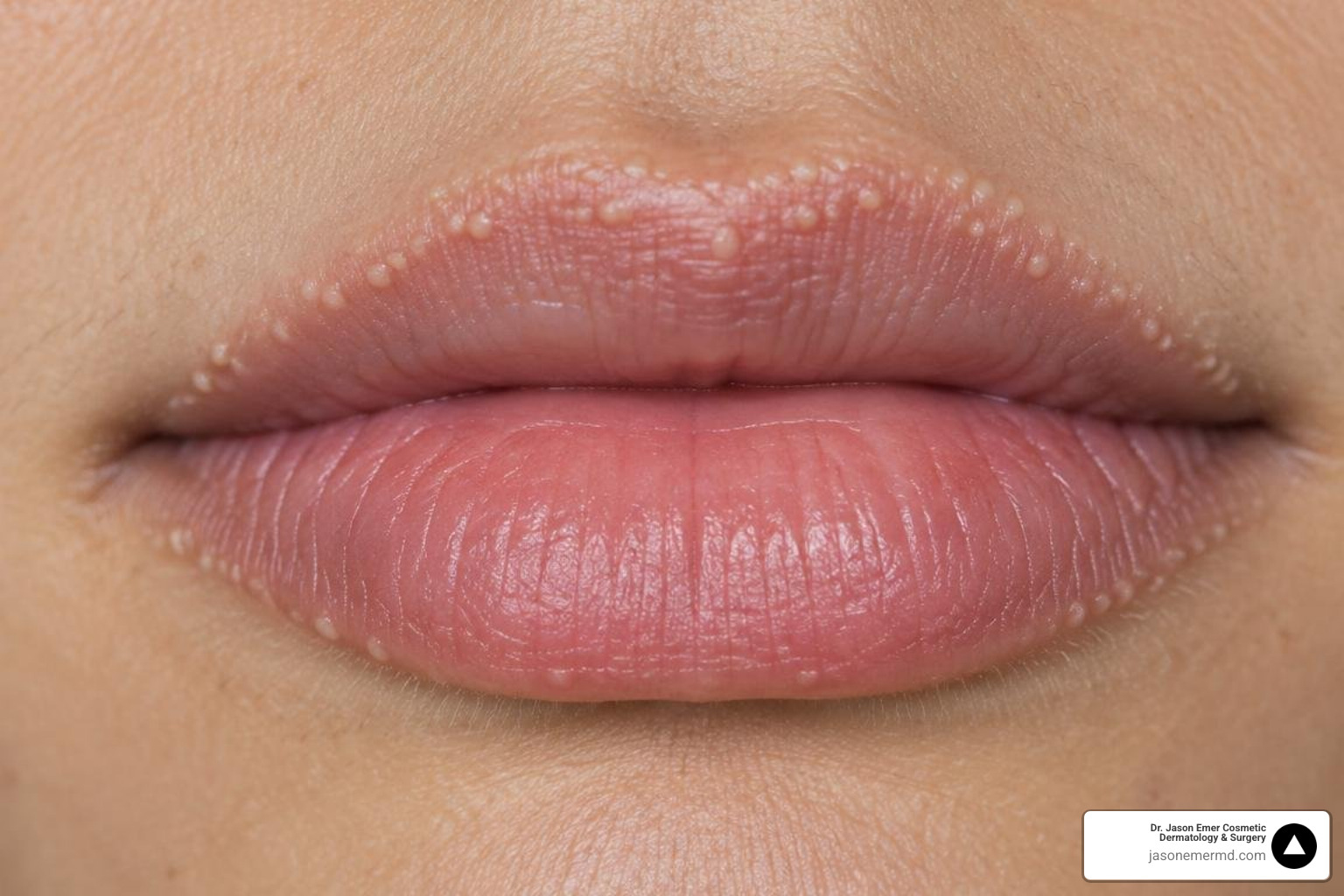
Visible ectopic oil glands represent a natural anatomical variation rather than an infectious disease
Most people assume sudden small bumps on the lips or genital skin signal an infection. In Dr. Emer's practice, the assumption is inverted: these lesions are treated first as a question of normal tissue biology, not disease pathology, and the workup starts from that map rather than from fear of contagion. In clinical practice, these lesions represent a normal anatomical variation: visible sebaceous glands residing where hair follicles are absent. Understanding what causes Fordyce spots begins with recognizing normal tissue biology rather than disease pathology.
These glands exist from birth. During puberty, androgen surges stimulate sebum production, enlarging the glands and making them noticeable. Natural tissue stretching also increases prominence. Fordyce spots are harmless, non-contagious, and present in roughly 70% to 80% of adults. Medical intervention is never mandatory.
Dr. Jason Emer guides patients through accurate diagnosis, clarifying normal gland physiology and evaluating aesthetic options when patients desire cosmetic refinement. He also helps patients understand how these benign findings differ from other concerns addressed through cosmetic dermatology.
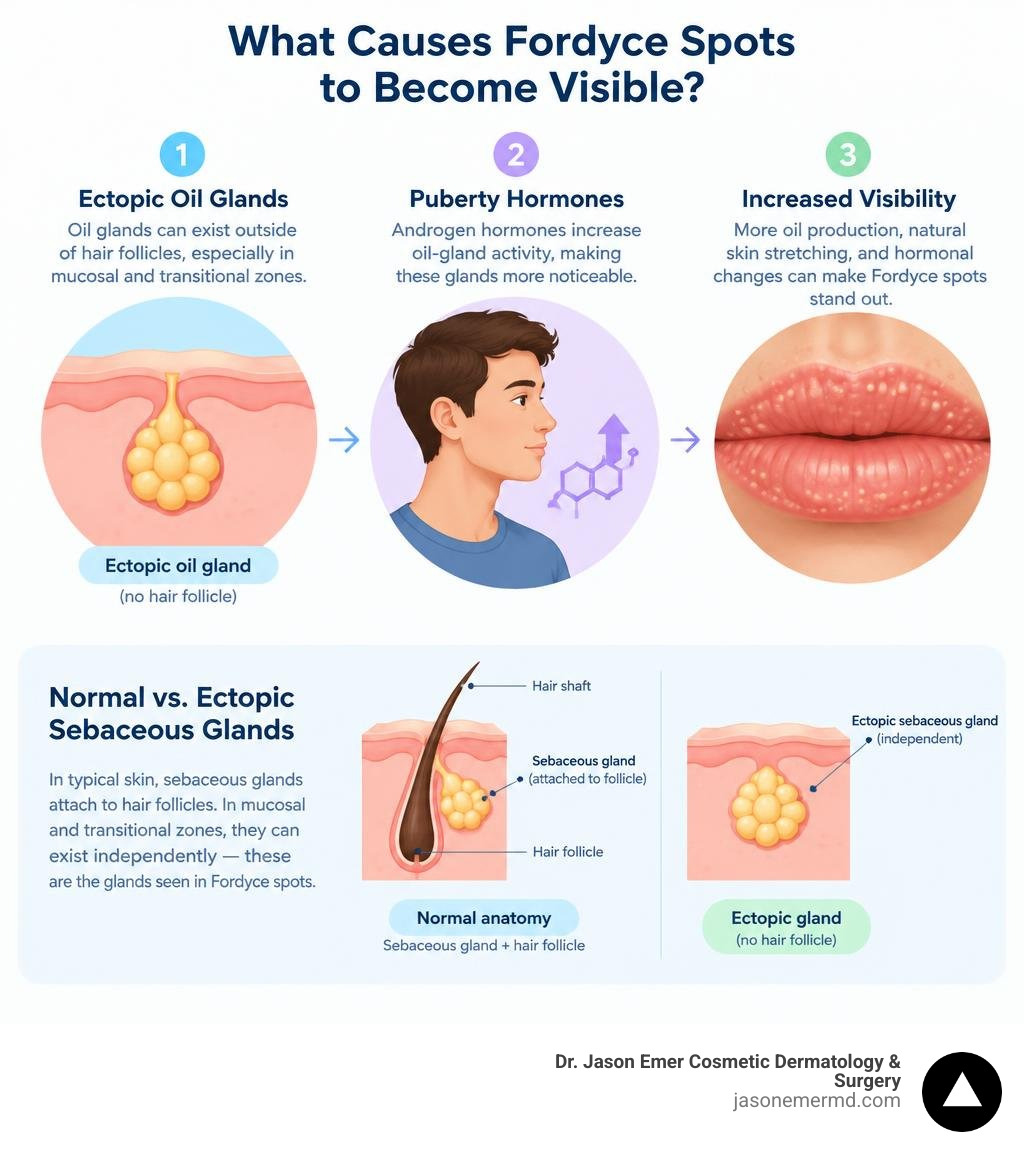
Understanding what causes Fordyce spots reveals natural gland biology and hormonal triggers
Fordyce spots are ectopic sebaceous glands. Under standard cutaneous anatomy, sebaceous glands connect directly to hair follicles to lubricate epidermal tissue. In mucosal and transitional tissues, these glands develop independently without accompanying follicular units. They remain dormant until endocrine changes stimulate them.

Endocrine maturation is the primary driver of glandular visibility. During puberty, rising androgens increase sebocyte lipid synthesis. As intracellular lipids accumulate, glandular volume expands, pushing the structures toward the epithelial surface. Men exhibit prominent spots roughly twice as often as women due to higher baseline androgens.
Metabolic factors may also influence gland expression. Observations documented by DermNet indicate that elevated systemic lipid levels can correlate with higher oral spot prominence. When assessing sensitive anatomy in down under cosmetic dermatology, Dr. Emer evaluates these biological factors to confirm that papules are benign structures rather than active infections.
The alternative to any workup is simply watching the spots over time, since they follow a predictable pattern tied to hormonal maturation rather than to an unpredictable disease process.
Recognizing clinical characteristics helps distinguish benign papules from other skin conditions
Fordyce spots appear as discrete, yellowish-white or skin-colored papules measuring 1 to 3 millimeters across. They occur symmetrically on the vermilion border, buccal mucosa, penile shaft, prepuce, and labia majora. They do not itch, ulcerate, or produce spontaneous drainage.
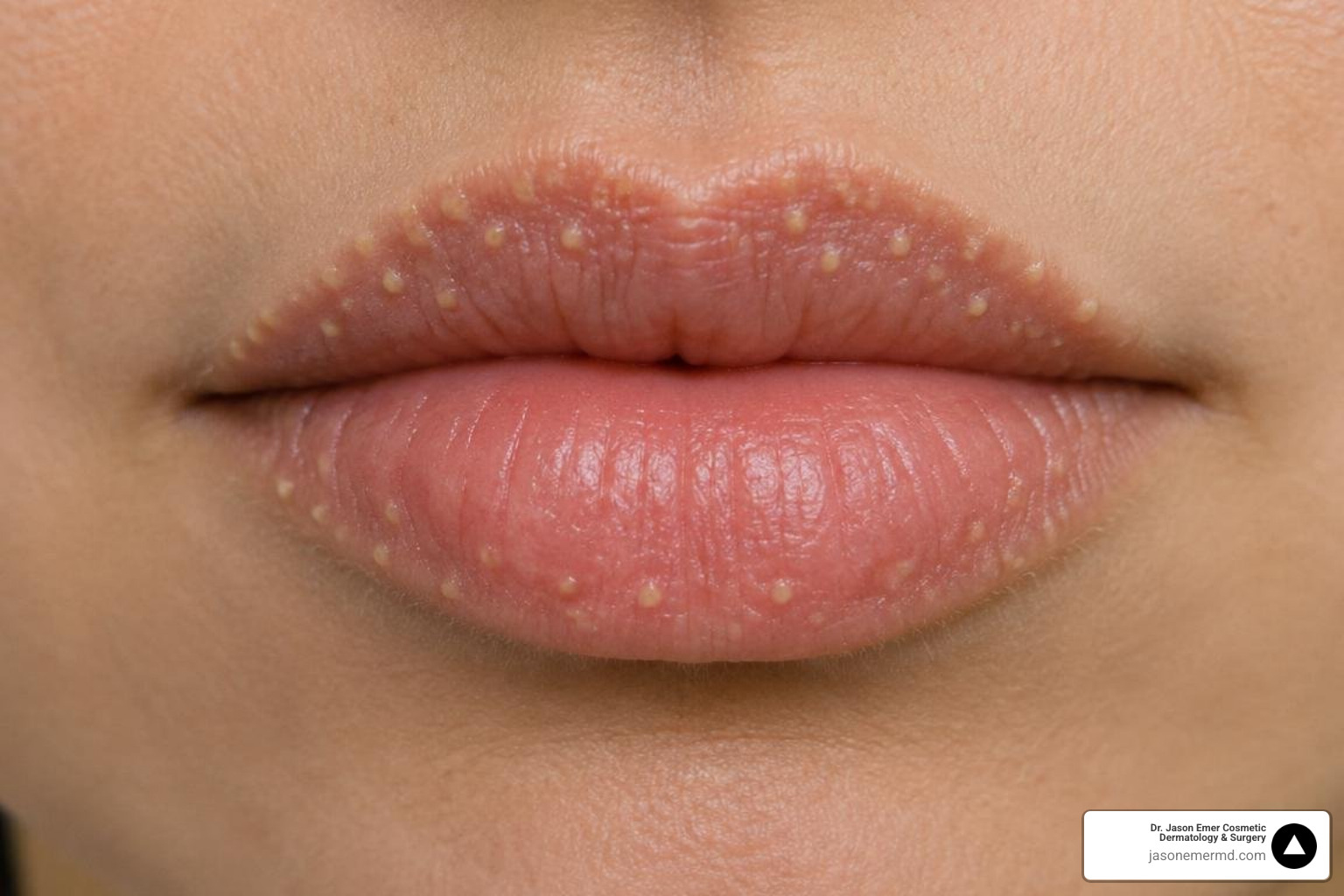
Accurate differentiation prevents unnecessary anxiety. Patients often mistake genital papules for sexually transmitted infections like human papillomavirus (HPV) or herpes simplex virus. Fordyce spots remain uniform and stable, unlike HPV lesions that exhibit irregular borders or herpes vesicles that erode.
| Feature | Fordyce Spots | Genital Warts (HPV) | Calcinosis / Other Papules |
|---|---|---|---|
| Etiology | Ectopic sebaceous glands | Viral infection (HPV) | Calcium deposits / Fibrous |
| Contagious | No | Yes | No |
| Surface | Smooth, uniform papules | Rough, cauliflower-like | Firm, hard nodules |
| Symptom Profile | Asymptomatic | Occasional itching/pain | Variable tenderness |
Dermatologists also differentiate these lesions from conditions requiring alternative therapies, such as calcinosis on the scrotum treatment or specialized pearly penile papules and Fordyce spot removal. Visual dermoscopy confirms characteristic gland architecture non-invasively, which spares patients an unnecessary biopsy in most cases.
Dermatological assessments and aesthetic procedures can support individualized management of Fordyce spots
Because Fordyce spots are harmless, observation without intervention is the primary clinical recommendation. Doing nothing at all remains a reasonable choice for many patients, since these glands carry no medical risk. For individuals seeking aesthetic reduction, specialized dermatological procedures can minimize glandular prominence, though each carries its own tradeoffs that are weighed during a consultation rather than decided in advance.
Ablative technologies such as CO2 laser resurfacing vaporize superficial gland components. Micro-punch excision physically extracts gland cores, while electrodessication desiccates target sebocytes.
Energy treatments require balancing cosmetic gains against recovery demands. Swelling, localized crusting, and redness require dedicated healing downtime, and this recovery period is treated as part of the plan rather than an afterthought. Skin phototype is critical; thermal modalities in darker skin types (Fitzpatrick IV–VI) carry a real risk of post-inflammatory hyperpigmentation (PIH) or hypopigmentation. For deeper complexions, Dr. Emer adjusts energy fluences, alters treatment sequencing, or integrates topical retinoids to protect the epidermal barrier. Candidacy and procedural staging are determined during private clinical evaluation, not assumed from a description alone.
Patients should avoid squeezing delicate mucosal tissue, which cannot clear deep architecture and risks infection or scarring. This limitation is one reason self-treatment is discouraged even when spots feel bothersome.
Medical literature reinforces that ectopic sebaceous structures are benign anatomical variants that can mimic viral lesions, a distinction detailed by Radhakrishnan S and Agarwal DC in "Fordyce spots masquerading as penile warts," published in the Medical Journal, Armed Forces India, 2016.
Frequently asked questions about Fordyce spots
What causes Fordyce spots to appear more prominent over time?
Gland visibility increases through natural skin thinning, skin stretching, and androgenic hormonal shifts that stimulate sebum accumulation.
Are Fordyce spots contagious or sexually transmitted?
No. Fordyce spots are non-infectious anatomical structures that cannot be transmitted through sexual contact or physical touch.
Do Fordyce spots require medical treatment?
No. Intervention is entirely voluntary and cosmetic, as the spots pose no medical risk.
Patients seeking clarification regarding unusual mucosal bumps can schedule an individualized evaluation with Dr. Jason Emer to discuss whether any of these options fit their situation.
What to remember
- Fordyce spots are benign, non-contagious ectopic sebaceous glands present in up to 80% of adults.
- Hormonal surges during puberty stimulate oil production, making these pre-existing structures visible on mucosal and genital skin.
- While medical intervention is unnecessary, aesthetic reduction options like laser ablation require tailored clinical evaluation to prevent scarring and pigmentary changes.
This content is for general education and does not provide a diagnosis, determine candidacy, or replace a consultation with a licensed clinician.
What to remember
- Fordyce spots are benign, non-contagious ectopic sebaceous glands present in up to 80% of adults.
- Hormonal surges during puberty stimulate oil production, making these pre-existing structures visible on mucosal and genital skin.
- While medical intervention is unnecessary, aesthetic reduction options like laser ablation require tailored clinical evaluation to prevent scarring and pigmentary changes.
This content is for general education and does not provide a diagnosis, determine candidacy, or replace a consultation with a licensed clinician.
This resource provides general educational information. Treatment recommendations depend on your health, goals, and consultation with a qualified clinician.