
A GHK-Cu peptide injection protocol starts with clinical oversight, not a standard dose
Most online guides start with syringe units. In Dr. Emer's practice, it starts with the prescription, vial concentration, patient history, and an individualized monitoring plan.
A GHK-Cu peptide injection protocol should only be followed under clinician and pharmacy guidance. Published community schedules often describe subcutaneous doses in the 1 to 2 mg range over multi-week cycles. However, injectable GHK-Cu is not FDA-approved, and there is no universal dose or schedule suitable for every patient.
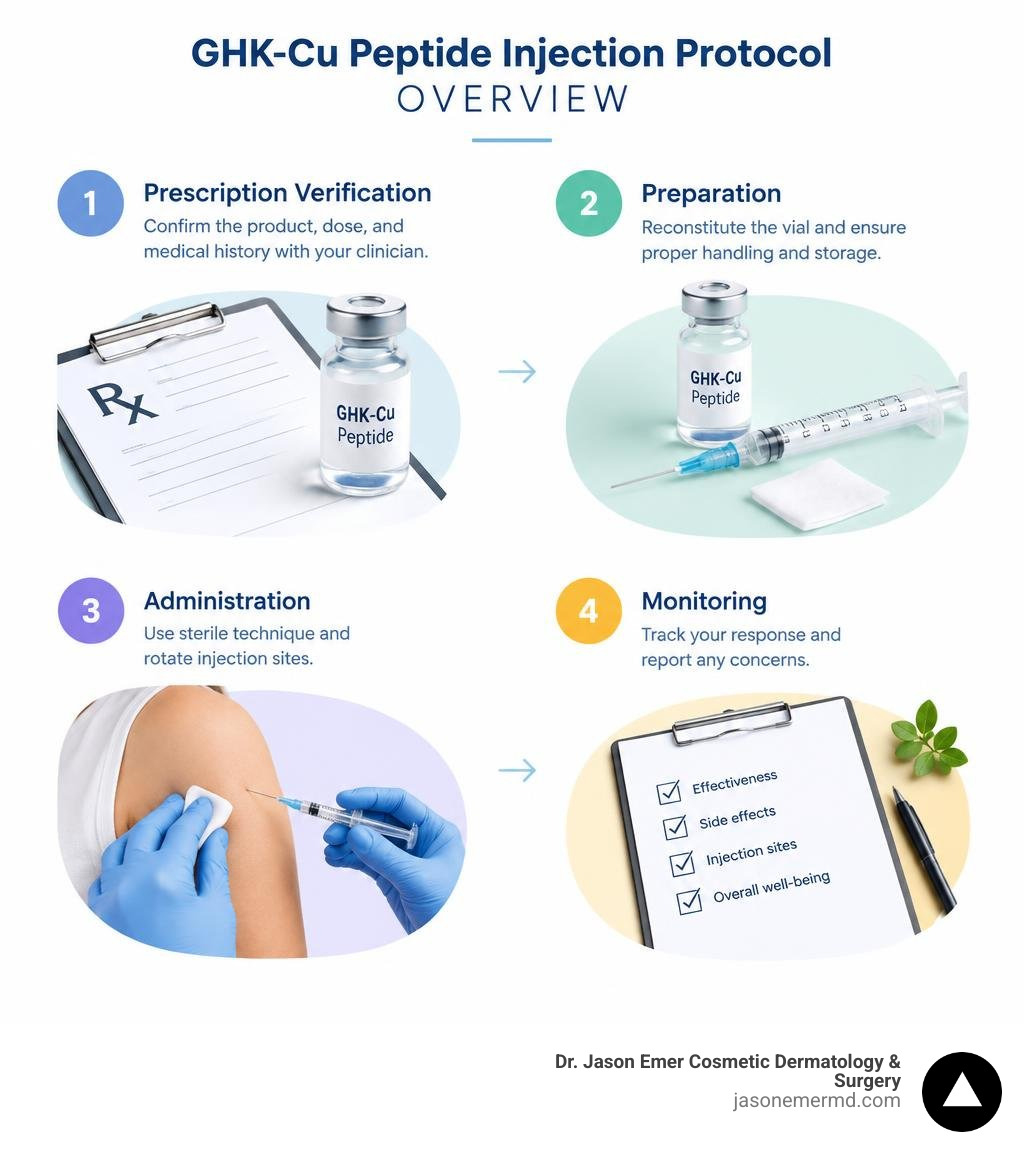
Before beginning an injection regimen, confirm:
- The peptide comes from a verified compounding pharmacy.
- The prescribed dose matches the vial concentration and reconstitution volume.
- A clinician has evaluated copper metabolism, current medications, health history, and injection-site risks.
- Sterile technique, site rotation, and proper storage are understood.
Topical formulations have more human skin-study data than systemic injections. Injectable protocols carry less controlled evidence and require close supervision. Scientific background on the tripeptide is detailed on the copper peptide entry on Wikipedia.
Dr. Jason Emer uses an individualized approach to regenerative care, prioritizing comprehensive evaluation and evidence-informed safety monitoring.
Learn more about copper peptide anti-aging, topical ghk-cu anti-aging serum, and ghk-cu anti-inflammatory mechanisms.
Individualized biological assessment guides GHK-Cu cycle design and cellular signaling
Naturally occurring GHK-Cu declines significantly with age. Young adults exhibit plasma concentrations near 200 ng/mL, whereas levels fall to approximately 80 ng/mL by age 60. This tripeptide delivers copper ions to support enzymatic pathways, including lysyl oxidase for extracellular matrix synthesis and matrix metalloproteinase modulation.

A structured protocol relies on clinical assessment rather than arbitrary schedules. Patient health, skin quality, and aesthetic goals guide suitability.
| Protocol Phase | Clinical Focus | Monitoring Parameters |
|---|---|---|
| Initial Assessment | Baseline lab review, contraindication screening | Serum copper, ceruloplasmin, liver panels |
| Active Cycle | Controlled administration, tissue remodeling | Injection tolerability, systemic response |
| Rest Interval | Cellular recovery, mineral balance review | Sustained tissue response, laboratory follow-up |
Loading and maintenance phases in a GHK-Cu peptide injection protocol
Rather than applying rigid escalations, Dr. Emer evaluates individual tolerance before adjusting any regimen. In clinical practice, modifications depend on patient response, tissue tolerance, and the underlying biology of youthful skin.
A clinician-directed rest interval may help manage ongoing use
Continuous administration is rarely advised. A standard 30-day off-cycle allows the body to process mineral exposure and supports cellular responsiveness. Understanding what to expect before and after peptide therapy clarifies realistic renewal timelines.
Sterile handling and precise reconstitution protect patient safety during administration
Lyophilized peptide vials require strict aseptic reconstitution using bacteriostatic water. Sanitizing the vial stopper with isopropyl alcohol and introducing diluent gently down the glass wall preserves delicate peptide structures. Reconstituted vials must remain refrigerated at 2°C to 8°C, protected from light, and used within 28 to 30 days.

Preparation and administration steps for a GHK-Cu peptide injection protocol
Subcutaneous injections are administered into fatty tissue of the lower abdomen, outer thigh, or posterior arm using a fine-gauge syringe. Daily site rotation minimizes localized irritation. Evening administration aligns with nocturnal cellular repair.
Calculating precise insulin syringe units from reconstituted vials
Syringe draw units depend directly on vial mass and diluent volume. Because compounding concentrations vary, patients must follow exact clinician instructions rather than online conversion charts.
Clinical considerations combine complementary peptide therapies with standard safety monitoring
Advanced protocols in regenerative medicine often incorporate targeted peptide therapy protocols alongside aesthetic procedures. Dr. Emer frequently coordinates systemic support with in-office interventions to optimize recovery.
Synergistic tissue recovery stacks and aesthetic procedure integration
Injectable protocols may be paired with BPC-157 combinations to support soft-tissue repair. When combined with energy devices or clinical microneedling, treatment staging requires care. Darker skin types carry a risk of post-inflammatory hyperpigmentation from aggressive energy treatments, so Dr. Emer adjusts device settings, prepares the skin barrier, and sequences procedures to protect pigment stability.
Navigating potential adverse reactions and regulatory status
Side effects may include transient injection-site erythema, mild bruising, or temporary skin dullness. Contraindications include pregnancy, active malignancy, and copper metabolism disorders such as Wilson's disease. Topical skincare and procedural alternatives remain valid, lower-risk options.
Frequently asked questions address practical issues in GHK-Cu therapy
What should be done if a scheduled daily injection is missed?
Resume the regular schedule the next day. Never double the dose to compensate.
Why might a clinician adjust the protocol during a cycle?
Adjustments address individual tolerability, localized reactions, or healing milestones.
What is the primary difference between injectable and topical copper peptide results?
Injectable GHK-Cu offers systemic bioavailability across connective tissues, while topical formulations deliver targeted epidermal benefits backed by research on copper peptides and tissue repair.
A clinician-guided approach keeps peptide administration evidence-informed and individualized
Safe peptide therapy requires professional diagnosis, verified compounding sources, and tailored cycling. Consultation with Dr. Jason Emer provides the medical framework for regenerative care decisions.
What to remember
- Injectable GHK-Cu requires clinical supervision, individualized dosing, and sterile handling rather than generic online schedules.
- Structured cycling with rest periods supports cellular signaling while allowing safe processing of mineral exposure.
- Combining peptide therapy with aesthetic procedures requires careful staging, especially for darker skin tones prone to post-inflammatory hyperpigmentation.
This content is for general education and does not provide a diagnosis, determine candidacy, or replace a consultation with a licensed clinician.
This resource provides general educational information. Treatment recommendations depend on your health, goals, and consultation with a qualified clinician.