What Is GHK-Cu and How Carrier Peptides Rejuvenate Dermal Architecture
GHK-Cu copper peptides support anti-aging by delivering bioavailable copper to the dermal microenvironment, where it helps stimulate collagen and elastin synthesis, strengthen antioxidant defenses, and guide extracellular matrix remodeling. This makes Copper Tripeptide-1 especially valuable for skin that is thinning, photoaged, irritated, or recovering from controlled micro-injury. Unlike simple hydrators that mainly improve surface moisture, carrier peptides like GHK-Cu help activate fibroblasts and support the enzymatic cross-linking processes that give skin firmness, elasticity, and resilience.
Human skin relies on a sophisticated internal communication network to repair environmental damage and maintain structural integrity. At the center of this network is GHK (glycyl-L-histidyl-L-lysine), a naturally occurring tripeptide composed of the amino acids glycine, L-histidine, and L-lysine. First isolated in 1973, GHK possesses a uniquely high affinity for copper(II) ions, spontaneously binding with them to form the bioactive complex known as GHK-Cu (or Copper Tripeptide-1). Its regenerative and protective actions have also been reviewed in the broader biomedical literature on GHK-Cu peptide biology.
In biological tissues, GHK is cleaved from its parent matricellular protein, SPARC (secreted protein acidic and rich in cysteine), during extracellular matrix degradation. When tissue experiences micro-injury or UV stress, GHK is liberated to scavenge free copper ions and direct cellular rebuilding. However, because systemic plasma levels drop by roughly 60% between youth and older adulthood (plummeting from 200 ng/ml at age 20 to approximately 80 ng/ml by age 60), the body's natural signaling capacity diminishes over time.
Topical replenishment helps bridge this physiological deficit. When applied to the skin, carrier peptides like GHK-Cu deliver vital copper micronutrients directly to the dermal microenvironment where fibroblasts reside, activating structural restoration pathways.
| Feature / Metric | GHK-Cu Copper Peptides | Retinoids (Tretinoin/Retinol) | Hyaluronic Acid |
|---|---|---|---|
| Primary Mechanism | Delivers copper cofactor; stimulates collagen, elastin, and antioxidant enzymes | Accelerates epidermal cell turnover; upregulates gene transcription | Binds water in the extracellular matrix (humectant) |
| Barrier Impact | Strengthens and calms; promotes lipid and protein repair | Can disrupt stratum corneum initially; potential peeling/dryness | Hydrates surface layers; non-irritating |
| Collagen Synthesis | Enhances collagen I, III, and IV via growth factor signaling | Direct stimulation via retinoic acid nuclear receptors | Indirect support via dermal hydration and turgor |
| Antioxidant Action | High (quenches hydroxyl/peroxyl radicals; boosts SOD) | Minimal direct antioxidant action (cellular renewal focus) | Mild indirect protection via barrier hydration |
| Skin Tolerance | High; suitable for sensitive, reactive, and post-procedure skin | Low-to-moderate; requires gradual acclimation and buffering | Universal; well-tolerated by all skin types |
GHK-Cu vs Signal Peptides and Enzyme Cofactors
In modern dermatology, we categorize topically applied peptides by their precise physiological function:
- Signal Peptides: Chains such as palmitoyl pentapeptide-4 or Matrixyl 3000 mimic fragments of broken collagen, signaling fibroblasts that structural damage has occurred and stimulating new protein synthesis.
- Carrier Peptides: Molecules like GHK-Cu perform a dual role. They deliver vital trace elements - specifically copper - directly into enzymatic cascades while simultaneously triggering regenerative cellular pathways.
- Neurotransmitter-Inhibiting Peptides: Molecules such as acetyl hexapeptide-8 (Argireline) subtly modulate neuromuscular transmission at the surface level to soften the tension behind dynamic expression lines.
Copper serves as an indispensable cofactor for lysyl oxidase, a copper-dependent enzyme responsible for cross-linking collagen and elastin fibers into a stable dermal matrix. Without adequate bioavailable copper, newly synthesized collagen strands lack structural strength and resilience. Advanced peptide therapy leverages these distinct biochemical roles by pairing carrier peptides with signal peptides to restore the structural foundation of aging skin.
Cellular Pathways in Copper Peptide Anti-Aging Action
At the cellular level, Copper Tripeptide-1 coordinates dermal regeneration through specific biological cascades:
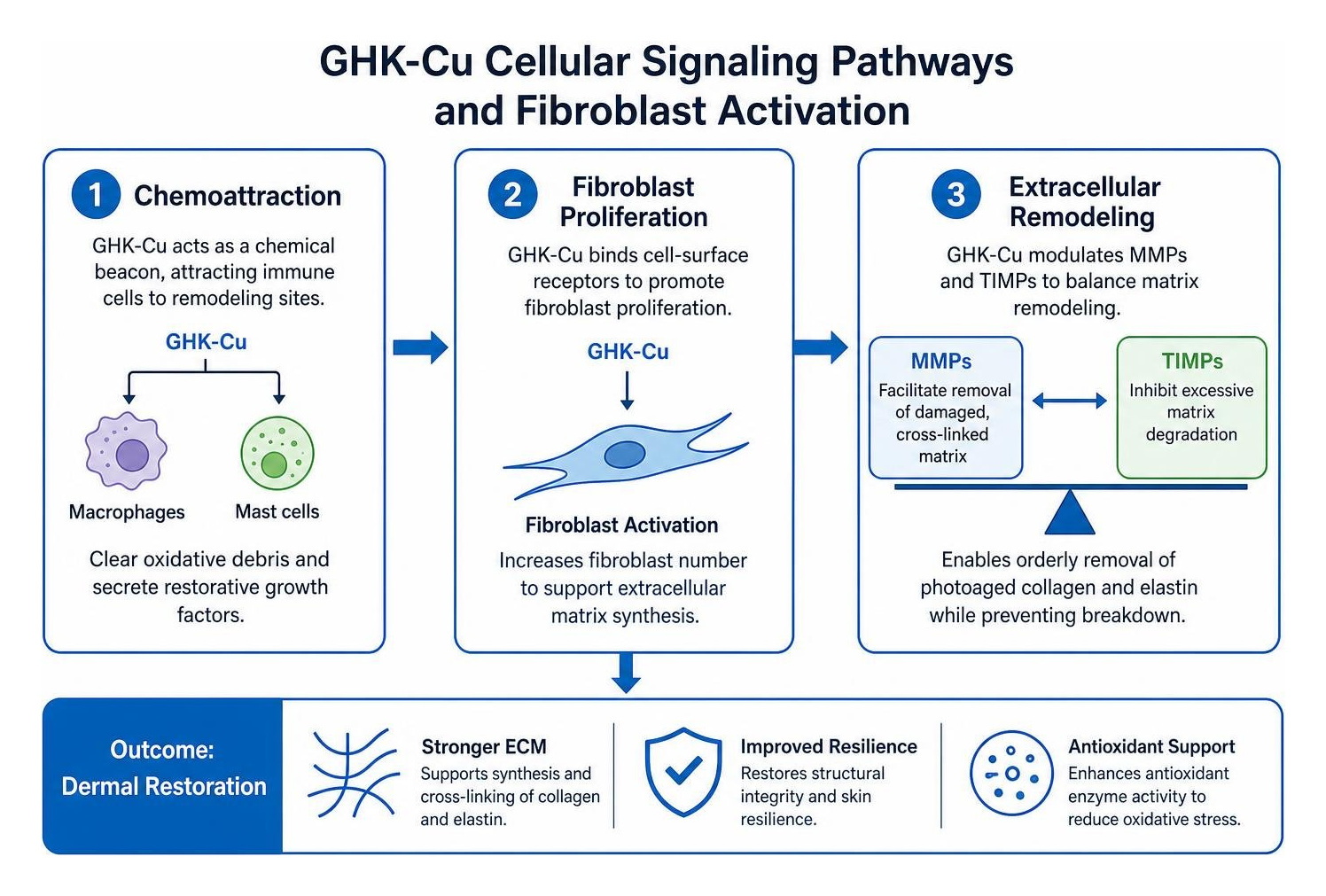
- Chemoattraction: GHK-Cu acts as a chemical beacon, attracting macrophages and mast cells to areas undergoing remodeling. These cells clear damaged oxidative debris and secrete restorative growth factors.
- Fibroblast Proliferation: The peptide complex interacts directly with cell-surface receptors to promote fibroblast proliferation, ensuring that the primary cells responsible for extracellular matrix synthesis remain active.
- Extracellular Remodeling: In laboratory investigations, GHK-Cu modulates both matrix metalloproteinases (MMPs) and their inhibitors (TIMPs). This balance prevents uncontrolled breakdown while facilitating the orderly removal of cross-linked, photoaged elastin and collagen fibers.
The Science of Copper Peptide Anti-Aging Mechanisms
The clinical interest surrounding GHK-Cu is rooted in extensive in vitro, preclinical, and human clinical evaluations. Rather than relying on simple surface hydration, copper peptides alter the expression of key cellular regulators involved in vascular support, oxidative protection, and structural rebuilding.
Extracellular Matrix Remodeling and Fibroblast Activation
In cell culture studies, irradiated and photoaged human dermal fibroblasts treated with GHK-Cu at nanomolar concentrations (as low as 1 nM) demonstrated significant increases in the expression of basic fibroblast growth factor (bFGF) and vascular endothelial growth factor (VEGF).
This upregulation stimulates angiogenesis—the formation of healthy new micro-capillaries—ensuring that regenerating tissue receives an adequate supply of oxygen and essential nutrients. Concurrently, GHK-Cu triggers the synthesis of large structural macromolecules, including:
- Type I and Type III Procollagen: Restoring dermal tensile strength and structural support.
- Tropoelastin: Providing skin with mechanical bounce and recoil.
- Glycosaminoglycans (GAGs): Expanding the dermal ground substance to attract water from within and create natural fullness.
For patients seeking comprehensive structural firming, combining topical carrier peptides with in-office collagen stimulators produces synergistic, multi-depth tissue renewal.
Antioxidant Defense and Free Radical Neutralization
Beyond matrix remodeling, GHK-Cu acts as a potent endogenous antioxidant. Electron spin resonance (ESR) spectroscopy reveals that GHK functions as an efficient quencher of both hydroxyl and peroxyl free radicals, demonstrating a quenching capacity for hydroxyl radicals that exceeds that of glutathione (GSH).
In cellular models, 10 µM GHK reduces tert-butyl hydroperoxide-induced reactive oxygen species (ROS) levels in intestinal epithelial cells by nearly 50%. Pretreatment of RAW 264.7 macrophage cells with GHK-Cu significantly reduces ROS induced by bacterial lipopolysaccharides (LPS).
It accomplishes this by:
- Increasing levels of endogenous superoxide dismutase (SOD) activity.
- Preserving total cellular glutathione (GSH) pools.
- Suppressing NF-κB p65 and p38 MAPK inflammatory cascades, which directly downregulates inflammatory cytokines such as TNF-α and IL-6.
By neutralizing cytotoxic lipid peroxidation byproducts (such as acrolein and 4-hydroxynonenal), copper peptides protect cellular membranes and DNA from ultraviolet radiation and environmental pollution.
Systemic Longevity and Neuroprotective Potential
The biological activity of GHK-Cu extends beyond cosmetic dermatology into systemic anti-aging and regenerative research. Animal models demonstrate that parenteral administration of GHK allows the peptide to cross the blood-brain barrier.
In a landmark study, 28-month-old male C57BL/6 mice treated with GHK at a dose of 10 mg/kg body weight five times weekly for three weeks demonstrated improved spatial learning and memory in maze trials compared to saline-treated controls. Researchers attributed this recovery to reduced neuroinflammation and the epigenetic modulation of histone deacetylase 2 (HDAC2).
These systemic tissue-remodeling and neuroprotective pathways underscore why advanced hormone & peptide therapy continues to gain traction in modern longevity medicine.
Protocol Layering and Clinical Ingredient Synergy
Because peptides are water-soluble molecules with delicate chemical bonds, their transdermal absorption depends heavily on formulation chemistry and application sequence. Achieving optimal outcomes requires maintaining product stability, respecting pH parameters, and avoiding chemical conflicts that could break the copper bond.
Integrating Copper Peptide Anti-Aging Serums into Daily Routines
To ensure complete penetration, water-based copper peptide serums should be applied directly to clean skin during the "Treat" phase of your regimen, prior to heavier emulsions, lipid-rich creams, or occlusives.
Key actives that pair synergistically with GHK-Cu include:
- Multi-Weight Hyaluronic Acid: Hydrates the stratum corneum and facilitates transdermal peptide movement.
- Polyglutamic Acid: Forms a breathable film over the surface to prevent transepidermal water loss (TEWL).
- Niacinamide (Vitamin B3): Enhances lipid synthesis and calms redness without destabilizing peptide structures at ambient temperatures.
- Ectoin and Allantoin: Soothe sensitive skin and support barrier integrity.
- Complementary Peptides: Matrixyl 3000, Matrixyl synthe'6, and Argireline work via alternative pathways to smooth expression lines.
Incorporating these targeted topicals alongside customized clinical skin care treatments ensures both superficial barrier health and deep dermal structural resilience.
Balancing Vitamin C, Retinoids, and Direct Acids
The copper(II) ion within the GHK-Cu complex is held in place by coordination bonds. Certain active ingredients can disrupt these bonds or cause irritation if applied simultaneously:
- L-Ascorbic Acid (Pure Vitamin C): Traditional L-ascorbic acid formulas are strong reducing agents operating at a low, highly acidic pH (typically below 3.5). When applied simultaneously with copper peptides, ascorbic acid can reduce copper(II) to copper(I), breaking the peptide bond, degrading both actives, and causing skin sensitization. Solution: Use L-ascorbic acid in your morning routine and copper peptides in the evening, or select non-acidic, lipid-soluble vitamin C derivatives (such as Tetrahexyldecyl Ascorbate or 3-O-Ethyl Ascorbic Acid) and allow them to dry completely before layering.
- Direct Hydroxy Acids (AHAs and BHAs): Low-pH chemical exfoliants (glycolic, lactic, and salicylic acids) can hydrolyze peptide bonds. Solution: Alternate nights, reserving exfoliating acids for dedicated treatment evenings.
- Retinoids (Retinol, Retinal, Tretinoin): While both actives promote skin firming, layering them simultaneously may cause irritation in sensitive complexions. Solution: For resilient skin, apply your copper peptide serum first as a hydrating buffer, allow it to dry for 5 to 10 minutes, and then follow with your retinoid. If your skin is easily sensitized, alternate them on separate evenings.
Candidate Selection, Safety, and Clinical Integration
Understanding how to select candidates and integrate products into wider treatment plans helps ensure optimal results while minimizing adverse reactions.
Ideal Candidates and Barrier Recovery Indications
Topical GHK-Cu is exceptionally versatile and well-tolerated by most skin types, including sensitive and reactive complexions.
It is particularly indicated for:
- Compromised Skin Barriers: Individuals recovering from over-exfoliation or harsh environmental exposure benefit from GHK-Cu’s anti-inflammatory and barrier-repair properties.
- Retinoid-Intolerant Patients: Those experiencing persistent erythema, peeling, or dermatitis from prescription retinoids can utilize copper peptides as a non-irritating collagen-support alternative.
- Mature and Thinning Skin: Patients in their 40s, 50s, 60s, and beyond who require enzymatic support for collagen cross-linking, hydration, and dermal density.
Safety Note: Although genuine adverse events are rare, patients should always perform a 24-hour forearm patch test before initiating full-face application. Additionally, individuals diagnosed with Wilson's disease or known systemic copper metabolic disorders should consult their physician before using concentrated copper-based formulations.
Synergistic In-Office Rejuvenation and Regenerative Procedures
In clinical dermatology, topical homecare yields the best outcomes when paired with evidence-based in-office procedures. Because GHK-Cu accelerates micro-wound healing and downregulates pro-inflammatory cytokines, it serves as an excellent adjunct to procedural treatments.
Through principles of regenerative medicine, we frequently utilize peptide serums alongside:
- Microneedling and Radiofrequency (RF) Microneedling: Applying stabilized GHK-Cu formulations directly through open micro-channels enhances peptide penetration down to the papillary dermis while shortening post-treatment recovery times.
- Non-Ablative and Fractional Laser Resurfacing: Post-procedural copper peptide applications help calm thermal erythema, prevent excessive matrix metalloproteinase spikes, and accelerate re-epithelialization.
- Platelet-Rich Plasma (PRP) Therapy: Combining autologous platelet growth factors with bioactive carrier peptides maximizes fibroblast signaling and structural extracellular remodeling.
Frequently Asked Questions About GHK-Cu
How quickly do copper peptides deliver visible anti-aging results?
Skin improvements with copper peptides occur across distinct physiological phases:
- Days 1 to 7: Immediate improvements in surface hydration and skin comfort due to humectant bases and reduced transepidermal water loss.
- Weeks 2 to 4: Calming of facial redness, refined surface texture, and improved barrier resilience.
- Weeks 6 to 12: Measurable improvements in skin elasticity, dermal density, and the softening of fine lines as newly cross-linked collagen and elastin fibers integrate into the extracellular matrix.
Can copper peptides replace retinoids in a skincare regimen?
Copper peptides are not an exact functional equivalent to retinoids, but they represent a powerful complementary or alternative approach. Retinoids work primarily by binding to retinoic acid nuclear receptors to dramatically accelerate epidermal cellular turnover and gene expression.
Copper peptides, by contrast, focus on tissue remodeling, antioxidant protection, enzymatic cross-linking, and barrier support without causing peeling, photosensitivity, or stratum corneum disruption. For patients who cannot tolerate retinoid dermatitis, GHK-Cu provides an effective structural firming alternative. For those who tolerate retinoids well, using both on alternating schedules delivers comprehensive anti-aging benefits.
Why are authentic copper peptide serums naturally blue?
The vivid blue hue of an authentic copper peptide serum is an intrinsic chemical property of the GHK-Cu complex itself. When the divalent copper ion ($Cu^{2+}$) binds with the three amino acids of the glycyl-L-histidyl-L-lysine tripeptide, its electronic orbital configuration changes, absorbing light in the red-yellow spectrum and reflecting a characteristic blue color. High-quality clinical formulations containing 1% pure GHK-Cu do not rely on synthetic dyes or colorants—their blue appearance is direct proof of active chelated copper.
Conclusion
Aging skin is characterized by a gradual breakdown of structural proteins, slower cellular repair, and a steady decline in endogenous signaling peptides like GHK. By replenishing this vital carrier peptide topically, you provide your skin with both the cellular instructions and the enzymatic minerals needed to rebuild the extracellular matrix, neutralize oxidative stress, and restore dermal firmness.
Whether you are seeking to repair a compromised barrier, soften early expression lines, or maintain long-term skin resilience, copper peptides represent one of the most scientifically validated tools in modern cosmetic science. To learn more about integrating pure GHK-Cu into an advanced, personalized rejuvenation plan, schedule a comprehensive consultation with our team at Dr. Jason Emer Cosmetic Dermatology & Surgery.
This resource provides general educational information. Treatment recommendations depend on your health, goals, and consultation with a qualified clinician.