How to Mix GHK-Cu Peptide Injections Safely
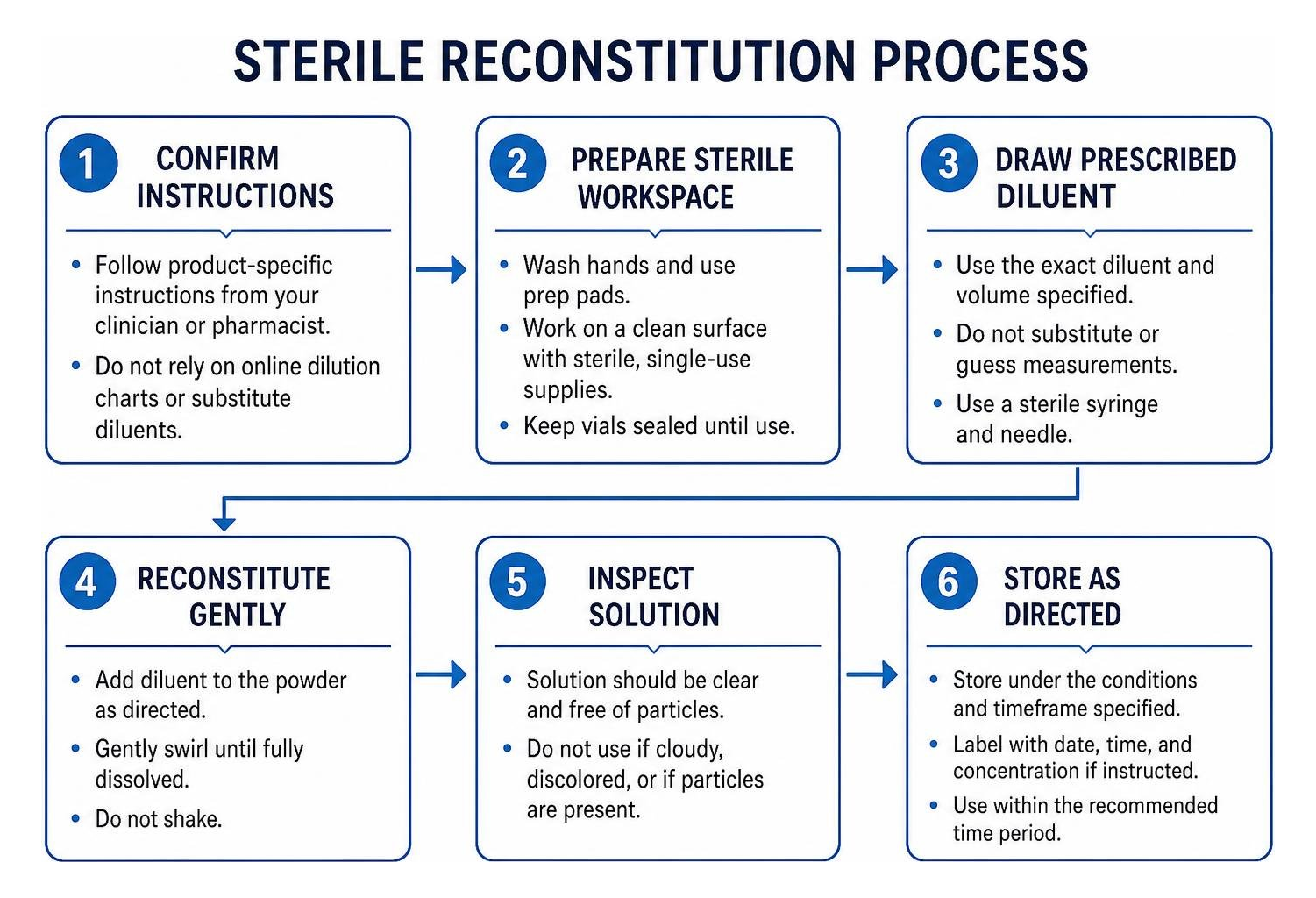
Most people assume mixing an injectable peptide is as simple as adding fluid to a vial. It is not. Reconstitution follows strict sterile compounding principles and precise stability rules, and the better clinical model starts with the prescription itself rather than a generic recipe. The correct diluent, concentration, and handling steps depend entirely on the specific formulation prescribed. Before preparing any injectable peptide, individuals must obtain direct instructions from the prescribing physician or licensed compounding pharmacy. Unofficial online charts or substituted fluids can degrade the peptide, alter concentrations, or introduce contamination.
This guide outlines clinical considerations around sterile handling, hygiene, and storage for how to mix GHK-Cu peptide injection solutions properly. It provides educational context rather than a substitute for direct medical supervision, and it explains why the steps matter clinically rather than simply listing them.
Jason Emer, MD, FAAD, is a board-certified dermatologist with more than 19 years of experience in cosmetic dermatology and cellular skin health. In his practice, peptide therapies are evaluated as part of individualized rejuvenation plans where clinical consistency is paramount, and candidacy for any such approach is determined only through direct evaluation.
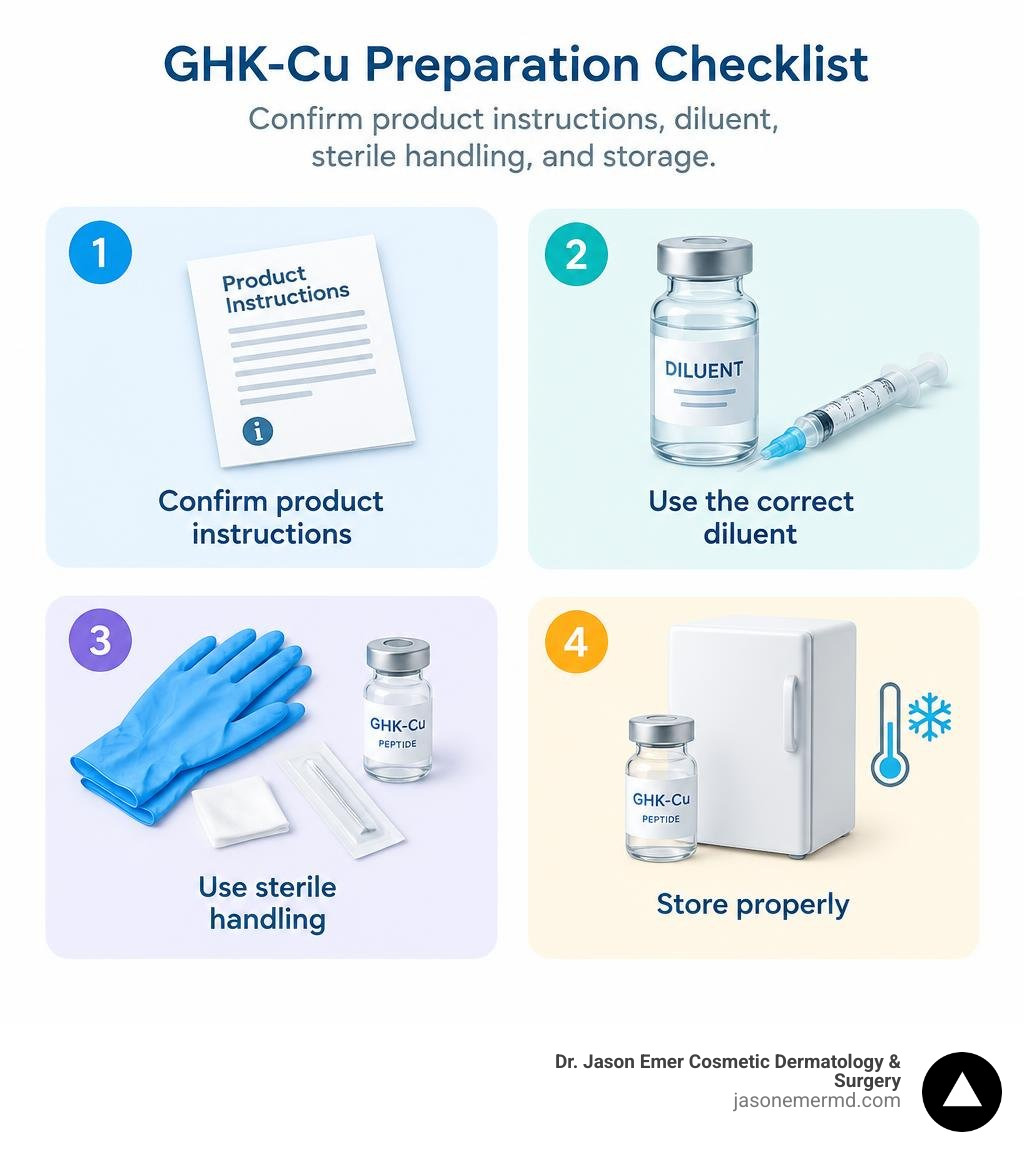
How to mix GHK-Cu peptide injections safely requires product-specific clinical instructions.
Reconstituting lyophilized peptides is a precise medical task. Injectable peptides are delicate biological complexes made of amino acid sequences bound to mineral ions. Reconstituting without explicit pharmacy instructions creates hazards: microbial contamination, incorrect dosing, and loss of potency. Each of these risks is a real limitation of at-home preparation, which is why the pharmacy's written instructions, not general guidance, should govern every step.
Preparation supplies and sterile handling should follow the product instructions
Sterile technique is essential. The workspace must be disinfected and clean. Hands must be washed thoroughly before touching any sterile component.
Every vial top should be wiped with a fresh 70% isopropyl alcohol pad and allowed to air-dry completely. When integrating copper peptides and tissue repair protocols into a regimen, all syringes and needles must be sterile, single-use items. Used sharps must go directly into an FDA-cleared sharps container.
The prescribed diluent and concentration should not be substituted or calculated independently
Each peptide preparation has specific solubility requirements. Substituting diluents can alter pH and destabilize the bond between the GHK tripeptide and the copper ion, causing oxidative breakdown. The United States Pharmacopeia provides general standards, but individual prescriptions carry unique requirements. Understanding the biology of youthful skin reinforces why molecular stability matters. Diluent should be introduced gently down the interior vial wall, never sprayed directly onto the powder, and the vial should be rolled gently between the palms rather than shaken. Patience during this step matters more than speed; rushing the process is one of the more common ways potency is lost before the first injection is ever drawn up.
Administration and storage should follow the prescribing clinician's directions.
Injection technique, delivery depth, volume, and storage requirements vary based on individualized medical evaluation and compounding specifications. None of these details are universal, and that is by design: a protocol that works for one formulation may be inappropriate for another.

Injection technique and site selection require individualized instruction
Dr. Emer emphasizes that delivery precision matters as much as reconstitution accuracy. Subcutaneous administration requires careful anatomical selection and controlled pacing. Injecting too rapidly increases local tissue pressure, causing stinging; incorrect depth shifts absorption kinetics.
Every intervention carries tradeoffs. Localized redness, swelling, tenderness, or transient nodules can occur at injection sites, and some patients react to preservatives like benzyl alcohol. These are real limitations worth weighing honestly. For some patients, doing less, or pausing a regimen altogether, remains a reasonable choice, and any decision about whether to proceed, pause, or adjust should be made in consultation rather than independently.
For patients with darker skin types (Fitzpatrick IV through VI), post-inflammatory hyperpigmentation risk is heightened whenever procedural treatments accompany systemic care. Dr. Emer adjusts treatment sequencing and recovery timelines for these patients to protect the epidermal barrier, and healing time is treated as part of the plan rather than an afterthought.
Storage and beyond-use dates depend on the specific product
Reconstituted peptide solutions are sensitive to temperature and light. Vials typically require refrigeration between 2°C and 8°C (36°F to 46°F) on an interior shelf to prevent hydrolysis. Beyond-use dates set by the dispensing pharmacy reflect validated stability testing and must be followed strictly. Deviating from these windows, even by a small margin, can compromise both safety and effectiveness.
Common questions about GHK-Cu preparation should be answered by a clinician or pharmacist.
What color should reconstituted GHK-Cu be?
Properly reconstituted GHK-Cu typically appears light to deep blue, reflecting the coordination complex between copper and the peptide. However, visual appearance alone cannot confirm sterility or concentration. If a solution appears cloudy, discolored, or contains particulate matter, it should not be used, and the pharmacy or clinician should be contacted immediately.
Should bacteriostatic water or sterile water be used?
The correct diluent depends on whether the medication is a single-dose or multi-dose vial. Multi-dose vials often require bacteriostatic saline or water with benzyl alcohol to suppress microbial growth across punctures. Single-use vials may call for preservative-free sterile water. Substituting diluents without guidance can compromise safety or cause discomfort.
Can reconstituted GHK-Cu be stored in the freezer?
Freezing is generally discouraged unless specifically directed by the compounding pharmacy. Ice crystal formation can shear the peptide structure and disrupt copper bonds. Reconstituted vials should remain refrigerated within the specified temperature range.
What to remember
- Reconstitution technique, diluent selection, and dosing must strictly follow the individualized instructions from the prescribing clinician or compounding pharmacy.
- Sterile handling and consistent refrigeration protect peptide stability and reduce contamination risk.
- Treatment sequencing and candidacy for injectable peptides are decisions made individually in consultation with a qualified clinician.
To discuss cellular rejuvenation options and learn more about Dr. Emer's GHK-Cu treatments, a personalized consultation with Dr. Emer is the appropriate next step.
This content is for general education and does not provide a diagnosis, determine candidacy, or replace a consultation with a licensed clinician.
This resource provides general educational information. Treatment recommendations depend on your health, goals, and consultation with a qualified clinician.