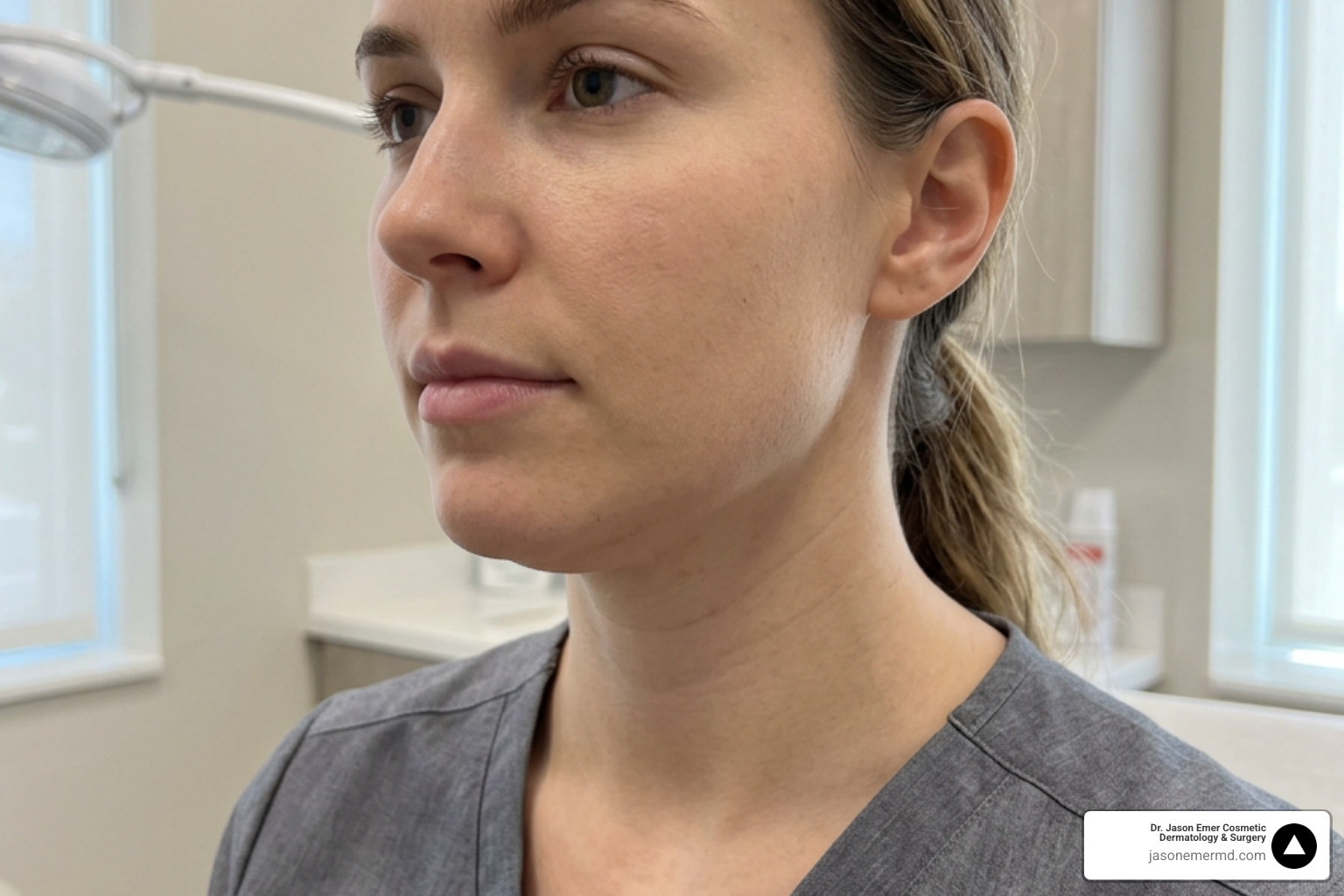
Understanding What Determines Lower Face Shape and Jaw Laxity
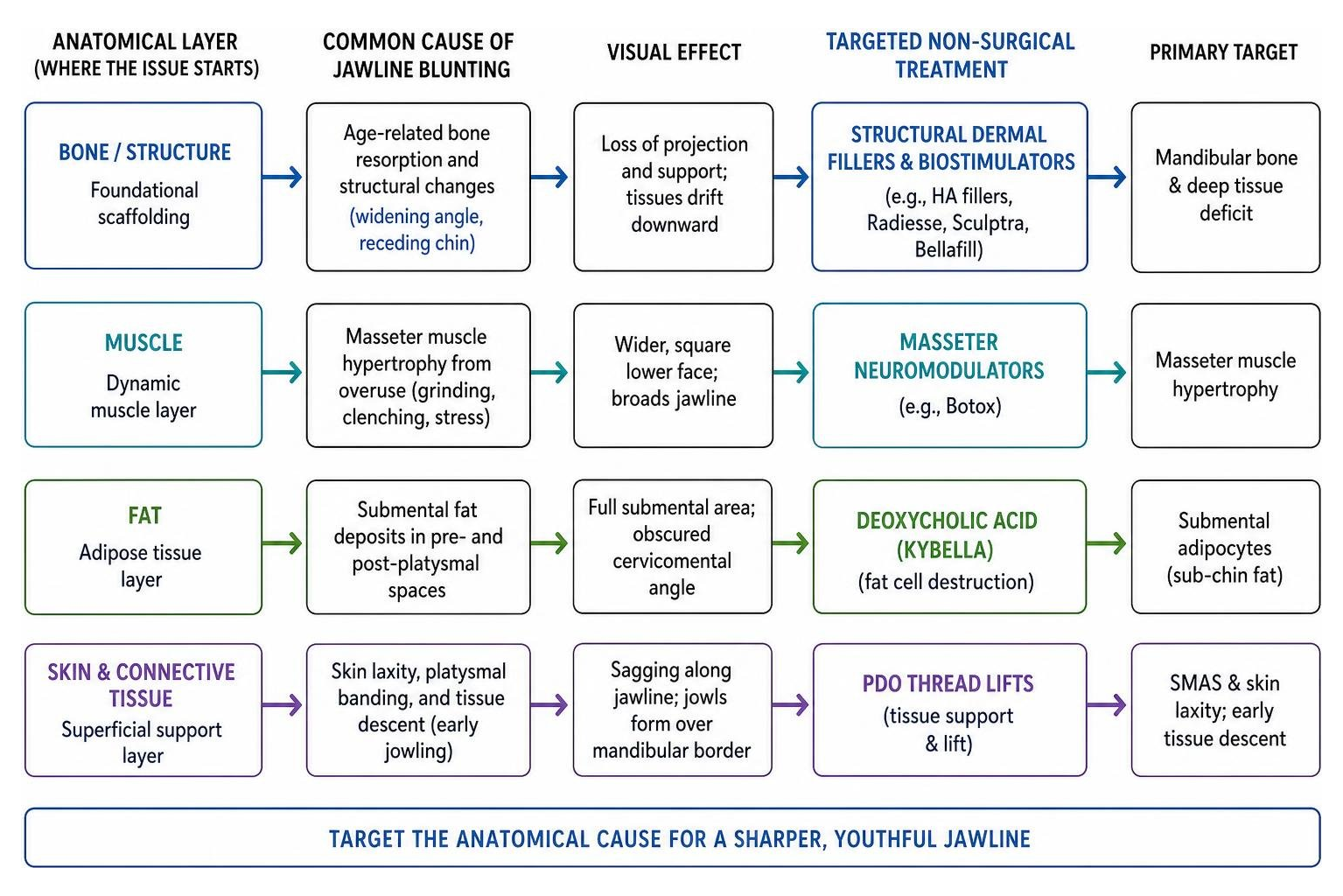
Non-surgical jawline contouring sharpens and defines the lower face by addressing structural volume loss, muscle bulk, localized fat, and skin laxity. Through targeted modalities—such as deep-plane structural dermal fillers to rebuild mandibular bone projection, masseter neuromodulators to slim a wide posterior jaw, deoxycholic acid (Kybella) to permanently destroy submental fat cells, and PDO thread lifts to mechanically elevate descended tissue—patients can achieve a crisp, sculpted jawline without incisions or extensive downtime.
The lower face is a dynamic, multi-layered architecture consisting of bone, deep fat compartments, active muscles, superficial fat, and the overlying skin envelope. When patients express frustration with a soft, blurred jawline, lower face definition is governed by how these structural layers interact across different life stages. A sharp contour requires crisp demarcation along the mandibular border, evaluated through the cervicomental angle. While DIY devices and aggressive chewing exercises claim to tone the lower face, repetitive chewing can enlarge the masseter muscles and broaden the jawline. True rejuvenation requires an anatomical approach.
Bone Resorption and Structural Mandibular Changes
Bone is the foundational scaffolding of the entire face. Starting as early as our late twenties, natural age-related bone resorption occurs across the facial skeleton, and the mandible (lower jawbone) is particularly vulnerable.
As the mandibular angle widens and the chin recedes, the skeletal framework providing tension to the lower face shrinks. Without adequate bone support, the overlying soft tissues drift downward and forward. This loss of skeletal projection creates an illusion of excess skin and prematurely softens the jaw angle. Treating this root cause demands structural restoration right along the periosteum (bone surface) rather than superficial fixes.
Soft Tissue Distribution and Muscular Volume
Directly atop the bone framework sits the muscular and adipose tissue layer, which profoundly influences lower face shape:
- Submental Fullness: Genetic predisposition or localized fat deposits in the pre-platysmal and post-platysmal spaces blur the transition between the chin and neck, obliterating the cervicomental angle.
- Masseter Muscle Hypertrophy: Overactive or enlarged chewing muscles (often exacerbated by chronic teeth grinding, clenching, or stress) widen the posterior jaw, turning an oval or tapered lower face into a heavy, boxy square.
- Platysmal Banding: The platysma muscle sheets in the neck exert a constant downward vector pull on the lower facial tissues, accelerating skin sagging.
- Jowl Formation: As midface fat pads descend and deep fat compartments atrophy, soft tissue pools directly over the mandibular border, creating noticeable jowling on either side of the chin.
The Best Jawline Non Surgical Procedures Ranked and Compared
No single treatment solves every jawline concern. In 2026, our clinical standard relies on selecting and combining targeted modalities that directly treat the underlying anatomical driver.
| Treatment Modality | Primary Anatomical Target | Ideal For | Typical Longevity | Social Downtime |
|---|---|---|---|---|
| Structural Dermal Fillers | Mandibular bone & deep tissue deficit | Weak chin, receding jaw angle, early jowls | 12–24 months | 1–3 days |
| Masseter Neuromodulators | Masseter muscle hypertrophy | Wide, square lower face, bruxism/clenching | 4–6 months (cumulative atrophy) | None |
| Deoxycholic Acid (Kybella) | Submental adipocytes (sub-chin fat) | Stubborn double chin, soft submental profile | Permanent (fat cell destruction) | 7–14 days (swelling) |
| PDO Thread Lifts | Superficial musculoaponeurotic system & skin | Mild skin laxity, early tissue descent along jaw | 12–18 months | 3–5 days |
Dermal Fillers and Biostimulators for Structural Projection
For patients with structural deficiencies, deep-plane dermal fillers offer immediate, chiseled definition. We do not use soft, highly spreadable fillers along the jawline. Instead, we utilize high G-prime, high-elasticity hyaluronic acid gels (such as Juvederm Volux or Restylane Lyft) and biostimulatory agents like Radiesse, Sculptra, and Bellafill.
By placing structural filler directly on the bone at the gonial angle and along the mandibular body, we recreate the crisp visual edge of the bone and camouflage early jowling. When performing full facial sculpting, augmenting the chin projection simultaneously tightens the submental skin hammock, dramatically sharpening the profile.
Masseter Neuromodulators for Lower Face Slimming
When the jawline appears overly square or heavy due to muscular bulk rather than bone or fat, neurotoxins like Botox, Dysport, or Xeomin provide transformative lower-face slimming. Injecting neuromodulators into the masseter muscles temporarily reduces their contractile strength, leading to targeted, progressive disuse atrophy over 4 to 6 weeks.
A clinical split-face trial published on The Efficacy Study of Facial Biomechanical A-Type Botox Injection in Reshaping the Jawline demonstrated that targeted biomechanical injection techniques significantly improved the Cervicomental Angle Severity (CAS) grade at 60 and 90 days (P < 0.001) with superior procedural comfort (P < 0.001) compared to standard diffuse microdroplets. Furthermore, repeated treatments yield cumulative, long-lasting muscle reduction, decreasing the frequency of maintenance sessions needed over time.
Submental Adipocyte Reduction via Deoxycholic Acid
Localized fat beneath the chin can hide even the most prominent jawbone. Kybella (synthetic deoxycholic acid) is an FDA-approved injectable that physically breaks down the cell membrane of targeted adipocytes. Once destroyed, these fat cells can no longer store lipids and are permanently cleared by the body's lymphatic system over several weeks.
Most patients require 2 to 4 treatment sessions spaced 4 to 6 weeks apart. Because the adipocyte lysis triggers an inflammatory healing cascade that tightens surrounding tissues, it delivers a sculpted, clean cervicomental angle that lasts indefinitely—as long as a stable body weight is maintained.
PDO Thread Lifts for Subdermal Repositioning
When the primary issue is mild to moderate tissue descent without significant volume loss, a threadlift utilizing polydioxanone (PDO) or Silhouette Instalift sutures provides mechanical repositioning.
Barbed PDO threads are inserted into the subdermal plane to physically grasp, lift, and anchor sagging skin and superficial fat backward toward the preauricular area. As the biocompatible sutures dissolve over 6 to 9 months, they stimulate robust neocollagenesis, leaving a scaffold of fresh, endogenous type I and type III collagen that preserves jawline tension for 12 to 18 months.
Tailoring Techniques: Gender Nuances and Multi-Modality Protocols
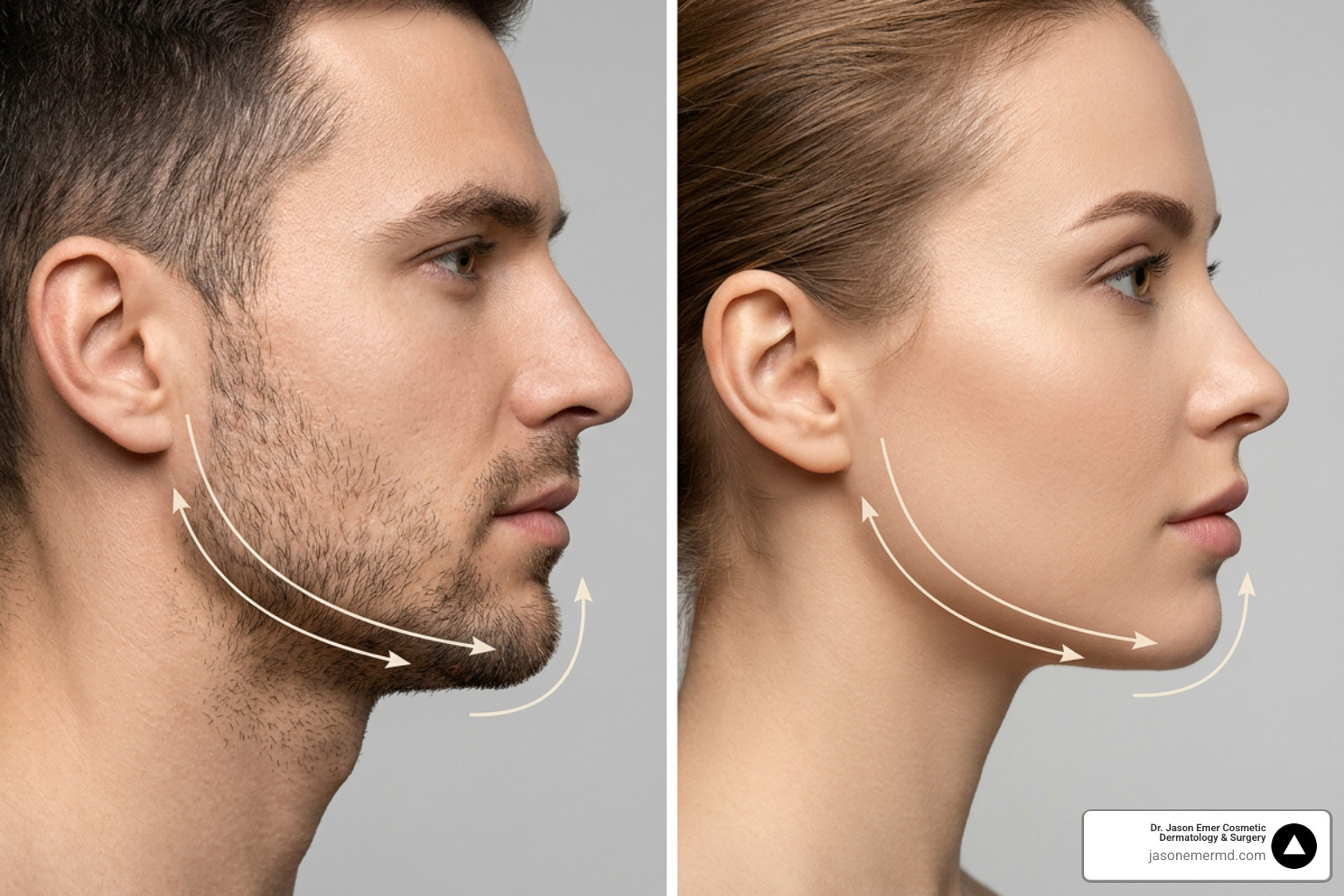
Achieving natural results requires moving away from cookie-cutter templates. A sculpted jawline on a male face requires completely different vectors, angles, and volumes than on a female face.
At our practice, comprehensive non-surgical jawline contouring combines multiple modalities in a single treatment plan:
- Masseter Botox + Chin Filler: Slims bulky lateral jaw angles while projecting the chin forward to convert a square face into an elegant oval or heart shape.
- Submental Kybella + Jawline Filler: Melts under-chin fat while laying down dense filler along the mandibular line to maximize contrast and shadow.
- PDO Threads + Biostimulatory Fillers: Mechanically repositions loose tissue while biostimulators like Radiesse or Sculptra thicken dermis and rebuild collagen.
Jawline Non Surgical Enhancements for Men vs. Women
Aesthetic goals differ significantly between male and female anatomy:
- For Men: Male facial sculpting focuses on creating a wide, prominent chin, a sharp 90-to-100-degree gonial angle, and a broad, straight mandibular border that projects lateral authority and strength.
- For Women: Female facial sculpting aims for a softer, more tapered aesthetic. The ideal female jawline features a gentle 120-to-130-degree gonial angle that slopes smoothly toward a refined, narrower chin apex, creating a youthful V-shape.
Non-Surgical vs. Surgical Lower Face Contouring
For patients comparing non-surgical options with invasive procedures like surgical genioplasty, neck lifts, or mandibular implants:
- Downtime: Non-surgical options require little to no time away from work (0–3 days for fillers, compared to 2–4 weeks of recovery for surgical interventions).
- Cost & Accessibility: Injectables provide accessible entry points ($700–$2,500 per session) without general anesthesia, surgical facility fees, or permanent scarring.
- Reversibility: Hyaluronic acid fillers can be completely reversed in minutes using hyaluronidase if adjustments are ever desired.
- Outcome Assessment: Reviewing clinical transformations in a before and after non-surgical facelift gallery helps establish realistic expectations regarding what injectables can achieve versus surgical tissue excision.
Clinical Safety, Vascular Considerations, and Treatment Longevity
While non-surgical contouring avoids surgical incisions, the lower face contains critical anatomical structures that require advanced injector expertise.
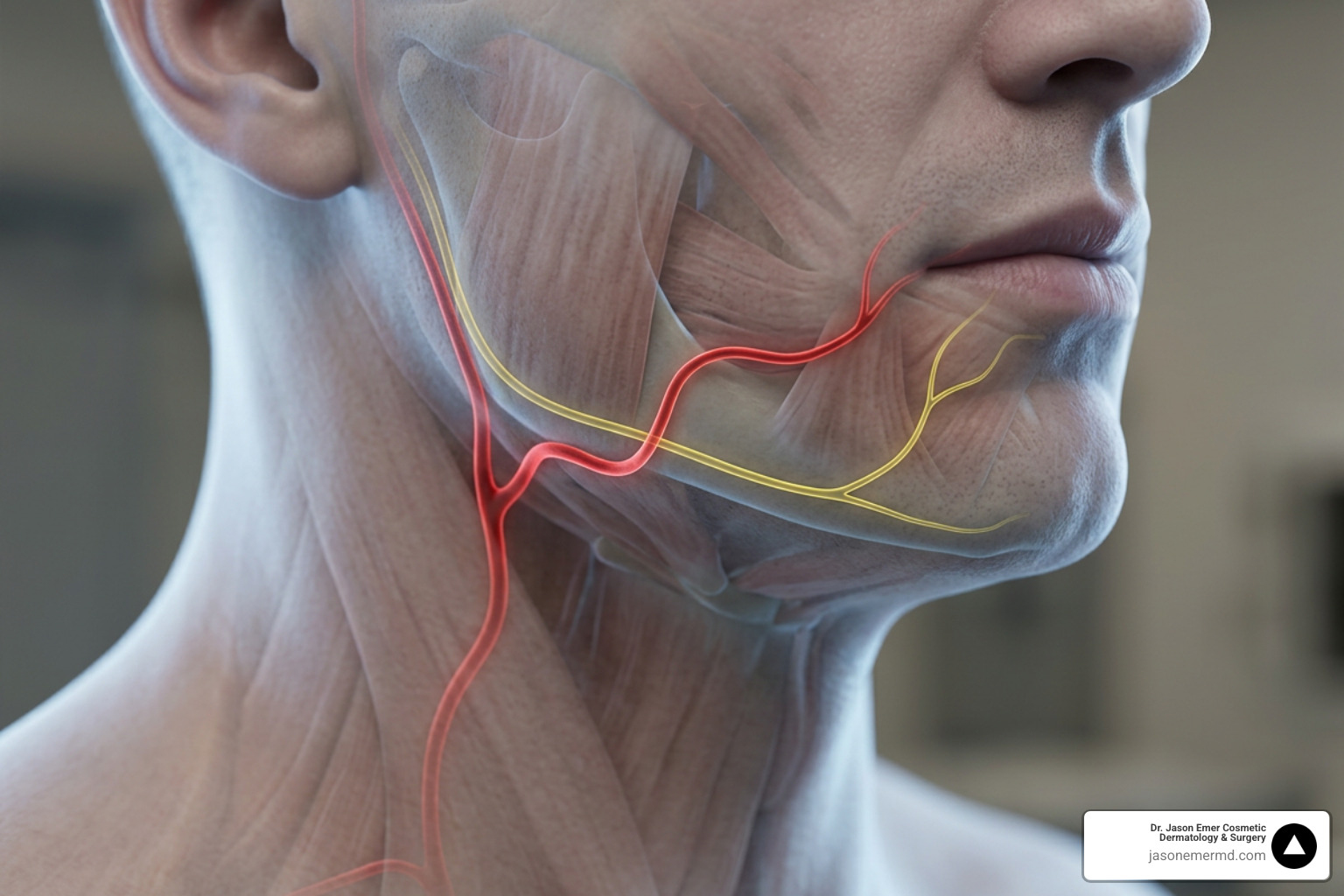
The facial artery and facial vein cross directly over the inferior border of the mandible just anterior to the masseter muscle. Inexperienced injectors risk inadvertent intravascular injection, which can cause vascular occlusion and skin necrosis. Similarly, the marginal mandibular branch of the facial nerve runs near the jaw angle; incorrect neurotoxin placement can lead to an asymmetrical smile or oral incompetence.
To ensure patient safety, our practice utilizes blunt-tipped microcannulas for structural filler placement, deep periosteal bolus delivery away from superficial vessels, and continuous anatomical mapping.
Maintaining Your Jawline Non Surgical Results Over Time
Maintaining optimal jawline definition does not mean repeating full-volume procedures every year:
- Hyaluronic Acid Fillers: Maintain structural definition for 12 to 18 months (up to 24 months for high-density formulations). Touch-ups typically require only half the initial volume.
- Masseter Neuromodulators: Re-treat every 4 to 6 months initially; over time, sustained muscle atrophy allows intervals to stretch to 6 to 9 months.
- Biostimulators (Sculptra / Radiesse): Gradual collagen synthesis builds structural density that often endures for up to 2 years.
- Kybella: Fat cell destruction is permanent; no ongoing maintenance is required unless significant weight gain occurs.
Frequently Asked Questions About Non-Surgical Jawline Enhancement
How long do non-surgical jawline contouring treatments last?
Longevity depends directly on the product used and individual metabolic rates. High G-prime hyaluronic acid jawline fillers last between 12 and 18 months, with biostimulatory products lasting up to 24 months. Masseter Botox typically lasts 4 to 6 months per cycle, while Kybella provides permanent results because destroyed fat cells cannot regenerate.
Does non-surgical jawline enhancement require downtime?
Most non-surgical jawline treatments involve minimal downtime. Fillers and masseter Botox allow you to return to normal activities immediately, though mild bruising or local soreness may persist for 24 to 48 hours. Kybella causes noticeable submental swelling ("bullfrog neck" effect) for 7 to 10 days, so plan social events accordingly.
Can non-surgical jawline treatments fix an asymmetrical jaw?
Yes. Non-surgical modalities excel at correcting baseline facial asymmetry. By placing differential filler volumes along the mandibular margin, projecting one side of the chin more than the other, or administering unilateral masseter Botox doses to balance uneven chewing muscle bulk, we can achieve natural, balanced symmetry without bone surgery.
Conclusion
A sculpted, well-defined jawline frames the entire face, establishing youth, vitality, and balance. By stepping away from one-size-fits-all treatments and diagnosing whether your lower face needs bone-level support, muscle relaxation, targeted fat elimination, or tissue elevation, we can create a customized, natural transformation with minimal downtime.
When non-surgical options reach their anatomical limit—such as in cases of severe skin laxity or significant platysmal separation—we transition patients seamlessly to advanced surgical techniques like surgical chin and jawline contouring. Schedule your consultation with Dr. Jason Emer to build your personalized facial contouring roadmap.
This resource provides general educational information. Treatment recommendations depend on your health, goals, and consultation with a qualified clinician.