(213) 985-0618Contact UsSchedule Consultation
EMERMED Schedule Consultation

Jason Emer, MD, FAAD, FACS

Fill the scar. Then rebuild the skin around it.

Permanent Improvement In Acne Scars: Microdroplet Silicone In Ethnic And Darker Skin Tones

How Dr. Jason Emer treats acne scars in ethnic and darker skin using microdroplet silicone combined with laser resurfacing, with side lighting to see every indentation.

Brand imagery. Not a patient of the practice.
THE DETAIL IS THE DIFFERENCE.See the results ↓

Dr. Jason Emer MD · FAAD · FACS

Microdroplet silicone fills each acne scar from beneath while Halo ProFractional laser stimulates collagen, pre-treated with retinol, hydroquinone, vitamin C and an Enlighten Peel to prevent pigmentation in ethnic and darker skin tones.

Your plan starts with Dr. Emer.

Schedule Consultation

Reserve online. West Hollywood and New York.

From the filmed session

Inside the treatment. With Dr. Emer.

Permanent Acne Scar Improvement: Microdroplet Silicone In Ethnic Skin | Dr. Jason Emer

Open on YouTube

What Dr. Emer did · RE:SKN

Every procedure. In order.

  1. 01

    Pre-treatment protocol RE:SKN

    Retinol, hydroquinone, vitamin C and Enlighten Peel applied before the session to limit melanin production when the skin is heated, reducing pigmentation risk and accelerating resolution if it occurs.

    “We pre-treat it with retinol hydroonone vitamin C peel and that prevents her body from producing as much pigment when it's heated.”

    Dr. Emer, in the film
  2. 02

    Microdroplet silicone injection RE:SKN

    Silicone placed in micro amounts beneath each superficial scar indentation using side lighting to reveal every depression, seating the material superficially to volumize the surface without forming lumps or cobblestoning.

    “You just want to volumize the surface. So, we're using the side light, which honestly very rarely I've seen any doctors do.”

    Dr. Emer, in the film
  3. 03

    Halo ProFractional laser resurfacing RE:SKN

    Halo ProFractional laser applied after silicone placement to stimulate collagen production and smooth the skin over the following weeks, calibrated for type three skin tone.

    “We're going to start our laser process now and she's going to get smooth in the next week or two.”

    Dr. Emer, in the film

Why patients fly in

What Dr. Emer does differently.

Side lighting reveals every scar

Dr. Emer changes the lighting angle during the session to see indentations that overhead lighting misses, a technique he has not observed other physicians using despite treating acne scars for 19 years.

“We're using the side light, which honestly very rarely I've seen any doctors do, which I'm surprised after all these years of copying everything I do.”

Pre-treatment prevents pigmentation in ethnic skin

The Enlighten Peel and skincare protocol limit melanin production when the skin is heated, allowing aggressive treatment in darker skin tones that most physicians avoid.

“A lot of doctors won't treat a darker or ethnic skin tone.”

Microdroplet silicone for 19 years

Dr. Emer has been placing microdroplet silicone since learning from the physicians who conducted the original studies, using amounts small enough to fill scars without forming lumps.

“The people that taught me you guys are um dead and they did all the studies.”

Under-stimulation prevents overcorrection

He places less silicone than the scar appears to need, knowing the material stimulates collagen over time and can continue to build volume if overdone.

THE THINKING BEHIND THE TREATMENT

The story.
The decisions.
The details.

Follow Dr. Emer’s approach through the stages described in this case.

Back to the video ↗
  1. 01Before

    The starting point

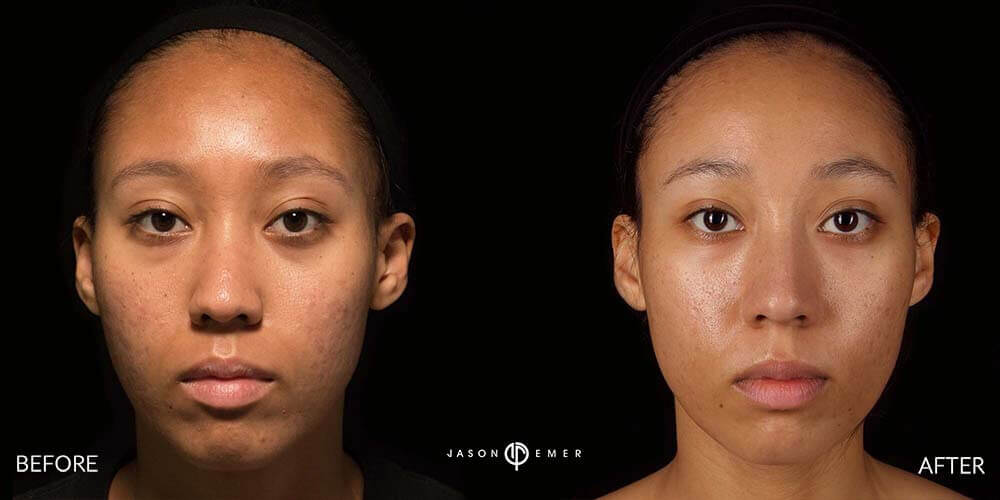
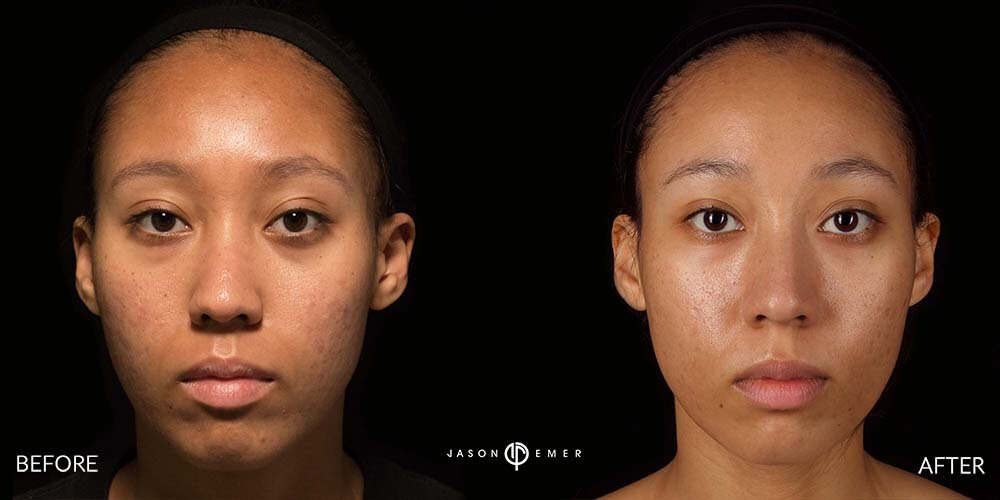
    One treatment improved her scars visibly. This session fills what remained.

    She arrived for her second session with Dr. Emer. The first treatment had improved her scars so much they were almost gone from certain angles. What remained were small, superficial indentations that needed microdroplet silicone to fill each one individually.

    “We did one treatment before, right? One treatment. Yeah. Yeah. It came out really good actually. If you look from the side, look at all these angles. Her scars are very much gone. I mean, almost.”DR. JASON EMER · FROM THE VIDEO
  2. 02The plan

    What Dr. Emer decided to do

    Pre-treated to prevent pigmentation, then filled and resurfaced in the same visit.

    “So, we're using the side light, which honestly very rarely I've seen any doctors do, which I'm surprised after all these years of copying everything I do. You think somebody would do it, but they're not.”DR. JASON EMER · FROM THE VIDEO
  3. 03The session

    In the room, in order

    Dr. Emer used side lighting to see every scar, placed silicone in amounts small enough to prevent lumps, and combined the treatment with Halo ProFractional laser to stimulate collagen. The elevations that appeared during the session were a sign the scars were filling out, and she was pre-treated with retinol, hydroquinone, vitamin C and a peel to prevent pigmentation.

    • Pre-treat with skincare and a peel
    • Use side lighting to see every scar
    • Place microdroplet silicone
    • Resurface with laser
    “So, I'm just going to do there's a couple little spots up here in her forehead. And we retreat. And again, it's you want to under stimulate.”DR. JASON EMER · FROM THE VIDEO
  4. 04The result

    What changed

    The patient in this video already had one treatment with Dr. Emer. Her scars were visibly improved, almost gone from certain angles. What remained were small, superficial indentations that needed a different approach: microdroplet silicone to fill each scar individually, combined with Halo ProFractional laser to stimulate collagen.

    This is the treatment Dr. Emer built for ethnic and darker skin tones when acne scars are the primary concern. It requires pre-treatment with retinol, hydroquinone, vitamin C and a peel to prevent pigmentation, side lighting to see every indentation, and precise placement so the silicone volumizes the surface without overfilling.

  5. 05What comes next

    Recovery and what to expect

    “So that's micro droplet and we're going to start our laser process now and she's going to get smooth in the next week or two.”DR. JASON EMER · FROM THE VIDEO
Explore the full treatment details +

Microdroplet silicone plus laser resurfacing, built as one plan / Patient story

Almost gone. Now finished.

One treatment improved her scars visibly. This session fills what remained.

She arrived for her second session with Dr. Emer. The first treatment had improved her scars so much they were almost gone from certain angles. What remained were small, superficial indentations that needed microdroplet silicone to fill each one individually.

Dr. Emer used side lighting to see every scar, placed silicone in amounts small enough to prevent lumps, and combined the treatment with Halo ProFractional laser to stimulate collagen. The elevations that appeared during the session were a sign the scars were filling out, and she was pre-treated with retinol, hydroquinone, vitamin C and a peel to prevent pigmentation.

The scars that stay after everything else

The patient in this video already had one treatment with Dr. Emer. Her scars were visibly improved, almost gone from certain angles. What remained were small, superficial indentations that needed a different approach: microdroplet silicone to fill each scar individually, combined with Halo ProFractional laser to stimulate collagen.

This is the treatment Dr. Emer built for ethnic and darker skin tones when acne scars are the primary concern. It requires pre-treatment with retinol, hydroquinone, vitamin C and a peel to prevent pigmentation, side lighting to see every indentation, and precise placement so the silicone volumizes the surface without overfilling.

What microdroplet silicone actually does

Silicone placed in micro droplets fills the scar from underneath, raising the indentation to match the surrounding skin. The amount is small enough that it cannot form lumps or bumps, and it stimulates collagen over time as the body integrates the material.

Dr. Emer uses side lighting during the session to see every scar that needs filling. The elevations that appear immediately after placement are a sign the scar is filling out. He waits a few seconds after each area to assess, then moves to the next spot, under-stimulating rather than overdoing it.

How a session is built

Four moves. One session.

Pre-treated to prevent pigmentation, then filled and resurfaced in the same visit.

  1. 01

    Pre-treat with skincare and a peel

    Retinol, hydroquinone, vitamin C and an Enlighten Peel prevent the body from producing as much pigment when the skin is heated.

  2. 02

    Use side lighting to see every scar

    Side lighting reveals indentations that overhead lighting misses, so every scar that needs filling is treated.

  3. 03

    Place microdroplet silicone

    Silicone is placed in micro amounts to fill each scar from underneath, raising the indentation to match the surrounding skin.

  4. 04

    Resurface with laser

    Halo ProFractional laser stimulates collagen and smooths the skin over the following weeks.

The treatment, explained

What is microdroplet silicone?

Also called silicone injection for acne scars, acne scar filler, Halo ProFractional laser, fractional laser resurfacing, acne scar treatment for ethnic skin, acne scar treatment for dark skin, atrophic acne scar treatment, rolling scar treatment, boxcar scar treatment.

What it is
Microdroplet silicone acne scar treatment is a procedure that fills atrophic acne scars from beneath the skin using medical-grade silicone placed in micro amounts, combined with fractional laser resurfacing to stimulate collagen. The silicone raises each indentation to match the surrounding skin, and the laser smooths the surface over the following weeks. This approach is designed for superficial to moderate acne scars in all skin tones, including ethnic and darker skin that carries higher pigmentation risk with laser alone.
How it works
Dr. Emer uses side lighting to reveal every scar indentation that overhead lighting misses. He injects microdroplet silicone beneath each scar, seating the material superficially to volumize the surface without forming lumps. The silicone stimulates collagen production over time as the body integrates the material. Halo ProFractional laser is then applied to the treated area to further stimulate collagen and smooth the skin. Patients are pre-treated with retinol, hydroquinone, vitamin C and an Enlighten Peel to prevent the body from producing excess pigment when the skin is heated.
Who it is for
This treatment is for patients with superficial to moderate atrophic acne scars, including rolling scars, boxcar scars and shallow ice pick scars. It is particularly suited to ethnic and darker skin tones (Fitzpatrick types III to VI) because the pre-treatment protocol reduces pigmentation risk. Patients who have been told their skin is too dark for aggressive laser treatment, or who have experienced pigmentation from previous laser work, are candidates. The treatment is not appropriate for very deep ice pick scars or keloid scars.
Recovery
The skin will be red and slightly swollen for a few days after the session. The silicone elevations that appear during treatment settle over the following week. The laser stimulates collagen for weeks after the session, with continued improvement over one to three months. Your recovery plan and any restrictions are set at consultation based on your skin type and the treatment performed.
When results show
Improvement is visible within one to two weeks as the skin smooths and the silicone elevations settle. Collagen stimulation continues for weeks to months after the session. The number of sessions needed depends on scar type and depth. Some patients see significant improvement after one session, while others require two or more sessions spaced several months apart. The silicone is permanent and continues to stimulate collagen over time. Results are individual and discussed at consultation.

Signature procedures

Only at Emer.

Peptides / biologic optimization

RECODEX™

Peptide and biologic protocols for recovery, body composition and longevity, with epigenetic testing. RECODEX™ peptides are available to purchase through the practice after consultation.

From Dr. Emer's Instagram

The work, as he shows it.

@jasonemermd @recodexsystem

Why Dr. Emer

Two decades of treating what others avoid.

Ethnic and darker skin tones require a different plan, and most physicians will not take the risk.

Dr. Emer has been treating acne scars in ethnic and darker skin for 19 years. His reputation is built on outcomes that improve scars permanently without causing pigmentation, using techniques that require pre-treatment, side lighting, and precise placement.

Patients come to him when they have been told their skin is too dark for aggressive treatment, or when previous laser work left them with pigmentation instead of improvement.

  • MD, FAAD, FACS: board-certified dermatologist and cosmetic surgeon
  • Former Chief Resident in dermatology, Mount Sinai, New York
  • More than 10,000 patient encounters
  • Male facial sculpting longer than anyone in the United States
  • The highest filler volume on the West Coast
  • West Hollywood and New York
About Dr. Emer Schedule Consultation
EMER METHOD™×RECODEX™

Pre-treatment prevents pigmentation

The Enlighten Peel and skincare protocol limit how much pigment the body can produce when the skin is heated. If pigmentation does occur, it resolves faster.

Microdroplet silicone fills without lumps

The amount placed is small enough to volumize the surface without forming bumps. It stimulates collagen over time as the body integrates the material.

Side lighting reveals every scar

Most physicians do not use side lighting, which is why they miss scars that need filling. Dr. Emer changes the lighting during the session to see every indentation.

Asked plainly, answered plainly

What patients ask before they book.

Is microdroplet silicone safe for acne scars?+

Dr. Emer has been using microdroplet silicone for 19 years, learning from the physicians who conducted the original studies. The key is precise placement in amounts small enough to fill the scar without forming lumps or bumps. The silicone is permanent and stimulates collagen over time as the body integrates the material.

Will my skin get darker after laser if I have ethnic or dark skin?+

Pre-treatment with retinol, hydroquinone, vitamin C and an Enlighten Peel prevents the body from producing as much pigment when the skin is heated. This does not eliminate pigmentation risk, but it limits how much can occur and accelerates resolution if it does. The laser settings are calibrated for your skin tone.

How many sessions will I need?+

It depends on your scar type and depth. The patient in this video is on her second session and her scars are almost gone. Some patients need one session, some need more. Superficial scars respond faster than deep scars. A consultation covers your scars and what realistic improvement looks like for your case.

What is the downtime after microdroplet silicone and laser?+

The skin will be red and slightly swollen for a few days. The silicone elevations that appear during the session settle over the following week. The laser stimulates collagen for weeks after treatment, with continued improvement over one to three months. Your specific recovery plan is set at consultation.

Why does Dr. Emer use side lighting?+

Side lighting reveals scar indentations that overhead lighting misses. Dr. Emer changes the lighting angle during the session to see every depression that needs filling. He has not observed other physicians using this technique despite treating acne scars for 19 years.

Can microdroplet silicone cause lumps or bumps?+

If too much silicone is placed, it can form lumps or continue to grow over time. Dr. Emer places amounts small enough to volumize the surface without overcorrection, intentionally under-stimulating to prevent this. The goal is to fill the scar, not to build excess volume.

What types of acne scars does this treat?+

This approach treats superficial to moderate atrophic scars, including rolling scars, boxcar scars and shallow ice pick scars. Very deep ice pick scars or keloid scars require different techniques. A consultation determines whether your scars are candidates for microdroplet silicone.

Why do most doctors avoid treating acne scars in darker skin?+

Darker skin tones carry higher pigmentation risk when heated with laser. Most physicians do not have a pre-treatment protocol to limit melanin production, so they avoid aggressive treatment. Dr. Emer's protocol allows him to treat ethnic and darker skin tones that other practices turn away.

Find out what your scars can become.

A consultation with Dr. Emer covers your skin tone, your scar type, and whether microdroplet silicone combined with laser resurfacing fits your plan.

Schedule Consultation

West Hollywood and New York City

Dr. Jason Emer West Hollywood · New YorkSchedule Consultation