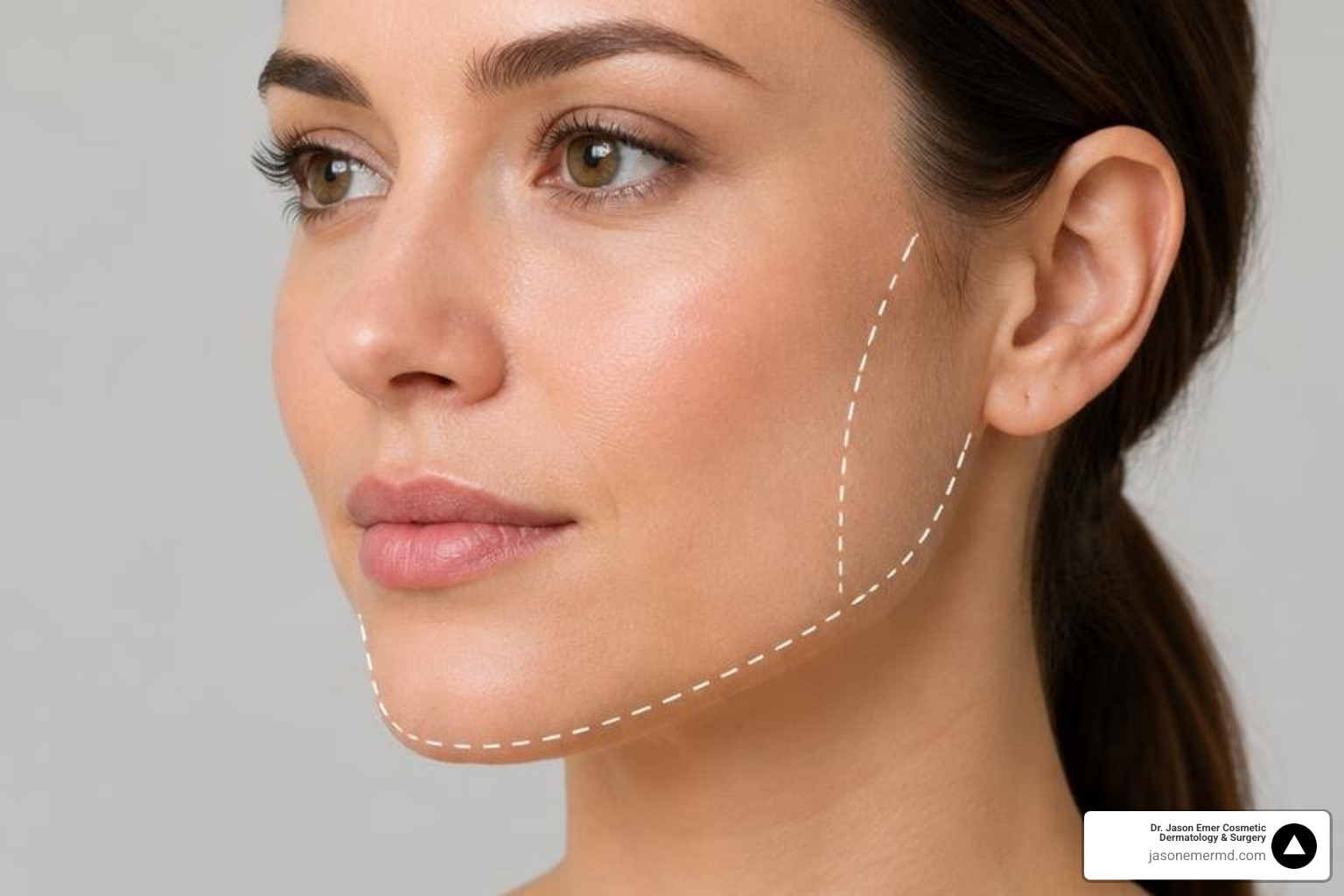
Lower facial anatomy determines the right approach to feminine jawline surgery
A softer jawline does not always require removing bone. Feminine jawline surgery starts with identifying what shapes the lower face: the chin, the jawbone, the masseter muscles, or a combination. Genioplasty reshapes the chin. Mandibular angle reduction changes the back of the jaw. Masseter reduction addresses muscle bulk. Each targets a different cause of width or angularity, so the plan depends on the person's anatomy and goals.
Jason Emer, MD, FAAD, is a board-certified dermatologist with more than 19 years of experience in cosmetic contouring and non-surgical facial rejuvenation. His work with facial fillers brings a soft-tissue perspective to feminine jawline surgery planning, while bone procedures call for a surgeon trained in jaw surgery.

Feminine jawline surgery basics:
Lower facial anatomy determines how bone and soft tissue contribute to contour.
Lower-third aesthetics rely on delicate proportions. Mandibular height, gonial width, and the external oblique ridge dictate baseline framework. A wider jaw angle creates a square silhouette, whereas a tapered taper supports a softer contour. When evaluating facial balance, Dr. Emer examines whether lateral fullness originates from bone or overlying soft tissue.

Skeletal dimensions differ significantly across facial profiles. Prominent mental protuberances produce wide, square chins. Thick cortical bone along the mandibular margin adds substantial lateral volume. Modifying these structural elements requires osseous surgery (Barnett et al., 2023).
Soft tissues also contribute heavily to lower facial width. Hypertrophic masseter muscles expand lateral contours due to genetics or clenching. Evaluating tissue depth ensures structural adjustments yield balanced results through female facial sculpting.
Treatment selection depends on skeletal dimensions and muscular volume.
Selecting the proper intervention requires distinguishing between osseous prominence and muscular bulk. Osseous genioplasty alters chin height, projection, and width via horizontal or vertical sliding osteotomies. Surgeons secure realigned bone fragments with titanium fixation plates to establish a refined anterior contour. This structural foundation integrates into wider chin & jawline surgery frameworks.

When muscular fullness causes lateral widening, neuromodulator injections offer an effective alternative. Injecting botulinum toxin into the masseters induces gradual muscle relaxation and atrophy. This narrows the jawline without surgical incisions or structural bone removal. For patients seeking non-invasive options, non-surgical jawline reduction provides temporary tapering. In severe cases, surgical myectomy can reduce muscle volume directly during open mandibular procedures.
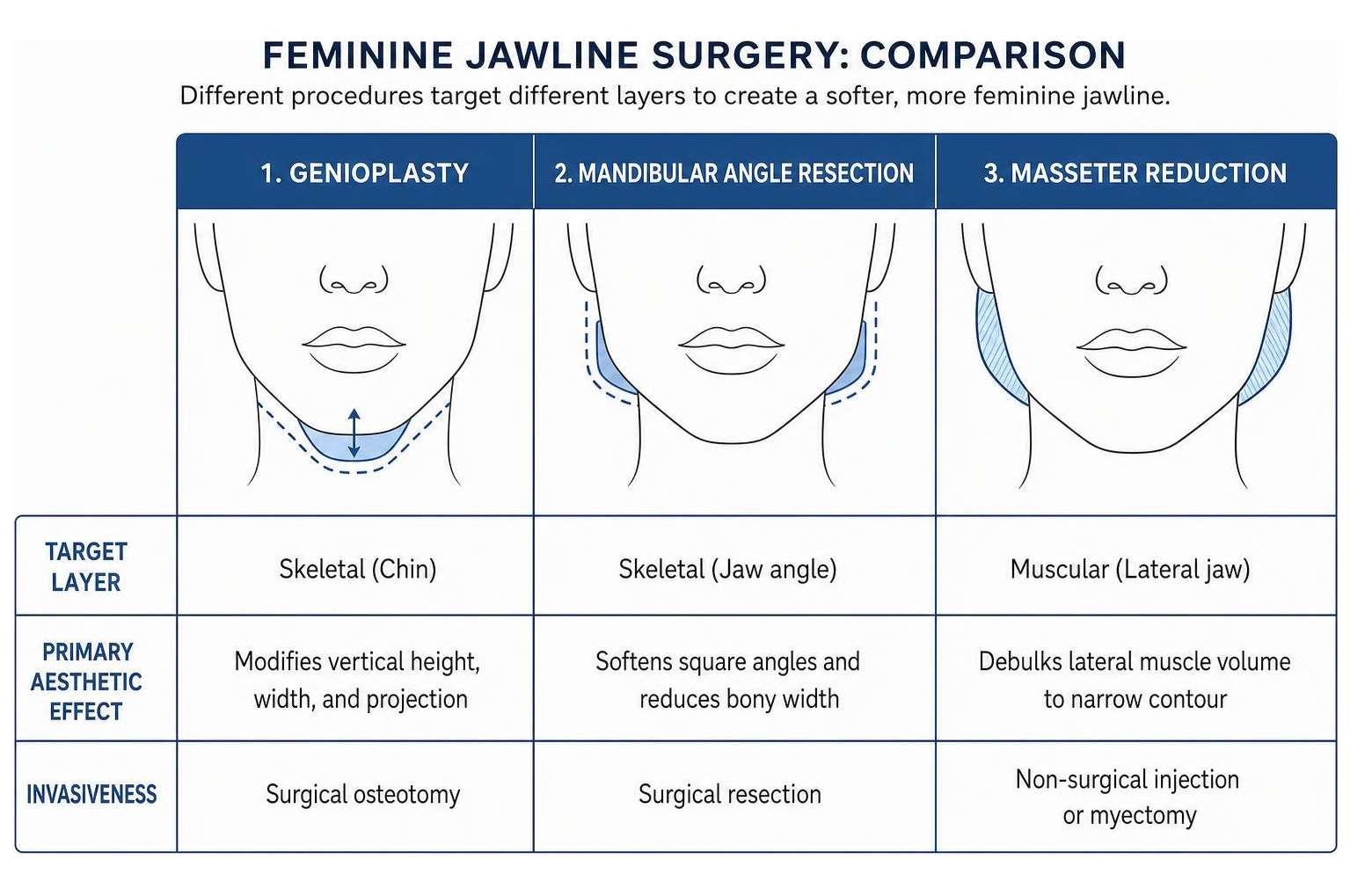
| Procedure | Target Layer | Primary Aesthetic Effect | Invasiveness |
|---|---|---|---|
| Genioplasty | Skeletal (Chin) | Modifies vertical height, width, and projection | Surgical osteotomy |
| Mandibular Angle Resection | Skeletal (Jaw angle) | Softens square angles and reduces bony width | Surgical resection |
| Masseter Reduction | Muscular (Lateral jaw) | Debulks lateral muscle volume to narrow contour | Non-surgical injection or myectomy |
Every approach involves clinical tradeoffs. Skeletal resection carries surgical risks, while neuromodulators require ongoing maintenance treatments. Deciding whether to alter bone or reduce muscle remains an individual decision made in clinical consultation.
Comprehensive treatment planning supports safe recovery and cohesive facial balance.
Precise execution relies on advanced diagnostics. Preoperative high-resolution CT imaging maps bone architecture and neural pathways. Virtual surgical planning enables custom cutting guides, which reduces operative times and improves structural symmetry.
Preserving sensory function is paramount. Intraoral incisions allow direct access while hiding external scars along the lower face. Careful dissection protects the inferior alveolar nerve and the mental nerve, reducing the risk of persistent numbness.
Healing requires dedicated management. Mandibular angle resection and genioplasty necessitate careful postoperative protocols. Swelling peaks around 72 hours before gradually subsiding over several months. Patients typically follow a liquid-to-soft diet for several weeks to protect internal incisions. Compression garments support soft-tissue redraping. Reviewing jaw line reduction recovery helps establish clear expectations.
Frequently asked questions about lower facial feminization
- How long is the recovery period following osseous jaw contouring? Bone procedures take approximately 1.5 to 3.5 hours under general anesthesia. Early swelling subsides within two to three weeks, but complete tissue settlement takes several months.
- Can neuromodulators replace osseous genioplasty for jaw narrowing? Neuromodulators only relax muscle tissue. They cannot alter chin projection, correct vertical bone excess, or narrow osseous structures.
- What measures protect the facial nerves during surgery? Three-dimensional CT imaging maps the mental nerve canal preoperatively, guiding intraoral osteotomies away from delicate neurovascular bundles.
What to remember
- Lower facial tapering requires addressing both bone shape and masseter thickness.
- Genioplasty modifies skeletal projection, while neuromodulators selectively reduce muscle bulk.
- Virtual surgical planning and high-resolution imaging help protect key sensory nerves during surgery.
A formal clinical evaluation determines the appropriate procedural sequence for your facial anatomy.
This content is for general education and does not provide a diagnosis, determine candidacy, or replace a consultation with a licensed clinician.
This resource provides general educational information. Treatment recommendations depend on your health, goals, and consultation with a qualified clinician.