GHK-Cu is a copper-binding peptide studied for skin repair
Many people assume copper belongs in wiring, not skincare. In dermatology, the better model is biological: GHK-Cu is a small tripeptide that binds copper and occurs naturally in human plasma. Early research suggests topical GHK-Cu may support collagen production, skin firmness, and tissue repair. While its potential role in hair growth remains under investigation, laboratory findings highlight its signaling capacity without guaranteeing cosmetic results on human skin.
This guide explores what copper peptide research demonstrates, where current clinical evidence remains limited, and how formulation chemistry shapes real-world stability. Scientific discussions around copper peptides in anti-aging and anti-inflammatory pathways continue to evolve alongside studies examining GHK-Cu peptide injections.
Jason Emer, MD, FAAD, is a board-certified dermatologist with more than 19 years of experience in cosmetic dermatology and skin rejuvenation. Dr. Emer evaluates peptide research through a clinical lens, distinguishing early mechanistic hypotheses from demonstrated clinical outcomes.
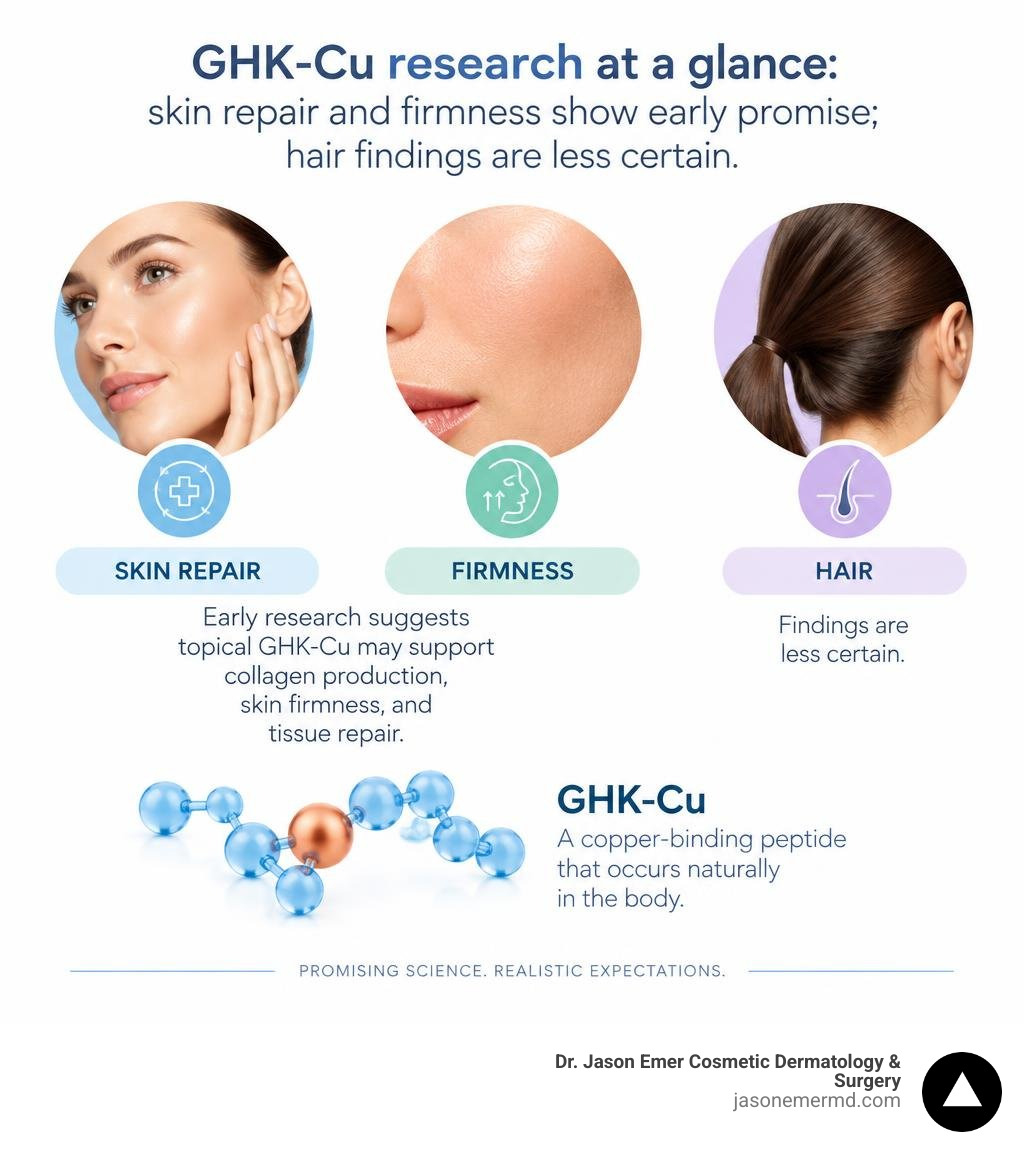
GHK-Cu is a copper-binding tripeptide studied for its role in tissue repair.
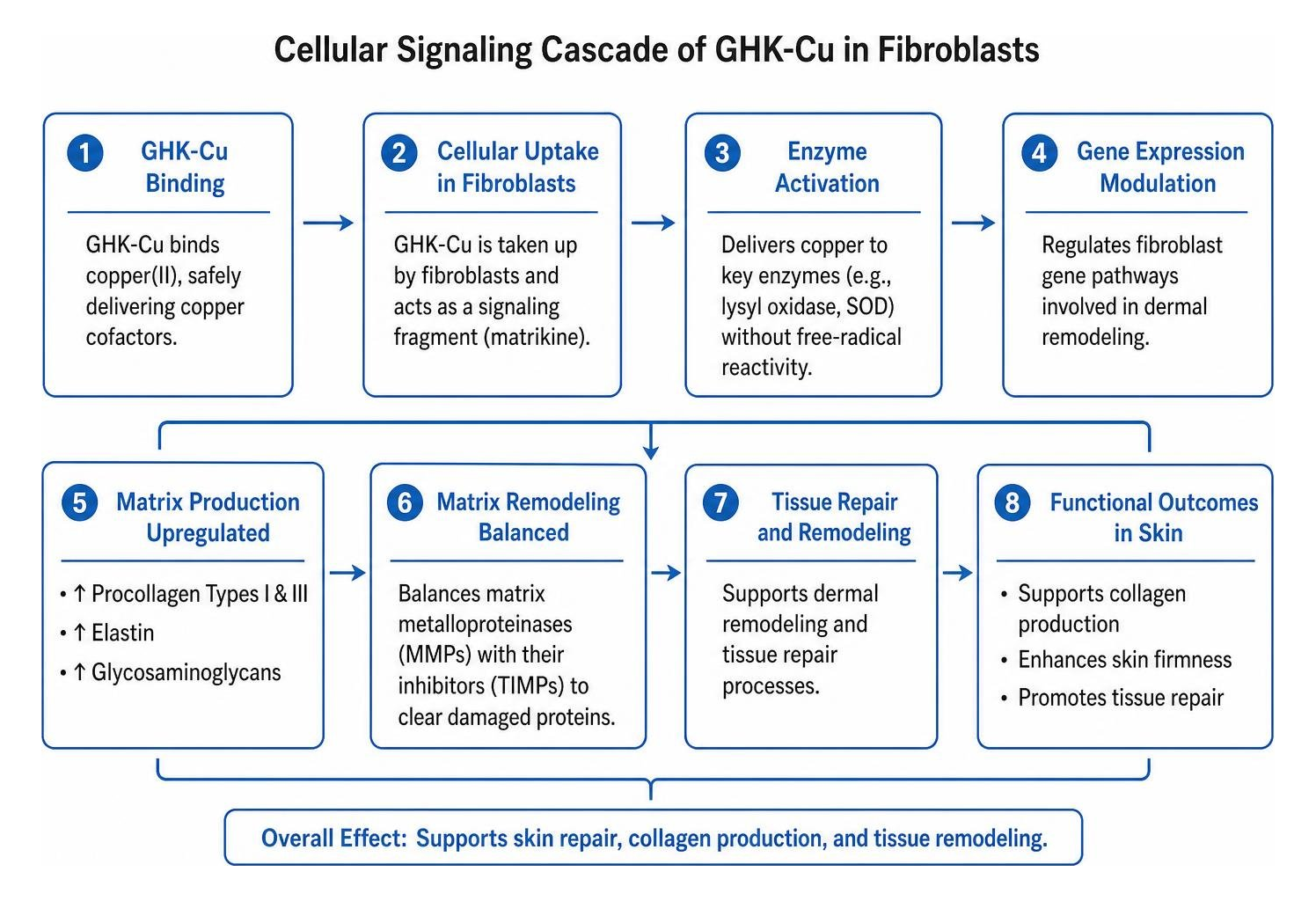
GHK-Cu consists of three amino acids—glycine, histidine, and lysine—bound to a copper(II) ion. First identified in human plasma in 1973, it functions as a signaling fragment, or matrikine, released during tissue injury to guide cellular rebuilding (Pickart & Margolina, 2018). Understanding the soothing science behind copper peptides and tissue repair begins with how this complex delivers copper cofactors to essential enzymes without triggering destructive free-radical reactions. Technical details are described in a monograph on copper tripeptide complex.
Molecular mechanisms of GHK-Cu in gene expression and collagen synthesis
The tripeptide complex appears to act directly on fibroblasts. Research suggests it stimulates procollagen types I and III, promotes elastin production, and increases glycosaminoglycans, while modulating matrix metalloproteinases that clear damaged proteins. A deeper look at GHK-Cu peptides and the biology of youthful skin highlights its broader regulatory effect on gene pathways.
Age-related plasma changes may have biological significance
Natural plasma levels of GHK-Cu decline with age, a shift that correlates with slower wound recovery, decreased antioxidant enzyme activity, and reduced collagen cross-linking capacity over time.
Research has explored GHK-Cu in dermal remodeling and hair follicle biology.
Controlled studies have investigated whether topical formulations can reproduce these cellular repair mechanisms in living skin. Some trials of low-concentration GHK-Cu gel-creams have reported reductions in wrinkle volume alongside gains in skin elasticity over several weeks of use.
Research on topical GHK-Cu formulations and reported outcomes
Topical studies point to measurable improvements in skin density and superficial texture, though peptide molecules face real penetration limits across the stratum corneum. GHK-Cu offers non-irritating barrier support, but deeper dermal remodeling often calls for energy-based devices such as laser treatments. Because melanin absorbs light energy differently, darker skin tones carry an elevated risk of post-inflammatory hyperpigmentation (PIH). For these patients, Dr. Emer stages treatments carefully and adjusts device parameters before layering topical healing agents, decisions made individually during consultation.
Research on follicular stimulation and scalp microcirculation
In trichology models, copper peptides stimulate vascular endothelial growth factor (VEGF) production. This microvascular stimulation promotes blood flow around the hair follicle bulb. Early in-vitro models suggest copper tripeptides may support follicle size and the anagen growth phase, though human clinical evidence remains limited.
Formulation and safety research helps explain how topical copper peptides are studied.
Incorporating copper peptides into a broader regimen requires attention to chemical stability. As outlined in the general GHK-Cu information, the bond between the peptide and copper remains stable only within a narrow, non-acidic pH range.

Formulation factors that may affect research findings
Strong acids, such as glycolic, lactic, or high-potency vitamin C at low pH, can dissociate copper from the tripeptide. Free, unchelated copper may oxidize adjacent actives and irritate skin, so study protocols typically apply direct acids and copper peptides at different times of day.
Safety considerations for reactive skin types
Topical GHK-Cu is generally well tolerated, even on reactive skin, and carries minimal photosensitivity risk. An important medical contraindication is Wilson disease, an inherited disorder of copper metabolism. For those who prefer not to use copper peptides, simpler alternatives exist, including a basic barrier cream or a gentle retinoid ester.
Frequently asked questions about copper peptides
How long does it take to observe changes in studies of copper peptide use?
Hydration shifts are often documented within 2 to 4 weeks. Structural changes in elasticity, dermal density, and wrinkle depth typically require 8 to 12 weeks of consistent use.
What does research say about combining copper peptides with direct acids or retinoids?
Direct acids can destabilize the copper complex. Pairing copper peptides in the morning with a retinoid in the evening may help avoid that interaction.
Is the natural blue hue of copper tripeptide formulations normal?
Yes. The clear blue hue reflects the Cu2+ ion chelated by the histidine residue. Loss of that coloration can indicate degradation or oxidation.
What to remember
- GHK-Cu is an endogenous copper-binding tripeptide studied for its role in extracellular matrix remodeling and antioxidant pathways.
- Early research points to topical improvements in skin elasticity and wrinkle appearance, though deeper remodeling may require office-based care.
- Formulation stability depends on avoiding low-pH acids in the same application to protect the copper-peptide bond.
This content is for general education and does not provide a diagnosis, determine candidacy, or replace a consultation with a licensed clinician.
Whether topical peptides or integrated in-clinic care may fit a particular skin goal is a decision best made during a consultation with Dr. Emer.
This resource provides general educational information. Treatment recommendations depend on your health, goals, and consultation with a qualified clinician.